

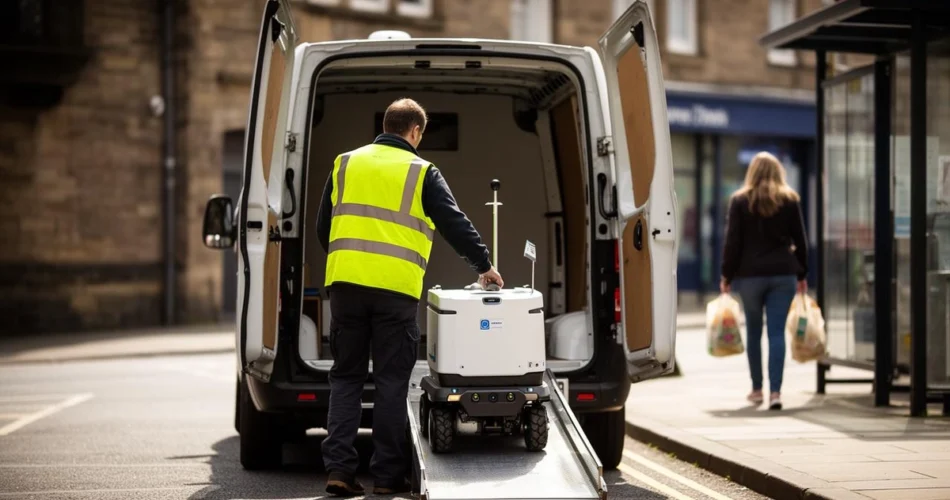
Self-driving food delivery robots have been taken off the streets of Sheffield after Starship Technologies ended a pilot program just five months after launch, underscoring the challenges autonomous delivery companies face in winning over local communities.
The six-wheeled machines were deployed across parts of the South Yorkshire city in March through a partnership with Uber Eats. During the brief trial, the foot-high vehicles repeatedly had their visibility flags snapped off, some were sprayed with graffiti, and a charging station was defaced. Traffic cones were also placed behind the robots to prevent them from moving. Residents complained the machines “got in the way” of pedestrians.
Ryan Case, public affairs and communication manager at Starship Technologies, said the company had paused the service while it reviewed what it had learned. “Our pilot in Sheffield has come to an end, and we have paused the service while we review what we’ve learned,” he said. “We’ll assess the results of the pilot before deciding on any future deployments of robots in the city. We regularly assess a number of areas across the UK, and Sheffield remains one of them.”
He insisted the vandalism did not influence the decision. “There have been a small number of incidents of vandalism in Sheffield, which is disappointing, not least because it affects the local businesses that rely on the robots for deliveries,” Case said. “However, vandalism was not a factor in our decision to pause the service: this was a commercial decision and a natural conclusion to the pilot phase.”
Delivery robots carrying supermarket and takeaway orders have become a familiar sight in major UK cities including Leeds and London. They have divided opinion, with some people praising their nimbleness and convenience, while critics have complained they obstruct pavements and carry what some describe as a “sinister” number of cameras.
In Leeds, the robots have become a permanent feature in parts of the city. The contrast highlights the uneven reception autonomous delivery technology has received across different urban environments.
European Expansion Continues
The Sheffield pullback comes as Uber Eats expands its robot delivery footprint elsewhere in Europe. This week, Finland became the first EU market where customers can receive orders delivered by autonomous robots, starting in central Helsinki through a partnership with Coco Robotics. Customers matched with a robot can track its journey in the Uber Eats app.
“We’re growing fast in Finland. We launched Uber Eats in May with three cities, and just three months later we’re adding eight more, bringing us to 11 cities and areas across the country,” a spokesperson said. “Helsinki is a particularly exciting place to take this next step: the robots have already been put through their paces on the city’s streets and in Finnish winter conditions. Now they’ll be delivering for Uber Eats alongside our existing courier network.”
The contrasting developments illustrate the broader dynamics shaping the autonomous delivery sector. The technology has proven functional in real-world conditions, but long-term deployments require more than operational capability — they demand community acceptance and sustainable economics.
| Market | Status | Operator | Notes |
|---|---|---|---|
| Sheffield, UK | Pilot paused after 5 months | Starship Technologies | Vandalism incidents; commercial review underway |
| Leeds, UK | Permanent deployment | Starship Technologies | Robots remain in parts of the city |
| Helsinki, Finland | Launching this week | Coco Robotics | First EU market for Uber Eats robot delivery |
| London, UK | Active | Starship Technologies | Established presence |
Note: Status reflects information available as of late August 2026.
For Starship, the Sheffield experience represents a recalibration rather than a retreat. The company said it regularly assesses multiple areas across the UK, and Sheffield remains under consideration for future deployments. The pilot provided data on how the robots perform in a city with distinct topography and community dynamics, which could inform how the company approaches similar markets.
The episode also raises questions about the economics of robot delivery in cities where adoption is slower. While the technology eliminates courier labor costs, the capital investment in robots, charging infrastructure, and maintenance — combined with the risk of vandalism and the need for community engagement — can erode the cost advantage in markets where order volumes do not reach sufficient scale.
For Uber Eats, the Sheffield setback does not appear to have dampened its enthusiasm for autonomous delivery. The company continues to pursue partnerships with multiple robotics providers across different geographies, suggesting a portfolio approach that spreads risk across operators and markets.
As autonomous delivery companies refine their strategies, the Sheffield pilot serves as a case study in the gap between technological capability and community integration. The robots worked as designed. What proved harder was convincing an entire neighborhood that they belonged there.
Source link
Author

- Ytv Market News
- Share-market news writer and analyst with deep experience covering equities, commodities, forex, and cryptocurrencies for readers in the USA, UK, Canada, and Australia. Ytv Market News delivers timely market updates, practical trading insights, and clear explanations of macro and company-level catalysts that move prices. Combines on-the-ground financial reporting with technical analysis, using concise charts and actionable ideas to help investors and traders make smarter decisions.
Latest entries
 Company NewsAugust 27, 2026K+S Aktie: Goldman Sachs halbiert Beteiligung
 Stock Market VideosAugust 27, 2026CPI Relief & AI Earnings Push Stocks Toward Records | The Close 8/12/2026
 UkAugust 27, 2026Jubilee Metals agrees to sell large waste project to preferred bidder
 UsaAugust 27, 2026Zhihu Inc. Reports Second Quarter 2026 Unaudited Financial Results

