


The Bank for International Settlements is renewing its criticism of stablecoins, questioning their credibility as everyday money as governments worldwide build regulatory frameworks around the tokens.
BIS General Manager Pablo Hernández de Cos, a candidate to succeed European Central Bank President Christine Lagarde next year, argued that stablecoins do not credibly function as a means of payment at scale. He said tokenized bank deposits offer a stronger alternative, Reuters reported on Friday.
“Tokenised deposits offer a more direct path to harness tokenisation while preserving the monetary system’s foundations,” de Cos said.
The comments come as regulators worldwide grapple with stablecoin adoption, while a new study from the BIS-linked Financial Stability Institute (FSI) shows significant differences in how major markets regulate stablecoin issuers.
Stablecoins could lower government borrowing costs
Hernández de Cos acknowledged that stablecoins could lower government borrowing costs, an argument also made by US Treasury Secretary Scott Bessent.
But the effect could cut both ways for consumers. If customers move bank deposits into stablecoins, banks could face higher funding costs and pass those expenses on to households and businesses through higher borrowing rates, Hernández de Cos said.
He also pointed to limited interoperability between stablecoin platforms and difficulties consistently applying anti-money laundering controls. Growing use of US dollar-pegged stablecoins outside the US could also undermine monetary sovereignty and weaken domestic monetary policy, he said.
Stablecoin issuers face different rules worldwide
The FSI study, published on Thursday, compared stablecoin regulations in the US, European Union, United Kingdom, Hong Kong and Singapore, finding substantial differences in which entities may issue stablecoins and what other business activities they can conduct.
The US and Singapore take relatively restrictive approaches toward non-bank issuers. Under the US GENIUS Act, lending, staking, proprietary trading and custody of third-party crypto assets generally fall outside the activities permitted for payment stablecoin issuers.
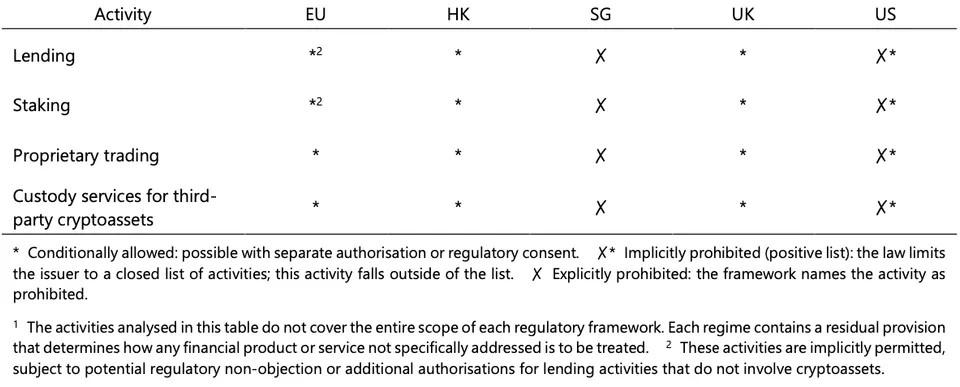
Stablecoin issuer rules across major markets. Source: BIS
Hong Kong, the UK and EU take a less restrictive approach, allowing some additional activities with separate authorization, regulatory consent or other applicable permissions.
The researchers also found that restrictions across all five jurisdictions apply to the issuing entity rather than the wider corporate group, meaning other group members can conduct activities that the stablecoin issuer itself cannot.
Source link
Author

- Ytv Market News
- Share-market news writer and analyst with deep experience covering equities, commodities, forex, and cryptocurrencies for readers in the USA, UK, Canada, and Australia. Ytv Market News delivers timely market updates, practical trading insights, and clear explanations of macro and company-level catalysts that move prices. Combines on-the-ground financial reporting with technical analysis, using concise charts and actionable ideas to help investors and traders make smarter decisions.
Latest entries
 Crypto NewsAugust 30, 2026Major Altcoin Cleanup: 18 Cryptocurrencies Delisted from South Korean Exchanges
 Investing InsightsAugust 30, 2026Is Export-Fueled Volume Growth Altering The Investment Case For Kinder Morgan (KMI)?
 UsaAugust 30, 2026Ameresco CEO Sakellaris Buys 5,000 Shares for $113,300. Is This a Sign Renewable Energy Projects are Taking Off?
 Politics News TodayAugust 30, 2026Ricardo Pacheco jailed for Baldwin Park bribery and marijuana permits


