


15h05 ▪
6
min read ▪ by
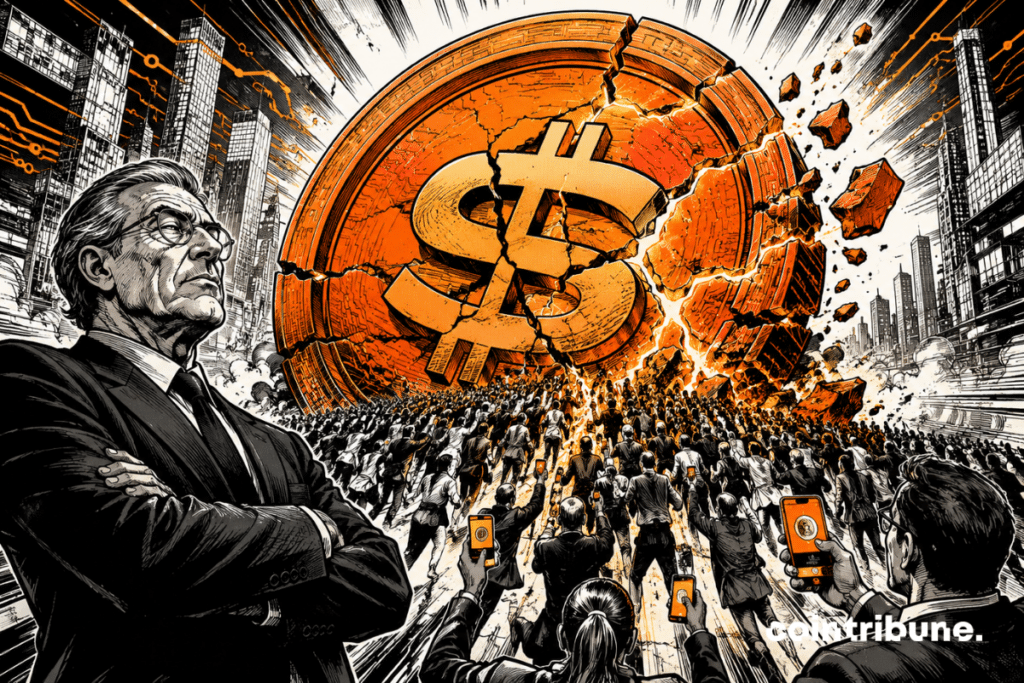
Stablecoins do not constitute a credible means of large-scale payment, decided Pablo Hernández de Cos, head of the BIS, on Friday. Before the Jackson Hole symposium on August 28, he preferred tokenized bank deposits. The day before, his institute published a study highlighting very uneven issuance rules across markets.
In brief
- The general manager of the Bank for International Settlements (BIS), Pablo Hernández de Cos, stated on August 28 at Jackson Hole that stablecoins lack credibility as a means of large-scale payment.
- The study by the Financial Stability Institute (FSI), published on August 27, highlights very different issuance frameworks in the United States, the European Union, the United Kingdom, Hong Kong, and Singapore.
- The study by the Financial Stability Institute (FSI), published on August 27, highlights very different issuance frameworks in the United States, the European Union, the United Kingdom, Hong Kong, and Singapore.
At Jackson Hole, the BIS Does Not Believe in Stablecoins as Payment Infrastructure
At Jackson Hole, Pablo Hernández de Cos did not hide the skepticism of the Bank for International Settlements (BIS). For its general manager, stablecoins can have their utility, but they do not present the necessary guarantees to become the foundation for large-scale payments.
The BIS’s position contrasts with that of the United States. In Washington, authorities are moving instead towards a specific regulatory framework for stablecoins, with the idea of making these assets a new instrument serving the American financial system.
The issue actually goes beyond the crypto market alone. The U.S. Treasury considers that the development of stablecoins could support demand for U.S. bonds and, by extension, further strengthen the dollar’s place in global finance.
The BIS, on the other hand, bets on another solution: tokenized deposits.
“Tokenized deposits offer a more direct way to harness tokenization while preserving the foundations of the monetary system,” stated Pablo Hernández de Cos.
The difference is important. A tokenized deposit remains a traditional bank deposit, even if its circulation relies on a digital infrastructure. The money thus remains in the banking system and under the control of the existing prudential framework. A stablecoin, conversely, is generally issued by a private company and backed by reserves.
For the BIS, the two models are not necessarily incompatible. But stablecoins should not, in its opinion, replace the banking system in everyday payments.
Five Markets, Five Regulatory Approaches
This statement comes the day after a study by the Financial Stability Institute (FSI), linked to the BIS. The report compares the rules applied to stablecoins in the United States, the European Union, the United Kingdom, Hong Kong, and Singapore.
First observation: rules remain very different from one market to another.
Issuance conditions, requirements imposed on companies, and authorized activities vary according to jurisdictions. Differences are especially visible when it comes to issuers that are not banks.
The United States and Singapore have adopted a relatively strict approach. The American framework notably limits certain activities for payment stablecoin issuers, such as lending, staking — that is, the remuneration obtained by locking assets on a network — proprietary trading, or certain cryptocurrency custody services.
Elsewhere, regulators appear more flexible. In the European Union, the United Kingdom, and Hong Kong, certain additional activities may be exercised with specific authorization.
However, the FSI notes a common limitation in several of these systems: the restrictions often target directly the company issuing the stablecoin, without necessarily covering the entire group to which it belongs.
This distinction could allow some actors to house different activities in multiple legal entities. The authors of the study therefore believe that group-level supervision would be more appropriate, especially for the largest issuers.
Banks Fear a Flight of Their Deposits
The BIS acknowledges that stablecoins can bring certain benefits to the financial system. Their growth could, for example, support demand for public debt and contribute to reducing financing costs for states, an argument regularly defended by the U.S. Treasury.
But for Pablo Hernández de Cos, the risk lies elsewhere: in the banks.
If a significant portion of deposits left banking institutions to be converted into stablecoins, banks would lose an essential source of funding. They would then have to borrow more on the markets, often under more costly conditions.
The additional cost would, according to this logic, eventually be passed on to loans granted to households and companies.
The BIS is also concerned about the multiplication of payment ecosystems that do not always communicate with each other. Switching from one stablecoin or platform to another can still involve costs and frictions, while the application of anti-money laundering rules remains difficult to harmonize internationally.
In Europe, the ECB continues its digital euro project and attempts to address surveillance concerns.
The debate could also take a political dimension in the coming years. Pablo Hernández de Cos is among the names mentioned for the succession of Christine Lagarde at the head of the ECB in 2027. If he were to take over the institution, his very cautious view of stablecoins could weigh more heavily in the monetary and regulatory choices of the euro area.
Maximize your Cointribune experience with our “Read to Earn” program! For every article you read, earn points and access exclusive rewards. Sign up now and start earning benefits.

Passionné par le Bitcoin, j’aime explorer les méandres de la blockchain et des cryptos et je partage mes découvertes avec la communauté. Mon rêve est de vivre dans un monde où la vie privée et la liberté financière sont garanties pour tous, et je crois fermement que Bitcoin est l’outil qui peut rendre cela possible.
DISCLAIMER
The views, thoughts, and opinions expressed in this article belong solely to the author, and should not be taken as investment advice. Do your own research before taking any investment decisions.
Author

- Ytv Market News
- Share-market news writer and analyst with deep experience covering equities, commodities, forex, and cryptocurrencies for readers in the USA, UK, Canada, and Australia. Ytv Market News delivers timely market updates, practical trading insights, and clear explanations of macro and company-level catalysts that move prices. Combines on-the-ground financial reporting with technical analysis, using concise charts and actionable ideas to help investors and traders make smarter decisions.
Latest entries
 Company NewsAugust 29, 2026Die Oceaneering-International-Aktie reagiert auf frische Gewinnprognosen und Anlegerzuflüsse
 Crypto NewsAugust 29, 2026Oscar Winner Matt Damon to Headline Ripple Event as Featured Speaker
 Stock Market VideosAugust 29, 2026Treasuries Will Have a Tough End to 2026: 3-Minutes MLIV
 UsaAugust 29, 2026Insider Purchase: 10% owner at $OPTU Buys 1,291,471 Shares


