

11h05 ▪
5
min read ▪ by
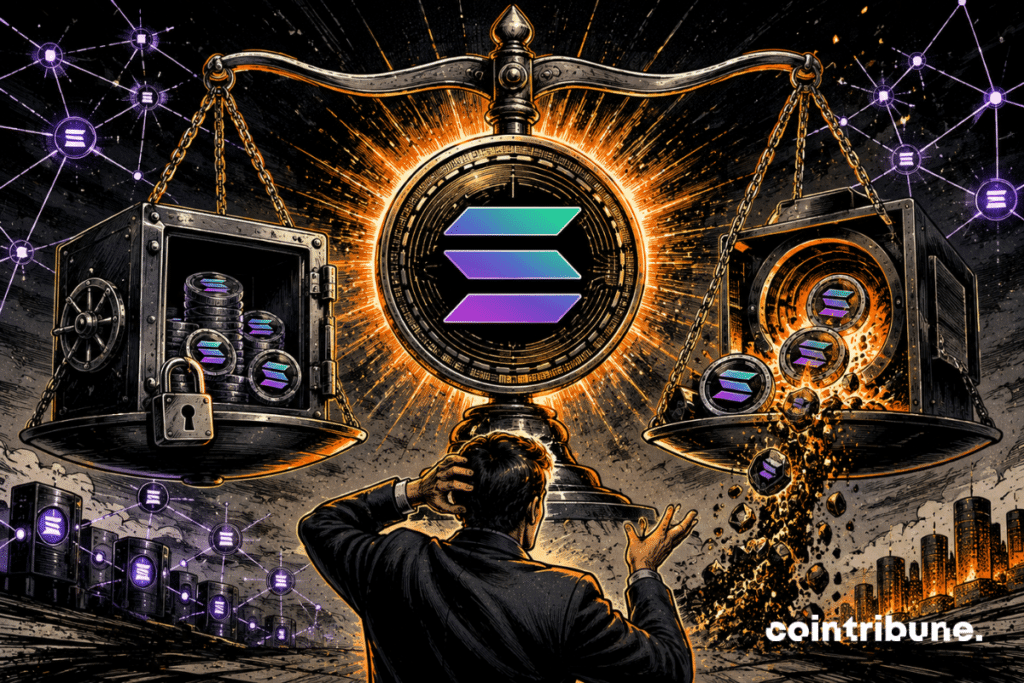
Solana could soon significantly reduce the remuneration of its stakers. The SIMD-550 proposal, currently submitted to the community vote, plans to accelerate the decline of SOL inflation. In the long run, the nominal staking yield could drop from about 5.25% today to 2.25% in three years. The community must decide between immediate income for stakers and increased scarcity of SOL.
In brief
- SIMD-550 would double Solana’s annual disinflation from 15% to 30%, aiming for terminal inflation of 1.5% as early as the first half of 2029.
- The nominal staking yield would slip to 4.34% in year 1, 3% in year 2, then 2.25% in year 3.
- Two validators out of 738 would become unprofitable from the first year, about thirty by the third year.
Solana accelerates the decline of its inflation
The vote on SIMD-550 began on August 23. Led by Helius, the proposal aims to gradually modify the SOL emission curve by doubling the disinflation rate from 15% to 30% per year. The goal is to reach the terminal inflation rate of 1.5% much faster.
Early votes already show a divided community. Forward Industries and Blueshift have voted in favor of the text, while Everstake and P2P.org voted against. To be adopted, SIMD-550 must gather votes representing at least two-thirds of staked SOL.
This threshold recalls the precedent of SIMD-228, another reward system reform that only obtained 38.61% of votes and was ultimately rejected.
Staking would lose some of its appeal
The most visible change would directly affect SOL holders who delegate their tokens to validators.
The nominal yield, currently close to 5.25%, would fall to around 4.34% starting the first year following the implementation of SIMD-550. It would then drop to 3% in the second year, then to 2.25% in the third.
The idea behind this decline is to limit the creation of new SOL. However, the network will need to find other revenue sources to maintain the economic interest of staking.
This is where SIMD-553 comes into play. The proposal, approved in July, increases SOL burns related to computational resources used by transactions. With the current activity level, daily destruction could rise from about 600-800 SOL to 7,500-9,000 SOL.
However, these burns are still below the current pace of new token creation. The desired effect is therefore mostly to gradually shift the supply trajectory.
The reform could have another consequence, less visible to investors: validator revenue.
With inflation rewards declining, operators will have to rely more on transaction fees and MEV-related revenue to remain profitable. Estimates cited by 21Shares suggest two validators could already become unprofitable in the first year. This number could reach about thirty after three years, depending on operating costs and voting fees evolution.
The question is thus not only about SOL yield. It also concerns the economic balance of the infrastructure securing the network.
The bet on DeFi
Solana also hopes that the decline in staking yield will push some capital toward decentralized finance applications.
Nearly 67.9% of SOL is currently staked, compared to about 34.1% for Ethereum. A less generous remuneration might encourage some holders to move their tokens toward lending, trading, or other on-chain applications.
The calculation is simple: if network activity increases enough, fees, MEV, and other revenue generated by Solana could gradually take over inflation.
Matt Mena, senior strategist at 21Shares, also believes that inflation should more closely follow the network’s economic performance and growth to offset the reduction of staking rewards.
For SOL holders, the compromise is now set. Less immediate yield, but also fewer new tokens in circulation. Time will tell if network usage grows quickly enough for this new economy to truly benefit SOL.
The vote on SIMD-550 will therefore be closely watched. Its adoption would not guarantee a price increase, but it would mark a significant change in how Solana balances participant remuneration and token scarcity.
Maximize your Cointribune experience with our “Read to Earn” program! For every article you read, earn points and access exclusive rewards. Sign up now and start earning benefits.

Passionné par le Bitcoin, j’aime explorer les méandres de la blockchain et des cryptos et je partage mes découvertes avec la communauté. Mon rêve est de vivre dans un monde où la vie privée et la liberté financière sont garanties pour tous, et je crois fermement que Bitcoin est l’outil qui peut rendre cela possible.
DISCLAIMER
The views, thoughts, and opinions expressed in this article belong solely to the author, and should not be taken as investment advice. Do your own research before taking any investment decisions.
Author

- Ytv Market News
- Share-market news writer and analyst with deep experience covering equities, commodities, forex, and cryptocurrencies for readers in the USA, UK, Canada, and Australia. Ytv Market News delivers timely market updates, practical trading insights, and clear explanations of macro and company-level catalysts that move prices. Combines on-the-ground financial reporting with technical analysis, using concise charts and actionable ideas to help investors and traders make smarter decisions.
Latest entries
 Forex NewsAugust 28, 2026US Dollar: Jackson Hole scenarios shape FX risk – MUFG
 IndiaAugust 28, 2026Broker’s call: Tata Power (Buy)
 Company Press ReleasesAugust 28, 2026Invesco Ltd: Form 8.3 – Prologis Inc; Public dealing disclosure
 Company NewsAugust 28, 2026Die Celesc-Aktie profitiert vom Ausbau der Ladeinfrastruktur in Südbrasilien


