
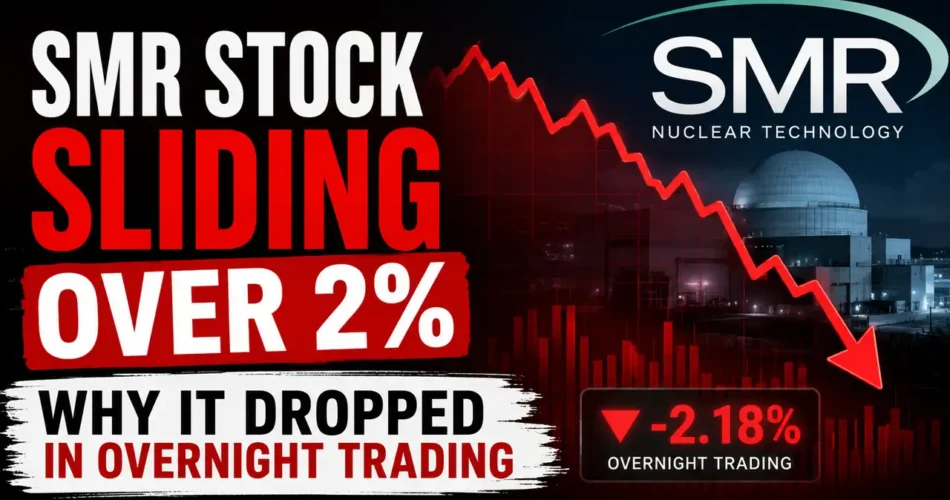
Why Is SMR Stock Sliding Over 2% in Overnight Trading?
Quick summary
SMR shares slipped more than 2% in overnight trading, sparking questions from investors and traders. This decline reflects a mix of company-specific signals, broader market forces, and short-term technical dynamics. Below we unpack the likely causes, what to watch next, and how different types of investors might respond.
What happened in the overnight session?
Overnight trading often reacts to late-breaking news, earnings updates, international market moves, and derivative activity after domestic exchanges close. In SMR’s case, the stock opened the after-hours window lower and traded down roughly 2% compared with the prior close. The move wasn’t a crash, but it was meaningful enough to attract attention because short overnight shifts can influence next-day premarket sentiment and intraday momentum.
Key reasons driving the decline
Company updates and earnings signals
Even small guidance adjustments, management commentary, or subtle shifts in forward-looking language after earnings calls can affect investor expectations. If SMR released any operational update — for example, softer revenue guidance, margin pressure, or delays in product rollouts — traders may reprice the stock quickly in overnight sessions where liquidity is thinner and reactions can be amplified.
Analyst moves and research notes
A new analyst downgrade, lowered price target, or cautious research note published after market hours often triggers immediate selling in after-hours markets. Institutional and algorithmic traders frequently react to such notes, magnifying price moves until regular market liquidity returns.
Macro and sector influences
Broader macro headlines (interest rate expectations, geopolitical developments, currency volatility) and sector-specific news can drag stocks lower even when the company’s own fundamentals remain unchanged. If peer firms in the same sector released weak numbers, or there’s negative sentiment across the industry, SMR can slide alongside them.
Overnight liquidity and technical selling
After-hours markets have lower volume and wider spreads, so even modest sell orders can push prices down more than during regular hours. Technical factors—like hitting a stop-loss cluster or algorithmic pattern triggers—can lead to quick moves. Traders who use premarket and after-hours signals may amplify the drop by executing additional sell orders at the first sign of weakness.
Options and derivatives activity
Heavy put buying or large option rollovers can indicate increased bearish positioning. Market makers hedging option exposure might sell underlying shares to balance risk, which shows up as downward pressure in overnight trading. Large institutional options flows disclosed in the evening can therefore precede stock moves.
Short-term vs. long-term implications
For short-term traders
A 2% overnight decline is actionable: momentum traders may short into weakness or buy put options, while scalpers look for heightened volatility to trade. Overnight volatility often leads to strong premarket moves that continue into the regular session. Day traders should watch volume, premarket price action, and level-based risk management (e.g., clearly defined stop losses).
For medium- and long-term investors
If the decline is due to transient factors—like a one-off comment, sector weakness, or options hedging—long-term holders may view it as noise. However, if the drop follows a genuine weakening in fundamentals (slower growth, margin compression, recurring guidance cuts), it’s a signal to reassess the investment thesis. Long-term investors should check recent financial statements, guidance changes, and whether the company’s competitive position has deteriorated.
How to investigate further (what to check next)
- Company filings and press releases: Look for any official statements or late-day disclosures.
- Earnings call transcript and management commentary: Note subtle language shifts in guidance or growth drivers.
- Analyst reports and price-target changes: Check reputable research outlets and sell-side notes.
- Peer performance: Compare SMR’s move with sector peers to gauge whether this is isolated or systemic.
- Options flow: Review after-hours options volume and large block trades that might indicate hedging pressure.
- Pre-market volume and level test: High pre-market volume confirms conviction; low volume suggests a possible reversal when markets open.
Practical trade and portfolio responses
- Conservative approach: Wait for regular-session confirmation before trading. Overnight moves can reverse quickly when liquidity returns.
- Tactical entry: If you’re bullish and the drop is headline-light, consider laddered buy orders to average in, with a stop below key support.
- Risk management: Use protective options or tight stop losses if you retain exposure; size positions to limit drawdown.
- Re-evaluate thesis: For long-term holdings, revisit revenue growth, margins, product pipeline, and cash flow to decide whether the decline changes fundamentals.
Market psychology and media effect
Even small declines can be magnified by news aggregation and social amplification. Overnight price weakness often becomes a headline that influences retail sentiment the next day. Monitor reputable financial news sources, but avoid overreacting to speculative or unverified reports that often circulate in low-liquidity periods.
When a slide might become a deeper correction
A single overnight drop to 2% is rarely catastrophic by itself. However, watch for these signs that the decline could extend:
- Follow-through selling during regular hours with increasing volume.
- Multiple downgrades or a consensus shift among analysts.
- Sequential quarterly misses or significantly lowered guidance.
- A widening divergence from peers that continue to show strength.
Example scenario
If SMR reported a guidance cut after the close, overnight traders could sell quickly and push the stock down 2–4%. If premarket trading shows heavy selling and peers are also weak, that suggests more downside at the open. Conversely, if no material company news exists and volume remains light, the drop may reverse when regular trading resumes.
Final checklist for investors
- Confirm whether the move was driven by company-specific news.
- Check premarket volume and price action for conviction.
- Review analyst commentary and sector trends.
- Apply appropriate trade size and stops based on time horizon.
- For long-term investors, verify whether fundamentals have changed materially.
FAQ
Q: Is a 2% overnight drop significant?
It’s noticeable but not necessarily alarming. Overnight markets are low-liquidity, so moves can be exaggerated. Look for confirmation in premarket and regular session volume before concluding the trend.
Q: Could the drop be due to options activity?
Yes. Large put buying or hedging by market makers can force the underlying stock lower in after-hours trading.
Q: How should day traders react?
Watch premarket confirmation, set clear entry and stop levels, and avoid trading solely on after-hours price without volume confirmation.
Q: Should long-term investors sell?
Not automatically. Assess whether the decline reflects a lasting change in fundamentals. If fundamentals are intact, a short-term dip can be an opportunity to average down; if fundamentals deteriorate, consider trimming or selling.
Q: Where can I find the cause quickly?
Check the company’s investor relations page, recent filings, reliable financial news outlets, analyst notes, and premarket trade logs for significant block trades or options signals.
References
- U.S. Securities and Exchange Commission (SEC) – SMR Filings: https://www.sec.gov/edgar/searchedgar/companysearch.html
- U.S. Bureau of Labor Statistics (BLS) – Employment & Economic Data: https://www.bls.gov/data/
- U.S. Census Bureau – Economic Indicators: https://www.census.gov/economic-indicators/

