

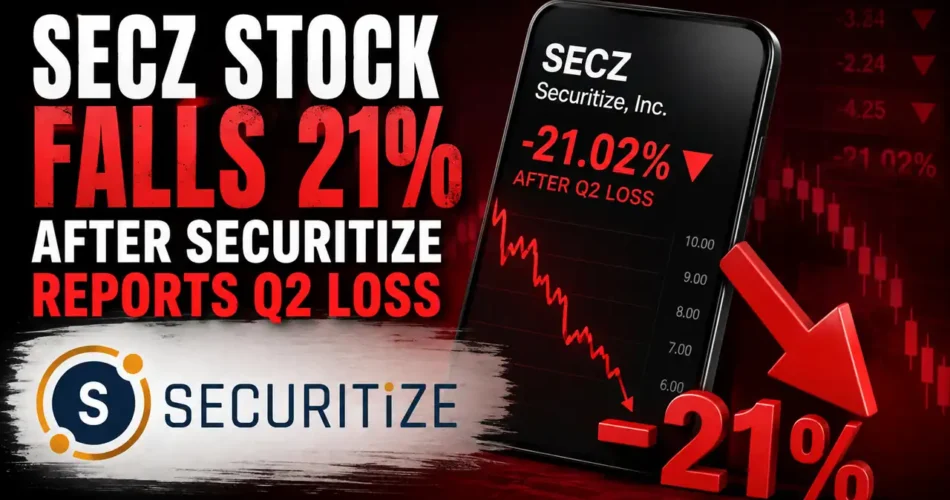
Securitize Reports $21.7 Million Q2 Loss as SECZ Stock Falls 21%
Securitize faced renewed pressure in the stock market after the company reported a net loss of $21.7 million for the second quarter. Following the announcement, shares of SECZ dropped approximately 21%, reflecting investor concerns about the company’s financial performance and near-term outlook.
The decline highlights the challenges facing digital-asset and blockchain-focused companies as investors continue to scrutinize earnings, operating costs, and growth prospects. Although Securitize operates in a sector with long-term expansion potential, the latest quarterly loss has raised questions about profitability and market confidence.
Securitize Posts Significant Quarterly Loss
Securitize’s second-quarter results showed a net loss of $21.7 million. A net loss occurs when a company’s total expenses exceed its revenue during a particular reporting period.
For investors, the size of the loss is important because it may indicate that the company is spending heavily on expansion, technology development, staffing, regulatory compliance, or other operating activities. However, a quarterly loss does not necessarily mean that a company is in financial distress. Investors typically examine additional factors, including revenue growth, cash reserves, debt levels, and management guidance.
The latest figures nevertheless created immediate pressure on SECZ stock. Market participants appeared to focus more on the company’s bottom-line performance than on its longer-term business opportunity.
Why the Loss Matters
A substantial quarterly loss can affect a company in several ways:
- It may reduce investor confidence.
- It can increase pressure on management to control expenses.
- It may limit the company’s ability to invest in future projects.
- It can raise concerns about additional share issuance or financing.
- It may increase short-term stock volatility.
The market reaction suggests that investors were not prepared to overlook the reported loss. In growth-oriented industries, shareholders may tolerate losses when revenue is increasing rapidly. When growth does not clearly offset expenses, however, the market can respond negatively.
SECZ Shares Fall 21%
SECZ shares fell about 21% after Securitize released its second-quarter financial results. Such a sharp move indicates that the report materially changed market expectations.
Stock prices often react to the difference between reported results and investor expectations. Even if a company’s loss is known in advance, shares can decline if the loss is larger than anticipated or if management provides cautious comments about future performance.
The sell-off may also reflect broader weakness in digital-asset-related stocks. Companies connected to blockchain technology, tokenization, and cryptocurrency infrastructure can experience higher volatility than businesses in more established industries.
Investor Sentiment Turns Cautious
The fall in SECZ stock suggests that investors are taking a more cautious approach to Securitize. Shareholders may now want clearer evidence that the company can move toward sustainable revenue growth and improved operating efficiency.
The company’s future performance could depend on its ability to attract customers, expand its platform, manage expenses, and benefit from increased adoption of blockchain-based financial products.
A stock decline of 21% does not automatically determine the company’s long-term value. It does, however, show that the market is demanding stronger financial evidence before assigning a higher valuation.
Securitize’s Role in Digital Finance
Securitize is associated with blockchain-based financial infrastructure and the tokenization of real-world assets. Tokenization involves representing ownership or economic rights in assets through digital tokens recorded on a blockchain.
The technology has attracted attention from financial institutions, asset managers, and fintech companies. Supporters believe tokenization could make certain assets easier to transfer, track, and access. Potential applications include private funds, credit products, real estate, and other financial instruments.
Despite this opportunity, the industry remains relatively young. Companies operating in the sector must deal with regulatory requirements, technology costs, customer education, and competition from traditional financial firms.
Long-Term Opportunity Versus Short-Term Losses
Securitize’s reported loss illustrates the gap that can exist between a promising business model and current profitability. A company may operate in a growing market while still producing significant losses during its expansion phase.
Investors must therefore assess both sides of the story. The potential benefits include:
- Expansion of blockchain-based financial services.
- Rising institutional interest in digital assets.
- Greater use of tokenized investment products.
- New revenue opportunities through financial technology.
The risks include:
- Regulatory uncertainty.
- High operating expenses.
- Limited mainstream adoption.
- Competition from larger financial institutions.
- Continued volatility in digital-asset markets.
The balance between these factors will likely influence SECZ’s performance in the coming quarters.
What Investors Should Watch Next
Following the quarterly loss and stock decline, investors may focus on several key indicators in Securitize’s future reports.
Revenue Growth
Revenue growth could become one of the most important measures of progress. If revenue increases consistently, investors may view current losses as part of an investment phase. Weak or stagnant revenue, on the other hand, could intensify concerns about the company’s business model.
Expense Management
Investors may also examine whether Securitize is reducing unnecessary spending. Lower operating expenses could help the company narrow its losses and move closer to profitability.
Cash Position
A company’s cash position determines how long it can continue funding operations without raising additional capital. Investors may review cash balances, cash flow, debt obligations, and financing plans.
Regulatory Developments
Regulatory clarity could benefit companies involved in tokenization and digital assets. At the same time, new compliance requirements could increase costs and slow product launches.
Management Guidance
Comments from company executives may provide insight into expected revenue, customer activity, strategic priorities, and the timeline for improving financial results. Clear guidance can help reduce uncertainty, while cautious or limited guidance may keep pressure on the stock.
Is SECZ Stock a Buy After the Decline?
The 21% drop may attract investors who believe the sell-off was excessive. A lower share price can create an opportunity if the company’s long-term prospects remain strong and management can improve its financial performance.
However, a falling stock price does not necessarily mean that shares are undervalued. Investors should avoid relying solely on the decline when making a decision. The company’s valuation, cash flow, competitive position, balance sheet, and growth expectations also require careful review.
SECZ may appeal more to investors who are comfortable with high-risk, growth-focused companies. Conservative investors may prefer to wait for evidence of stronger revenue growth, reduced losses, or improving cash flow.
Market Outlook for Securitize
Securitize’s outlook will depend on whether it can convert interest in tokenized assets into consistent commercial activity. The broader market for blockchain-based finance continues to attract attention, but adoption may develop gradually.
The company could benefit if institutional investors increasingly use blockchain technology for fund administration, settlement, ownership records, and asset distribution. Partnerships and new product launches may also support future growth.
At the same time, the company must prove that it can operate efficiently. Continued large losses could create additional pressure from shareholders and potentially limit strategic flexibility.
Frequently Asked Questions
What happened to SECZ stock?
SECZ stock fell approximately 21% after Securitize reported a $21.7 million second-quarter loss. The decline reflected investor concerns about the company’s profitability and financial outlook.
What does Securitize do?
Securitize operates in the digital-finance and blockchain sector, including technology related to tokenized financial assets. Tokenization uses blockchain-based digital representations to record ownership or economic rights.
Is a quarterly loss always a bad sign?
Not necessarily. Growth companies may report losses while investing in technology, staff, compliance, and expansion. However, investors generally want to see a clear path toward stronger revenue and improved profitability.
Why are digital-asset stocks volatile?
Digital-asset stocks can be affected by cryptocurrency prices, regulation, investor sentiment, technology adoption, and changing expectations about future growth. These factors can produce larger price movements than those seen in more established industries.
Should investors buy SECZ after the 21% decline?
The decision depends on an investor’s risk tolerance, investment horizon, and analysis of Securitize’s financial position. Investors should review the company’s revenue, cash flow, expenses, valuation, and future guidance before making a decision.
What should investors monitor in the next earnings report?
Investors may focus on revenue growth, operating expenses, cash reserves, financing needs, customer adoption, regulatory developments, and management’s guidance for the remainder of the year.
Final Perspective
Securitize’s $21.7 million second-quarter loss triggered a sharp 21% decline in SECZ shares and placed the company’s financial performance under greater scrutiny. The report does not by itself determine Securitize’s long-term prospects, but it reinforces the need to monitor profitability, cash flow, revenue growth, and operating discipline.
For U.S. investors, SECZ represents a higher-risk opportunity connected to the developing tokenization and blockchain-finance industry. The company may benefit from long-term institutional adoption, but it will need to demonstrate stronger execution and a clearer path toward financial sustainability.
External References
U.S. Securities and Exchange Commission: Search Company Filings
U.S. Securities and Exchange Commission: EDGAR Full-Text Search
U.S. Department of the Treasury: Official Website
United Kingdom Financial Conduct Authority: Official Website
Government of Canada Department of Finance: Official Website
Disclaimer: This article is for informational purposes only and does not constitute investment advice. Investors should conduct their own research and consider consulting a qualified financial professional before making investment decisions.

