
A record earnings week sent Microsoft‘s (MSFT +0.27%) stock up 18% in the last week of July. Satya Nadella claimed that the company’s custom AI accelerators are delivering up to 40% efficiency-per-watt gains over the last generation of Microsoft Maia chips. That’s a signal that Microsoft is turning its huge artificial intelligence (AI) infrastructure spend into a more profitable business.
This claim matters because it suggests Microsoft can keep ramping up AI while spending less per unit of compute, and do so on its own terms rather than living on OpenAI’s cost structure. Those chips include the Maia accelerator and Cobalt CPU families, designed specifically for Azure workloads and Copilot-level scale.
The message is simple: Microsoft can now get more AI work done per unit of energy and hardware by using its own silicon. That combination of lower running costs and greater control over the stack is exactly what Wall Street needs to see to remain comfortable with a $100-plus-billion-a-year AI build-out.

Today’s Change
(0.27%) $1.28
Current Price
$481.63
Key Data Points
Market Cap
Day’s Range
$477.15 – $484.27
52wk Range
$349.20 – $553.72
Volume
24.1M
Avg Vol
40.2M
Gross Margin
67.94%
Dividend Yield
0.74%
The capex backdrop right now
This broader efficiency story lands in a world where investors have been fixated on AI capital spending. Microsoft is on track to spend roughly $190 billion in calendar 2026, with the vast majority allocated to data centers, GPU clusters, and related infrastructure.
In FY26 alone, it spent about $116 billion on capex and still managed to grow operating cash flow to roughly $55 billion, even as free cash flow dipped to about $19.6 billion. If each rack of AI hardware runs 40% more efficiently on homegrown chips, the return on that spending improves without Microsoft needing to slow the build-out.
Less dependence on OpenAI’s economics
Nadella also framed Microsoft’s models and chips as a more affordable option than those of OpenAI or Anthropic, whose assistants are powerful but often more expensive to run.
That matters because a large share of Azure’s AI demand currently flows through OpenAI, and Microsoft’s earnings disclosures show that investments in OpenAI have already weighed on net income in prior quarters.
Shifting more AI volume onto Microsoft silicon and Microsoft software models reduces its exposure to another company’s pricing, margin structure, and governance risk.
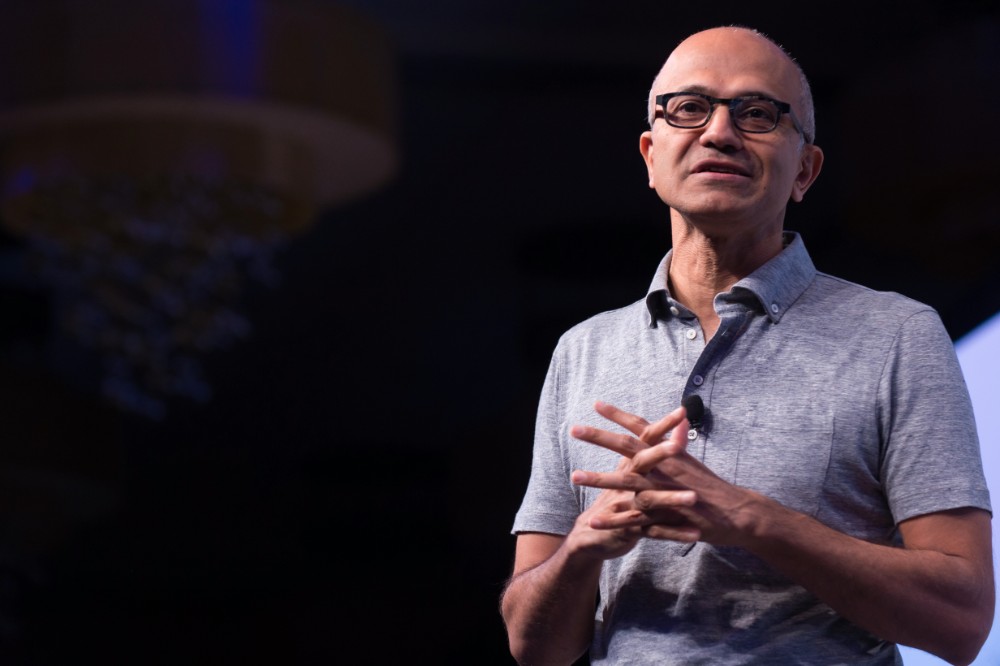
Satya Nadella, CEO of Microsoft. Image source: Microsoft Corporation.
Why investors should care right now
The report for fiscal year 2026 showed Azure growing about 40% to 45%, overall revenue jumping 18% to roughly $332 billion, and contracted AI revenue backlog exploding 84% year over year to about $678 billion. The stock has risen about 15% since then because that growth came with evidence that AI is expanding earnings, not just capex, and that Microsoft can keep scaling without torching its balance sheet.
For shareholders, Nadella’s 40% efficiency gain is really a signal about future margins and resilience. If Microsoft can turn a $190 billion infrastructure plan into decades of high-margin AI services using cheaper, in‑house chips, the current spending spike looks less like a dangerous cash burn and more like the foundation of a long‑term cash machine.
Source link