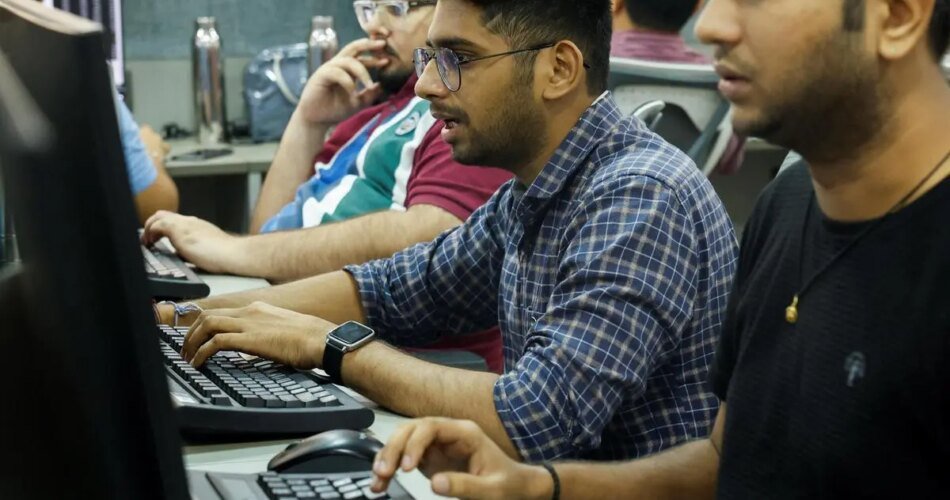

Traders below 30 accounted for 32.83 lakh, or 43 per cent, of individual F&O traders in FY26, up from 31 per cent in FY22, making them the largest group in the segment
| Photo Credit:
FRANCIS MASCARENHAS
India’s retail F&O market is getting younger, with traders below 40 now accounting for nearly four out of every five individual participants while generating over half of derivatives turnover despite holding just 29 per cent of the aggregate equity portfolio of individual F&O traders.
Traders below 30 accounted for 32.83 lakh, or 43 per cent, of individual F&O traders in FY26, up from 31 per cent in FY22, making them the largest group in the segment. Another 35 per cent were aged between 30 and 40, taking the share of traders below 40 to 78 per cent, according to SEBI’s latest F&O study.
The intensity of their participation moved in reverse to their ages, with traders below 30 generating turnover worth 93 times the value of their equity portfolios in FY26, compared with 73 times for those aged between 30 and 40. For traders aged 50 and above, the ratio was about 20 times. Traders with higher turnover relative to their equity portfolios tended to report a higher incidence of losses and greater average losses per trader.

The younger cohort, however, was not the biggest contributor to aggregate losses. Traders aged between 30 and 40 lost ₹36,642 crore in FY26, accounting for 41 per cent of individual traders’ total losses. Traders below 30 lost ₹19,287 crore, or 22 per cent.
About 88.55 per cent of traders below 30 lost money, compared with 88.05 per cent of those aged between 30 and 40. However, the average loss was substantially higher for the latter at ₹1,36,418, compared with ₹58,749 for traders below 30.
Learning from Hard Bite
The lure of quick gains continues to attract young traders despite the high odds of losses. A 33-year-old engineer-turned-full-time trader said the possibility of outsized returns kept him in the market.
“Even though I knew the odds were against me, once I managed to make more than 10 per cent on the money put in within a week, the hope of the potential upside kept me going,” he said.
Looking back, he acknowledged that the occasional winning trade masked his overall losses. “I may have made more losses per trade in total, but those one-off profits softened the blow and kept me coming back,” he said.
Not all traders stayed the course. A 29-year-old trader said he exited the derivatives market after SEBI’s tightening of F&O regulations. Having consistently incurred losses, he saw little reason to continue. “I was mostly making losses. After the new rules kicked in, I decided to stop trading derivatives altogether,” he said.
The rise in younger participation comes against the backdrop of a sharp expansion in India’s retail market over the past few years. A top retail broker said the firm saw the largest increase in new accounts during the 2023-24 equity market rally, when the strong rise in equities attracted more young investors and traders to the market.
The influx of younger traders has changed the face of derivatives participation, even as the underlying wealth of this cohort remains relatively small. The number of individual traders fell by 20 per cent during the year, but those below 30 remained the largest age group.
For many, F&O trading appears to have become a route into the markets, alongside or even before building a substantial equity portfolio, with the youngest traders turning over their equity wealth at multiples far higher than those of older participants.
Published on August 21, 2026
Source link