Meta trial begins as states accuse company of harming children online
Meta is once again facing legal scrutiny over the potential risks its platforms pose to children while maintaining that it works tirelessly to keep users safe.
The high-stakes trial involving the parent company of Facebook and Instagram began Tuesday in a California federal court, where four states are demanding billions of dollars in damages and structural changes to how Meta operates.
A jury will determine if state prosecutors proved the technology giant built its platforms to “hook the users, hold them for as long as they can, harvest their data and hide the truth from the public,” as Megan O’Neill, a deputy attorney general for the California Department of Justice, declared during opening statements.
The lawsuit argues that Meta routinely collects data on children under 13 without their parents’ consent, in violation of federal law (AP Photo/Noah Berger)
California, Colorado, Kentucky and New Jersey were among the 29 states that sued the tech giant in 2023 over child safety and privacy — the other 25 will go to trial later. The company also faces lawsuits in state courts, including one underway in Tennessee.
The lawsuit accuses Meta of contributing to the youth mental health crisis by knowingly and deliberately designing features that addict children to its platforms and hides these harms from the public. It also argues that Meta routinely collects data on children under 13 without their parents’ consent, in violation of federal law.
The company has defended its safety record and said it has a strong case.
States argue Meta exploited research on child development
O’Neill laid out the states’ case for the eight jurors during opening statements in federal court in Oakland, California.
“You’re going to hear that Meta knew a lot about kids’ brains,” O’Neill said. This includes how they are constantly seeking rewards, how they are sensitive to social feedback and “how they are still developing their ability to control impulses the way adults do.”
Meta, she said, researched these vulnerabilities and talked about how it could change Instagram to respond to them.
” ‘The young ones are the best ones’ is a title of a Meta study we are going to show you,” she said, telling jurors that for Meta, “kids are the product.”
Meta, O’Neill said, also knew that kids under 13 were using its products even though they were banned from it, and “failed to take the simplest most obvious steps to keep them off.” For instance, she said, when Meta found that someone on Facebook was under 13, it would disable the person’s Facebook account but not their connected account on Instagram.
The states called as their first witness former Meta executive Arturo Béjar, who worked as an engineering director at Facebook from 2009 to 2015, attracting wide attention for his work to combat cyberbullying. He returned from 2019 to 2021 as a contractor to work on safety issues.
Béjar said that, contrary to Meta’s statements, the company’s research on safety issues was not being used to improve products.
Béjar said that, contrary to Meta’s statements, the company’s research on safety issues was not being used to improve products (Reuters/Vicki Behringer)
For example, regarding eating disorder content, Meta’s engineers “had very good ideas on how to make it better” so that users, especially young ones, would not be exposed to it.
“But once it was reviewed, it got whittled down to a little pebble that didn’t make a difference,” he said.
Meta attorney highlights company work on safety
Meta lawyer Paul Schmidt laid out his case beginning with what is not disputed in the trial — that even though kids under 13 are not supposed to be on its apps, some lie about their ages; that some teens struggle to manage their time; and that some people post “negative content” on Facebook and Instagram.
But he said he will focus on the work Meta does to make its platforms safer and share information with the public.
“Much of this lawsuit is about the government attorneys and their witnesses saying in trying to improve, we’d do it a little differently,” Schmidt said. “In talking about how to improve, we disagree with how you talk about it. It’s meaningful, and the evidence will be meaningful, these efforts Meta has taken to improve.”
U.S. District Judge Yvonne Gonzalez Rogers in Oakland is overseeing the proceedings, which are expected to last six weeks with testimony from Meta CEO Mark Zuckerberg and other executives and former employees. Gonzalez Rogers, appointed to the bench by President Barack Obama in 2011, has overseen a bevy of complex, high-profile cases involving Big Tech. These include Elon Musk’s lawsuit against OpenAI and its founders as well as Epic Games’ lawsuit against Apple over its app store.
If Meta loses the trial, the court would have wide discretion over the size of any financial penalty. Meta has said if it loses, the case could leave it liable for damages amounting to $1.4 trillion, but legal experts say anything close to that amount would be unlikely.
Meta lawyer Paul Schmidt laid out his case beginning with what is not disputed in the trial — that even though kids under 13 are not supposed to be on its apps, some lie about their age (Benjamin Fanjoy/Getty Images)
Meta faces thousands of lawsuits, angry parents
The trial is the latest in an avalanche of lawsuits against Meta Platforms and other social media companies including Google’s YouTube, TikTok and Snap, over arguments that their platforms harm young people, illegally collect their data and are deliberately designed to addict them.
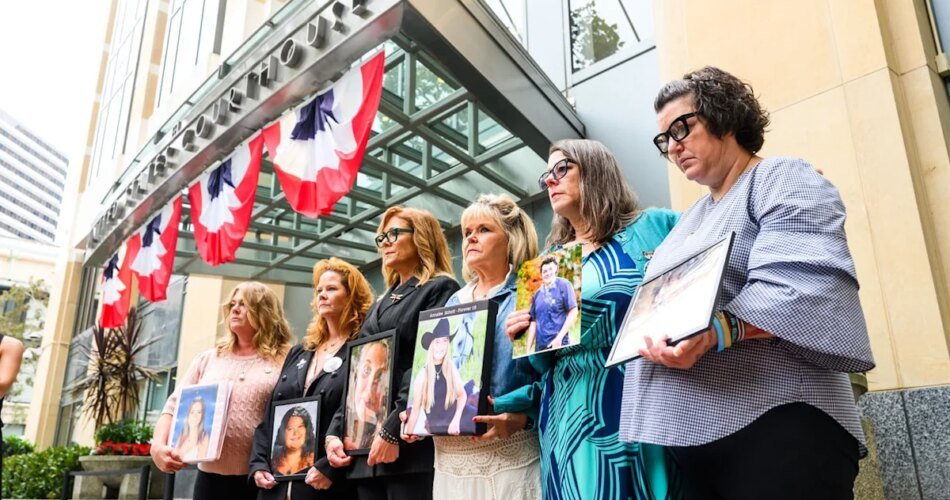
As the trial began, child safety advocates and parents who trace their children’s deaths to social media harms gathered outside of the courthouse Tuesday. Many parents held photos of their late children as they spoke to reporters outside, at times speaking through tears.
Several parents held a banner with the names and ages of children who died from social media-related harms. It was several feet long.
Mary Rodee, whose son Riley Basford died by suicide at age 15 after being sextorted on Facebook Messenger, was among the parents and said she had helped write the names. They have had to add 39 new ones to the banner since March, she said.
“It’s not just a banner,” Rodee said. “Every name that I wrote on there is a promise that these children will never be forgotten and that their stories will force accountability where silence once reigned.”