
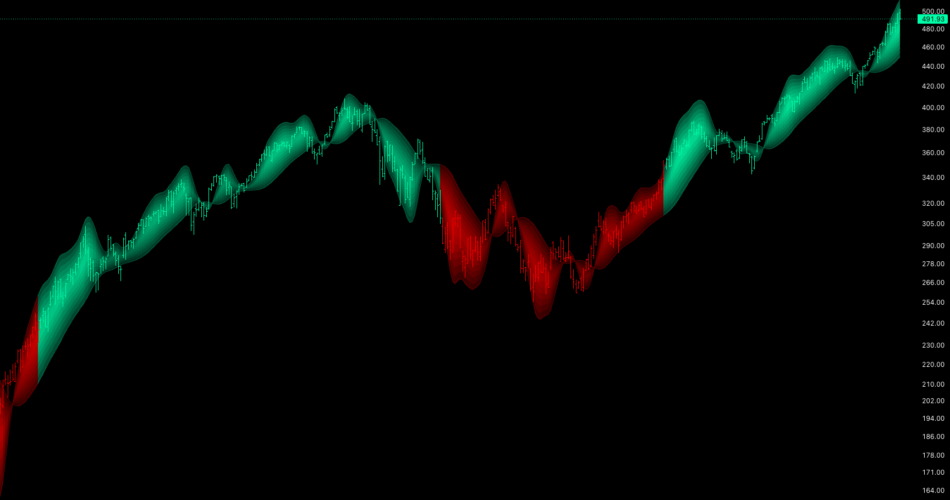
The Jurik Trend Ribbon is a trend-following indicator built on a phase-compensated recursive filter rather than fixed-weight averages or price crossovers. It measures the residual between price and its own running estimate, then feeds a scaled portion of that residual back into the output to recover lag without the overshoot a shorter average introduces. Direction is anchored to a stored level that only advances once the filtered path clears a volatility deadband, helping traders separate sustained directional displacement from movement contained inside the prevailing range across every timeframe and market.
🟢 How It Works
The foundation of the indicator is a three-stage recursive cascade. A preliminary stage smooths the source, a detrending stage retains the residual price leaves behind against that estimate, and a final stage applies phase compensation before accumulating the result:
Two coefficients govern the cascade. Beta is fixed by the sampling Length and weights the detrending stage. Alpha is the smoothing coefficient, and under Classic mode it stays fixed at the Power setting throughout. Under Adaptive mode it is rescheduled on every bar from realized volatility measured against its own longer baseline:
Because beta is less than one, a larger exponent produces a smaller alpha and a faster filter, so the cascade tracks more closely as volatility expands and settles as it contracts. Classic holds a constant response that changes only with Length, while Adaptive shifts its response with the regime and will register state changes more readily at the same envelope width.
Direction is not read from the filter’s slope. A stored level tracks the filtered path at a fixed distance in ATR units and only steps when the path clears it:
Because that level rests a full deadband away from the filter, reversing direction requires the path to travel twice that distance, roughly three ATR at default settings. The level holds still through movement contained inside the envelope and commits only once displacement clears it outright, so the state persists through pullbacks rather than resetting on every fluctuation in the filter.
🟢 Signal Interpretation
▶ Bullish Trend (Green): When the filtered path clears the lower edge of the envelope, the stored level steps upward and the indicator enters bullish mode with green coloring applied across the ribbon and its layered bands. The level then trails beneath the path and only ever ratchets higher, so the reading persists through pullbacks that fail to displace price far enough to reach it. The transition into green marks a potential long/buy opportunity, with retracements toward the ribbon during an established bullish reading offering potential continuation entries.
▶ Bearish Trend (Red): When the filtered path clears the upper edge, the stored level steps downward and the indicator enters bearish mode with red coloring across all visual elements. The level trails above the path from that point and only tracks lower, requiring a full deadband of upward displacement before the state can flip back. The transition into red marks a potential short/sell opportunity, with rallies back toward the ribbon during an established bearish reading offering potential continuation entries on the downside.
🟢 Features
▶ Preconfigured Presets: Three parameter sets cover different trading approaches. “Default” targets swing trading on 1-hour and daily charts with a balanced filter and an envelope that holds direction through routine pullbacks. “Fast Response” shortens the filter, lightens the smoothing exponent, and tightens the envelope for intraday charts where the indicator needs to adapt to shorter-duration moves. “Smooth Trend” extends the filter, deepens the exponent, and widens the envelope for position trading on daily and weekly timeframes, where the cost of a false flip exceeds the cost of a delayed one. Selecting a preset overrides the individual filter and envelope inputs.
▶ Built-in Alerts: Three alert conditions cover all directional states. “Bullish Trend Signal” fires on the bar where the trend confirms bullish. “Bearish Trend Signal” fires on the bar where it confirms bearish. “Any Trend Change” combines both into a single condition for traders who want a unified notification regardless of direction. Because the filter reads its source on every tick, alerts should be set to Once Per Bar Close so they fire only on values that are final.
▶ Visual Customization: Six color presets (Classic, Aqua, Cosmic, Cyber, Neon, and Custom) apply coordinated bullish and bearish color schemes across the ribbon, its layered bands, and optional bar and background coloring. The ribbon renders the same cascade across its phase range rather than a single line, so it opens as price runs ahead of the smoothed estimate and closes as that gap narrows, with band opacity brightening and fading on the same measure, and a width multiplier scales the whole ribbon for presence on zoomed-out charts. Bar coloring tints price candles with the active trend color at a configurable transparency level, and background coloring extends the directional tint across the full chart pane.
Source link
Author

- Ytv Market News
- Share-market news writer and analyst with deep experience covering equities, commodities, forex, and cryptocurrencies for readers in the USA, UK, Canada, and Australia. Ytv Market News delivers timely market updates, practical trading insights, and clear explanations of macro and company-level catalysts that move prices. Combines on-the-ground financial reporting with technical analysis, using concise charts and actionable ideas to help investors and traders make smarter decisions.
Latest entries
 Crypto NewsAugust 24, 2026Crypto: Armstrong Says Washington Can No Longer Delay Regulatory Clarity
 Crypto NewsAugust 24, 2026Top 3 Price Prediction: Bitcoin, Ethereum, Ripple – BTC, ETH and XRP pause as momentum indicators signal overbought conditions, massive rallies
 CanadaAugust 24, 2026DENARIUS METALS ANNOUNCES CLOSING OF STRATEGIC INVESTMENT IN COPPER GIANT RESOURCES AND CONCURRENT PRIVATE PLACEMENT WITH TRAFIGURA
 Trading IndicatorsAugust 24, 2026Universal Signal Backtester | Trading Indicator