

In 2024, Constance Soule got a surprise from her landlord: a “notice of termination” that gave her 10 days to move out of her apartment.
Soule, a disabled Alzheimer’s patient with a housing voucher, had paid her rent at a Larkspur, California complex managed by Greystar, the country’s largest apartment manager. But she was about to be evicted from her home across from the Golden Gate Bridge solely over utility charges, court documents show.
“It just kept adding up,” said Margot Jones, Soule’s older sister. “I said, ‘She’s paid her rent. You’re charging her all these extra fees.’”
Soule’s story is a familiar one to Lucie Hollingsworth, policy director of Legal Aid of Marin county, California, which helped Soule and Jones navigate the eviction notice. Hollingsworth estimated that a majority of the evictions her agency currently sees for “nonpayment” involve tenants who are unable to pay their utilities.
Soule, 81, had run into a problem emerging nationwide: “ratio utility billing system” fees – known within the apartment industry as “Rubs” – that are charged on top of rent.
These costs are rarely given prices in apartment listings or leases. Unlike standard utility bills, where tenants owe money to the utility company, Rubs are owed to the landlord and often paid through a third-party billing company. Many leases that include Rubs are written so tenants can be evicted for not paying utilities even if they have paid their rent.
For more affluent tenants, Rubs can be an unwelcome jolt that raises housing costs by hundreds of dollars. For working-class and low-income tenants like Soule, falling behind on these utility charges can lead to eviction notices.
While there is no national data on evictions tracked by cause, tenant attorneys and advocates in Philadelphia, Los Angeles, Oakland and Columbus, Ohio, said utility-related eviction cases appear to be increasingly common.
Across the nation, tenants and their allies are fighting back.
Eight cities in California have banned the use of Rubs within their borders and multiple states have passed laws regulating the practice. California’s attorney general reached a settlement of nearly $500,000 last year with a national property management firm to resolve allegations that it had used Rubs to make “shadow” rent increases that violated the state’s limits on how steeply landlords can raise rents.
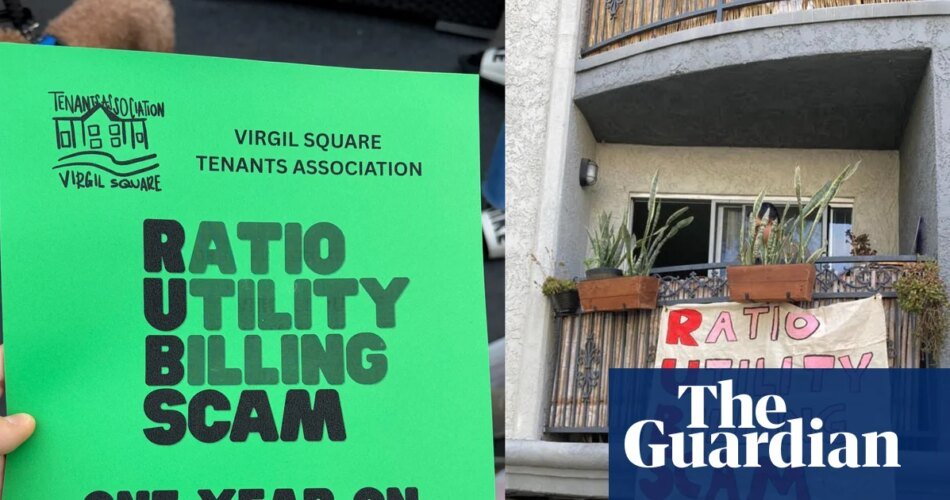
Tenants in Los Angeles and Seattle, meanwhile, have launched “Rubs strikes”, refusing to pay utilities until landlords agree to reduce charges that can approach $300 a month per apartment. Members of LA’s Virgil Square Tenants Association hung hand-made signs from their buildings that said: “Ratio Utility Billing Scam”.
In Colorado, a study released last month by the Urban Institute and Denver’s Community Economic Defense Project found that utility fees were the most common charge on top of rent for more than 1,100 tenants facing eviction. In one example, the study said, a tenant had to pay as much as $2,620 a month to stay current on rent and fees and avoid eviction, but the only monthly charges listed in their lease were $1,725 for rent plus $35 for “pet rent”.
Apartment industry representatives defend Rubs as a valid tool that allows landlords to deal with the financial and administrative challenges of operating buildings that do not have meters to capture individual units’ water and electricity usage. They also argue that Rubs helps to encourage tenants to conserve water.
Greystar declined to comment on Soule’s eviction case or answer other questions for this story. The company, which was the subject of a recent investigation by the Guardian, previously said that “consumer education, communication and compliance with respect to upfront, ongoing, and situational expenses incurred in addition to base rent has always been a priority at Greystar”.
How Rubs work
Many tenants who get hit with add-on utility fees have not heard of Rubs before, Hollingsworth said.
Ratio utility billing services typically work like this:
A landlord or property management company contracts with a third-party biller which takes over management of various building utilities and infrastructure. Charges often include gas, water, sewer, electric, pest control and trash. Fees may be for “common area” charges, such as electricity in hallways, as well as for charges assigned to individual units.
The bills tenants get for Rubs do not reflect their individual usage. Instead, formulas are used to estimate a tenant’s share of the building’s bill based on things like a unit’s square footage, the number of residents in an apartment or the number of units occupied in the building that month.
It is often confusing for tenants.
Jaslyn Cosey, a disabled tenant at a Greystar-managed building in Las Vegas, was surprised by nearly $140 in monthly fees she was charged at the company’s Glo complex. The fees covered common area gas, electric and maintenance; utility administration and service; and individual sewer, trash and water in a single month, according to a ledger reviewed by the Guardian.
Cosey said she didn’t know how much the utilities would be, or that she would owe her landlord utility fees, because they were described in her lease as “usage based” and “third party”.
Ordinarily, Cosey said, she could economize on utilities if necessary.
“If I struggle and I can’t pay for cable or lights or something, and it gets cut off, I’m not homeless. I can burn the candle if I need to, you know?” said Cosey. “I didn’t know that it would be considered rent.”
At first, Cosey paid the fees every month. Then her disability checks began to arrive later than her rent’s due date, and she fell behind.
When a state assistance program sent money to cover Cosey’s back rent, Greystar used it to cover her fees, according to court claims. This left Cosey short on rent, and Greystar went to court and had her evicted.
Last September, Cosey filed a lawsuit seeking class-action status in state court in Nevada alleging that Greystar charged “unreasonably high utilities fees” and failed to disclose a clear formula for calculating utility costs.
In court documents, Greystar denied Cosey’s allegations and called her lawsuit an attempt “to transform a straightforward landlord-tenant accounting dispute into a sweeping consumer-fraud class action”. The fees and billing practices in question, the company said in a court filing, were disclosed in her lease agreements.
The case, now in US district court in Nevada, is pending.
Utah-based Conservice – which manages nearly 8m “utility service points” and markets itself as “real estate’s one true hope for full-service utility management” – said that ratio billing reduces usage of water and other utilities and is fairer than rolling utility costs into rent charges.
“Rubs is much better for the tenants, owners and environment than in-rent utilities,” Marc Treitler, general counsel and president of sustainability for Conservice, said in an email.
Marketing materials for third-party utility management companies and property managers highlight the model’s potential for increasing revenue. A Conservice marketing video on utility billing features an image of hundred-dollar bills and a voiceover explaining, “When you choose Conservice billing, you’ll experience higher revenue” and higher “utility cost recovery” from residents. An April marketing email from Livable, a ratio utility biller, encouraged potential customers to “turn utility billing into a revenue tool”. Its website includes a calculator to help potential customers estimate how much utility cost they can pass on to tenants.
Highlighting revenue to potential customers makes sense, said Livable’s CEO, Dan Sharabi, in an email, “because it speaks to a benefit relevant to them: cost recovery”.
Utility and trash fees were the most common complaint among nearly 500 public comments submitted to the Federal Trade Commission this spring as part of an FTC rule-making process that is assessing prospects for regulating fees that are charged to renters, according to a Guardian analysis of the comments.
Rubs appear to be common at buildings run by Greystar. In New York City, the Guardian found at least one mandatory third-party utility charge at 12 of 14 Greystar-run buildings in Manhattan, Brooklyn and Queens, across which Greystar manages roughly 10,000 units of housing. At the 12 buildings, the charges were listed as “usage based” and gave no indication of a price. Similarly, the Guardian found unpriced, usage-based third-party utility fees for Greystar listings in Washington DC and 38 of the 42 states in which its website said it managed a building.
Greystar declined to answer specific questions regarding utility fees. The company’s website has a blog post suggesting that monthly fees for water, sewer and electric cost tenants up to $247 a month.
Evictable utility fees have become common enough that tenants cannot easily avoid them. When Soule, the Alzheimer’s patient who faced eviction in California, moved into her next apartment, she found more fees: water, sewer, trash, water heating and charges for administration and service.
“I didn’t realize they existed in other places,” said Soule’s sister, Margot Jones. “I just stepped out of the frying pan and into the fire.”
Soule’s new complex charged her an average of $257.92 a month for mandatory utilities at her studio apartment between December 2024 and June 2026, according to ledgers reviewed by the Guardian. The fixed fees, for administration and service, averaged $9.15 a month. In total, Soule’s Rubs fees totaled more than $5,500 over and above her rent.
The only real difference, said Jones, is that now they know that utility fees can mean eviction. “It’s a nightmare,” she said. Eviction, said Jones, is “a constant worry”.
A $24m settlement
Housing attorneys and tenant activists say the use of Rubs often misleads people looking for apartments by advertising units at one price, then tacking on expenses that can lead to eviction if not paid.
“It’s a way of advertising a lower rent, but then adding on costs so that the tenant ends up paying more,” said Jackie Zaneri, a supervising attorney for SeniorLaw Center, a legal group in Philadelphia.
In December, Greystar agreed to limit unpriced, add-on fees under a $24m settlement with the Federal Trade Commission, which had alleged the company violated fair competition laws by charging junk fees. However, the settlement allows Greystar to continue to charge unpriced, add-on utility fees in listings and advertisements.
As part of the FTC rule-making process, Greystar has urged the agency to replicate its settlement terms in future regulations covering the apartment industry as a whole. The company also said variable utility costs should be excluded because they “cannot be accurately calculated in advance”.
Conservice’s Treitler said his company does not believe “the utility amounts themselves” should be disclosed in leases and advertisements.
Scrutiny of Rubs has also increased on the state and local levels.
At least 13 lawsuits have challenged Rubs since the start of 2025 across five states – including the California attorney general case that led to a settlement last fall with a national property manager, Mission Rock Residential. The office of that state’s attorney general, Rob Bonta, alleged that Mission Rock’s California arm had charged tenants in Marin county utility fees that pushed their housing costs above what was allowed under the state’s tenant protection law.
“Some California landlords have tried to get away with illegal rent increases by shifting utilities and other fees to tenants and pretending those new charges are not ‘rent’” under state law, Bonta said in a statement announcing the October 2025 settlement.
Mission Rock blamed the alleged practices on the prior owner of the properties. The company declined to answer questions from the Guardian.
Efforts to limit or ban add-on utility fees are gaining momentum. Alameda and West Hollywood are among eight California cities that now prohibit landlords from using Rubs billing in most arrangements, according to a Guardian scan of existing legislation. In July, New York City officials announced plans to develop regulations on utility fees as part of a citywide effort to address “rental ripoffs”. Seattle officials, who passed legislation banning many apartment fees in August, said they may do the same. Los Angeles’s city council is also considering strengthening Rubs protections for tenants.
In Los Angeles, the Virgil Square Tenants Association has been on a “Rubs strike” against their property manager, Equity Residential, since June 2025. Members are refusing to pay utility bills until they see documentation of building-wide utility costs. Ledgers provided by tenants show monthly utility bills totaling as much as $226 a month.
The Virgil Square tenants are working with the Debt Collective, a national debtors union, said Rose Lenehan, a tenant organizer with the nationwide group. She estimates that residents of about a dozen buildings across LA are currently working with either Debt Collective or the Los Angeles Tenants Union to address concerns with Rubs.
Marty McKenna, a spokesperson for Equity Residential, said the company’s utility practices are “fully compliant with California law”. He did not address questions about the building’s utility costs.
Tenants at the Qualman apartments in Seattle also went on a Rubs strike this year. Utility fees had been a flat $50 a month until the building switched to Rubs last spring, said tenant Lexy Salas, whose ledger shows monthly utility charges averaging $143 since the change. Tenants stopped paying utilities in January, hoping to prompt their property manager, Cornell & Associates, to disclose the building’s actual utility bills and calculations as required by local law.
When the landlord threatened to evict tenants in June for failing to pay their utilities, the strike ended, Salas said.
Salas and her neighbors have also formed a citywide group, Seattle Ban Rubs, that has heard complaints about Rubs from 128 other buildings, Salas said.
Colin Smith, a property manager at Cornell & Associates, told the Guardian in an email that Rubs are legal in Seattle. He said the company switched to Rubs to “collect an appropriate share of the increasing utility expenses” and to distribute costs more equitably among tenants, because costs are based on unit size and number of occupants. He also said the company has shared the method of billing calculations used, but did not address questions from the Guardian about providing tenants with copies of the bills their charges are based on.
In San Rafael, California, the 400 Canal Street Tenants Association managed to negotiate with a new landlord, Tesseract Capital Global, to keep Rubs fees down. At first, new utility fees for water, sewer and trash – all of which had previously been covered by rents – were as high as $550 a month. When tenants organized over this issue, Tesseract agreed to cap utility charges at $270 and $330 a month for the roughly 70 units billed under Rubs.
The Rubs cap means that Tesseract is “absorbing roughly half of the building’s total utility cost rather than passing all of it through to residents” and tenants who use less will pay less, Angelo Trinh, a Tesseract vice-president, said in an email.
Glendy Barros, a mother of three, shared with the Guardian a ledger from Tesseract showing that she often pays roughly $250 to $300 a month in utility fees. Barros, who cleans houses in Mill Valley, said she and her husband, who collects and resells scrap metal, struggle to afford even that reduced rate.
Before the fees, she said, she spent the weekends with her children. Now, she said, she has to work on Saturdays.
“The end of the month is so stressful for us because we have to come up with all that money,” she said.


