

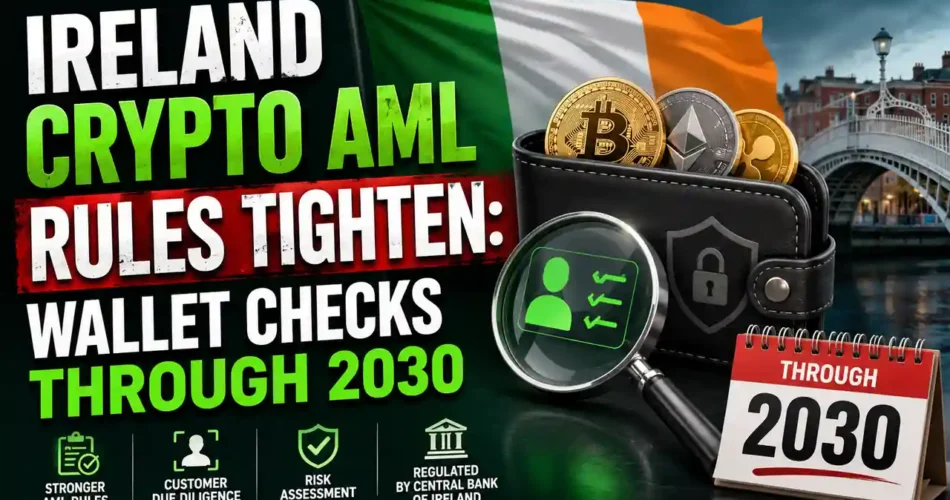
Ireland AML Strategy Tightens Crypto Wallet Checks Through 2030
Ireland is moving toward a more comprehensive anti-money laundering (AML) framework that could significantly strengthen oversight of crypto-asset activity over the coming years. The country’s evolving strategy places greater emphasis on identifying financial crime risks, improving coordination between authorities and adapting regulatory controls to newer technologies, including virtual assets and crypto wallets.
The direction of travel is important for cryptocurrency businesses, exchanges, wallet providers and investors operating in Ireland. Rather than treating crypto as a separate financial ecosystem, regulators are increasingly incorporating digital assets into the broader AML and counter-terrorist financing (CFT) framework.
Ireland’s Department of Finance says its AML/CFT framework is designed to protect the financial system from illicit funds and maintain confidence among businesses, investors and international partners. The department’s current framework also identifies virtual asset service providers as entities subject to AML supervision.
Ireland’s AML Strategy Enters a New Phase
Ireland has been strengthening its AML infrastructure for years, but the rapid development of digital assets has created new challenges for regulators. Crypto transactions can move across borders quickly, involve multiple wallets and interact with decentralized services that do not always resemble traditional financial institutions.
The Irish government is therefore taking a broader approach. Its Anti-Money Laundering Steering Committee provides national coordination across government departments, law enforcement agencies and financial regulators. In 2026, the committee’s work includes preparing for the European Union’s new Anti-Money Laundering Authority and improving national AML coordination.
The government has also been developing a National Strategy on Anti-Money Laundering and Countering the Financing of Terrorism, informed by an updated national risk assessment. In an April 2026 speech, Ireland’s Minister for Finance said the updated risk assessment would help identify risks across different sectors and guide the development of the national strategy.
Why Crypto Wallets Are Receiving More Attention
Crypto wallets are central to the digital-asset economy because they allow users to hold and transfer tokens without relying exclusively on conventional bank accounts. However, the same characteristics that make crypto efficient can create challenges for financial-crime investigators.
Transactions can be conducted using blockchain addresses rather than conventional names and account numbers. Funds may also pass through several addresses, exchanges, decentralized applications or cross-border services within a short period.
For regulators, this means AML controls increasingly need to focus not only on the identity of customers but also on transaction patterns and the destinations of digital assets.
From Customer Checks to Transaction Monitoring
Traditional AML programs generally rely on customer due diligence, beneficial-owner identification, transaction monitoring and suspicious transaction reporting. Crypto businesses must increasingly combine these measures with blockchain-related monitoring.
This can include evaluating where funds originate, where they are sent and whether transactions display characteristics associated with illicit activity. The objective is not necessarily to prohibit private crypto wallets but to make it more difficult for criminals to use regulated crypto businesses as gateways for laundering money.
EU Rules Are Driving Much of the Change
Ireland’s approach cannot be separated from the wider European Union regulatory framework. The EU has adopted a new AML package that includes a new AML Regulation, a revised AML Directive, changes to transfer-of-funds rules and the creation of the Anti-Money Laundering Authority, known as AMLA.
Ireland’s Department of Finance notes that the revised EU transfer-of-funds framework extends information requirements to certain crypto-asset service providers. The department also states that the new AML Regulation and Directive entered into force in 2024, with major provisions scheduled to become applicable or require national implementation in subsequent years.
This European framework is likely to shape how Irish crypto businesses handle customer information, transfers and compliance procedures through the remainder of the decade.
What Stricter Wallet Checks Could Mean
For consumers, stronger AML controls may mean more questions when opening accounts or transferring cryptocurrency through regulated providers. Exchanges and other service providers could require additional information when transactions involve external wallets or unusual activity.
For businesses, the implications could be more significant. Compliance departments may need stronger systems for customer identification, transaction screening, risk scoring, record keeping and suspicious activity reporting.
Greater Scrutiny of External Wallet Transfers
One of the key issues for crypto businesses is the movement of assets between regulated platforms and self-hosted or external wallets. Regulators want businesses to have sufficient information to assess the risk associated with transfers while preserving legitimate access to digital assets.
As European rules develop, service providers may therefore place greater emphasis on identifying the parties connected with transfers and assessing whether transactions present elevated AML risks.
Technology Will Become More Important
Compliance teams are also likely to depend more heavily on blockchain analytics and automated monitoring. Such technology can help identify connections between wallet addresses, high-risk services and suspicious transaction patterns.
The use of technology does not eliminate the need for human investigation. Instead, automated systems can help compliance teams identify transactions that deserve additional review.
Impact on Irish Crypto Companies
Crypto businesses operating in Ireland should expect AML compliance to become an increasingly important part of their operations. Companies may need to invest in more sophisticated monitoring systems and maintain stronger documentation demonstrating how risks are identified and managed.
The Central Bank of Ireland already has responsibility for supervising credit and financial institutions, including virtual asset service providers under Ireland’s AML framework.
For established businesses, stronger regulation could increase operating costs but potentially improve market credibility. Firms capable of demonstrating robust compliance may find it easier to build relationships with banks, institutional investors and other regulated financial companies.
Could Regulation Affect Crypto Adoption?
There is a balance between financial-crime prevention and maintaining an environment where legitimate digital-asset businesses can grow.
Excessively complicated compliance requirements could increase costs for smaller companies and make it harder for startups to compete. At the same time, weak AML controls could expose the financial system to criminal activity and damage confidence in the crypto sector.
Ireland’s challenge will therefore be to create rules that are sufficiently strong to address genuine risks without unnecessarily restricting legitimate cryptocurrency activity.
The Road to 2030
The period through 2030 is likely to be particularly important for Ireland’s financial-crime strategy. European AML reforms are being implemented progressively, while national authorities continue developing their own risk assessments, supervisory approaches and enforcement capabilities.
Ireland’s AML Steering Committee has identified preparation for AMLA as one of its strategic themes, alongside national coordination, preparation for its mutual evaluation, measurement of AML work and dissemination of best practices.
That suggests crypto regulation should not be viewed as a one-time rule change. Instead, businesses can expect continued evolution as regulators gain more experience with digital assets, blockchain technology and emerging financial-crime techniques.
What Crypto Users Should Watch
Crypto users in Ireland should pay attention to changes announced by regulated exchanges and wallet-related services. Requests for additional identity information or transaction details may become more common as compliance requirements evolve.
Users should also keep accurate records of their crypto transactions and understand which services they are using. Choosing regulated providers can reduce some compliance uncertainty, although regulation does not eliminate investment or market risks.
Why Ireland’s Approach Matters
Ireland is an important financial and technology hub, making its AML policies relevant beyond the domestic crypto market. Stronger controls could influence how digital-asset companies structure compliance operations and interact with traditional financial institutions.
The country’s participation in international AML initiatives also means its framework is influenced by global standards. Ireland has been a member of the Financial Action Task Force since 1991, and FATF standards remain an important reference point for national AML/CFT systems.
Ultimately, the tightening of crypto-related AML controls is part of a broader shift toward treating digital assets as an established component of the financial system rather than an isolated technology sector.
Conclusion
Ireland’s evolving AML strategy signals a stronger compliance environment for crypto businesses and transactions. The focus on virtual asset service providers, transaction information, risk assessment and European regulatory coordination points toward greater scrutiny of crypto activity over the coming years.
For legitimate users and businesses, stronger controls may bring additional compliance requirements. However, they could also contribute to greater trust and integration between the crypto sector and traditional finance.
Through 2030, the key issue will be how Ireland balances effective financial-crime prevention with innovation and consumer access. As EU rules become increasingly operational and Ireland continues refining its national strategy, crypto companies will need to treat AML compliance as a core part of their long-term business models.
FAQ
What is Ireland’s AML strategy?
Ireland’s AML strategy is the country’s coordinated framework for preventing and detecting money laundering and terrorist financing. It involves government departments, regulators, law enforcement and other competent authorities.
Why are crypto wallets receiving greater AML attention?
Crypto wallets can facilitate rapid transfers across borders and between different blockchain addresses. Regulators therefore want regulated crypto businesses to identify and assess risks associated with digital-asset transfers.
Will Irish crypto users have to provide more information?
Users of regulated crypto services may face additional identity or transaction-related checks as EU and Irish AML requirements develop. The precise requirements can depend on the service, transaction and applicable regulations.
Are crypto businesses already covered by Irish AML rules?
Yes. Ireland’s existing AML framework includes virtual asset service providers within the supervisory responsibilities of the Central Bank of Ireland in relevant circumstances.
Will Ireland’s crypto AML rules remain unchanged until 2030?
No. The regulatory environment is expected to evolve as Ireland implements the EU’s new AML framework, prepares for AMLA and updates its understanding of financial-crime risks.
Does stronger AML regulation mean crypto will be banned in Ireland?
No. AML regulation is designed to reduce financial crime and improve transparency. It does not by itself constitute a ban on legitimate cryptocurrency ownership or use.
What should crypto companies do now?
Crypto businesses should monitor Irish and EU regulatory developments, maintain appropriate customer due-diligence procedures, strengthen transaction monitoring and ensure that their compliance programs can adapt to changing requirements.
External References
- U.S. FinCEN – Application of AML Regulations to Virtual Currencies
- U.S. Treasury – Binance AML and Sanctions Enforcement Action
- UK Government – Cryptoassets: Regulation and Anti-Money Laundering
- UK Government – Economic Crime and Corporate Transparency Act: Cryptoassets
- Government of Canada – 2025 Assessment of Money Laundering and Terrorist Financing Risks: Crypto Assets

