

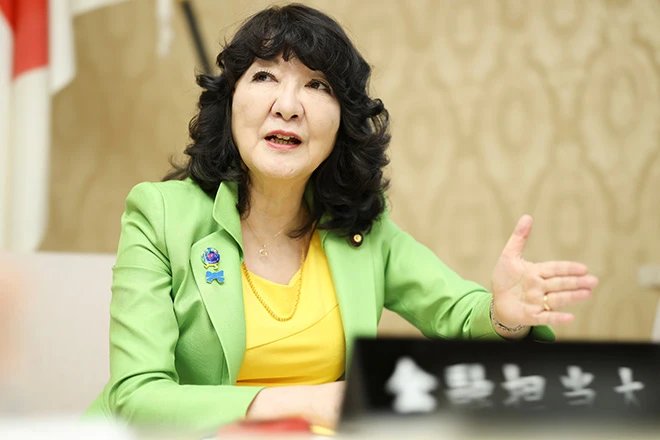
The financial industry is entering a new era of risk as advanced artificial intelligence models, such as Claude Mythos, gain the ability to expose vulnerabilities in core systems within minutes, according to Satsuki Katayama, minister of state for financial services.
In a recent interview with The Asahi Shimbun, Katayama described high-performance AI models as a serious but manageable threat, saying that gaining access to Mythos allowed Japanese authorities to assess its capabilities firsthand.
The minister argued that while Japan needs its own AI capabilities for national security, the country should focus on strengths in robotics, manufacturing and defense technologies instead of competing head-on against U.S. and Chinese industry leaders.
She added that China’s strategy of promoting open-weight models, as symbolized by DeepSeek, could create new risks in cybersecurity and intelligence gathering even though some U.S. technology companies laud its benefits.
Excerpts from the interview follow:
* * *
Asahi: You described the threat posed by Claude Mythos, the U.S. company Anthropic’s advanced AI model, as a “clear and present danger.” What kind of danger does it pose?
Katayama: What made Mythos shocking is its ability to identify weaknesses in core systems within an extremely short period. There are reports of flaws being found not in hours, but in 30 minutes or even five minutes.
Until now, we have relied on programmers to find and patch vulnerabilities, but such labor-intensive approaches may no longer be able to keep pace.
Cybercrime tends to inflict its greatest damage on financial institutions.
That is why we needed the United States to grant us access to Mythos to first grasp what is happening on the ground.
Q: Was securing access worthwhile?
A: It was immensely valuable. It has allowed us to gain a firsthand understanding of the capabilities of frontier AI models.
It represents a risk that should be taken seriously, but it is not something that should be feared excessively. Being able to make that assessment alone demonstrates the value of gaining access.
Major U.S. banks are said to have discovered about 10,000 vulnerabilities through AI-based testing, but fixing all of them would take nearly a year.
As a result, the industry’s mindset has shifted toward prioritizing responses to the most dangerous issues first.
Beyond strengthening defenses, access to Mythos helps cultivate the personnel and organizational structures capable of dealing with AI.
Q: Are financial institutions making progress in preparing for the threats that high-performance AI models pose to the financial system?
A: Since spring, megabanks and other major banks have accelerated their learning curve, reaching a stage where they can establish defenses on par with U.S. banks.
Large regional banks should also be able to catch up. Credit cooperatives, credit unions, Japan Post Bank and agricultural cooperatives can implement coordinated defenses because they operate shared or common systems.
The financial system is a form of public infrastructure, and depositors must be protected regardless of where they hold their accounts.
There must be no regional disparities in defensive capabilities. We intend to proceed on the principle that no one should be left behind.
Q: How should Japan respond to high-performance AI models from China?
A: Not long ago, it was said that China would need at least six months to catch up with the United States. Recently, however, some observers believe it has virtually closed the gap.
Moreover, as exemplified by companies such as DeepSeek, the country has adopted a strategy of spreading the technology in an open format by releasing AI design information for anyone to use.
While that approach is convenient, there is no guarantee that Chinese-developed AI models will not be used for cyberattacks or intelligence gathering.
Given our relationships with China, North Korea and Russia, risks to the financial system have undoubtedly heightened.
At the same time, there are strong voices, particularly among major U.S. technology companies, supporting the advantages of China’s open-weight model approach, which makes key AI information publicly available.
This will likely become a subject of international discussions within forums such as the Group of Seven.
Q: As the United States and China compete for AI leadership, is Japan left with no choice but to follow their lead?
A: From a national security perspective, Japan needs its own AI capabilities.
It is also important to have large data centers that can process information domestically, without relying on overseas data or source code.
That said, it is not realistic to expect Japan to compete and catch up with OpenAI, Google or Chinese companies on the same playing field.
What matters is maintaining indigenous AI capabilities in areas where they are necessary, while concentrating resources on “physical fields” where Japan holds a competitive edge, such as robotics and manufacturing, as well as on defensive technologies.
Rather than trying to build everything in-house, we need to adopt the mindset of leveraging overseas technologies as well.
Q: Faced with the rise of Chinese AI, will Japan’s approach center primarily on alignment with the United States?
A: We have no choice but to take that path for the time being. The United States was the first country to produce frontier AI models, and it also has mechanisms for evaluating them.
However, the United States does not necessarily have a complete picture of what is happening in China.
I am personally interested in that point, and I hope to exchange views with U.S. Treasury Secretary Scott Bessent as soon as possible.
Q: How should the international community confront an era in which AI could destabilize the financial system?
A: This is no longer an issue that any single country can address alone.
In a conversation I had with the head of an international organization, a major topic was how AI is ushering in an entirely new dimension of risk for financial institutions.
Up to now, financial crises have revolved around capital inadequacy or liquidity shortages.
Today, however, we face a new breed of threat emerging from cyberspace that could undermine the very foundation of the financial system.
Individual countries cannot tackle this challenge in isolation. It is vital to work together internationally through the G-7 and the Group of Twenty.
The issue may be on the agenda at the G-20 meeting of finance ministers and central bank governors beginning at the end of August. Japan intends to raise necessary questions.
(This article is based on an interview by Toshiki Horigome.)
* * *
Satsuki Katayama, 67, has served as finance minister and minister of state for financial services since October. A graduate of the University of Tokyo and former Finance Ministry bureaucrat, Katayama was elected to the Lower House in 2005 and to the Upper House in 2010, where she is serving her third term.
Author

- Ytv Market News
- Share-market news writer and analyst with deep experience covering equities, commodities, forex, and cryptocurrencies for readers in the USA, UK, Canada, and Australia. Ytv Market News delivers timely market updates, practical trading insights, and clear explanations of macro and company-level catalysts that move prices. Combines on-the-ground financial reporting with technical analysis, using concise charts and actionable ideas to help investors and traders make smarter decisions.
Latest entries
 Crypto NewsAugust 25, 2026Bitcoin Exchange Coinbase Announces Listing of Two Altcoins on Spot Trading Platform! Here Are the Details
 Investing InsightsAugust 25, 2026Mexico GDP Grows 1.4% in Q2 Quarter-on-Quarter; Recovery Underway but Inflation Reacceleration Fuels Rate Hike Expectations — BigGo Finance
 GermanyAugust 25, 2026Shares drift ahead of Nvidia earnings; oil wobbles
 CanadaAugust 25, 2026The money conversation most roommates never have, until it’s too late

