
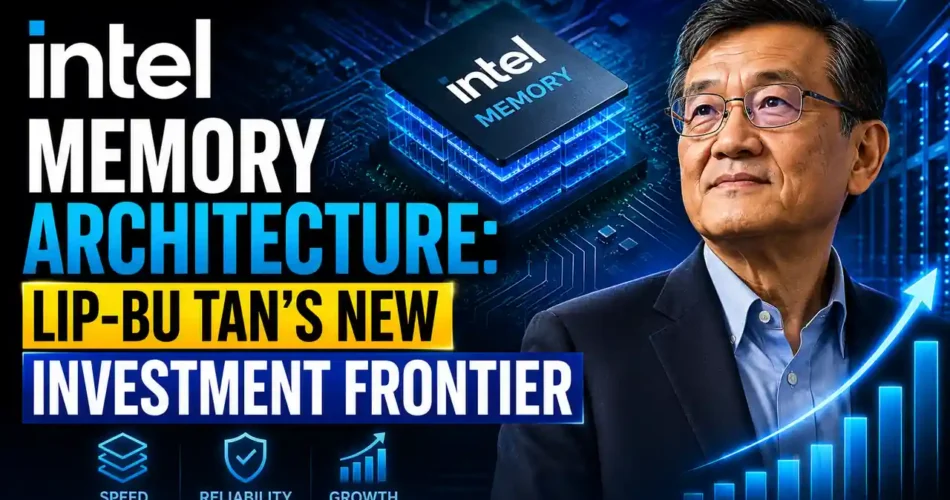
Intel’s Lip-Bu Tan Sees New Frontier in Memory Architecture — Market Talk
Intel’s leadership is signaling a strategic pivot toward rethinking how memory is designed, integrated, and scaled across its product roadmap. In recent market commentary, Intel executive Lip-Bu Tan has highlighted memory architecture as a critical frontier for performance gains, cost efficiency, and competitive differentiation in an era where traditional scaling is slowing. For investors, this shift underscores where Intel may place its R&D bets, how it plans to compete with rivals, and what it could mean for the company’s long-term profitability in data centers, AI workloads, and client computing.
Why Memory Architecture Matters Now
The End of Easy Scaling
For decades, the semiconductor industry relied on Moore’s Law-like scaling to deliver regular performance improvements. As transistor geometries shrink, gains have become harder and more expensive to achieve. At the same time, workloads in AI, high-performance computing, and real-time analytics are increasingly memory-bound rather than compute-bound. In simple terms, chips are often waiting on data rather than being limited by raw calculation speed.
This bottleneck makes memory architecture—how memory is organized, accessed, and connected to compute—a decisive factor in overall system performance. Improvements here can yield large efficiency gains without necessarily chasing the most aggressive node transitions.
The Rise of Heterogeneous and Chiplet Designs
Modern processors are moving toward heterogeneous designs: mixing different types of cores, accelerators, and memory technologies on a single package. Chiplet-based architectures, where multiple smaller dies are interconnected, further complicate memory design. In this context, how Intel structures its memory hierarchy (caches, on-package memory, DRAM interfaces, and emerging non-volatile options) will heavily influence:
- Latency and bandwidth for AI and data-center workloads
- Power efficiency per operation
- Total cost of ownership for cloud and enterprise customers
Tan’s emphasis on memory architecture suggests Intel sees outsized returns from optimizing these layers rather than focusing solely on raw CPU frequency or core counts.
What Lip-Bu Tan Is Highlighting
A Strategic Lens, Not Just a Technical Detail
While specific technical roadmaps are typically shared under NDA or in detailed technical briefings, Tan’s public remarks frame memory architecture as a strategic lever. For investors, the key takeaways are:
- Differentiation: Intel aims to distinguish its products through system-level efficiency, not just headline specs.
- Integration: Tighter integration between compute, memory, and packaging technologies is central to Intel’s next-generation platforms.
- Ecosystem Play: Memory architecture improvements often require coordination with DRAM vendors, OEMs, and cloud providers, pointing to a broader ecosystem strategy.
This aligns with Intel’s broader push to regain technology leadership and margin strength in a highly competitive landscape.
Implications for Product Segments
Data Center and AI
In data centers, memory bandwidth and capacity directly affect throughput for large language models, recommendation engines, and scientific simulations. Architectural innovations—such as high-bandwidth memory (HBM), advanced cache hierarchies, and memory-centric interconnects—can:
- Reduce time-to-result for AI training and inference
- Lower energy per operation, a critical metric for hyperscalers
- Enable new SKU tiers optimized for specific workload profiles
If Intel can deliver compelling memory-centric designs, it could win back share in AI accelerators and server CPUs, where competition from AMD, NVIDIA, and custom silicon is intense.
Client Computing (PCs and Laptops)
For client devices, memory architecture affects:
- Boot times and application responsiveness
- Battery life through more efficient data movement
- Thermal headroom, allowing sustained performance in thin-and-light designs
Tan’s focus suggests future Intel client platforms may emphasize “per-watt performance” driven by smarter memory use, not just higher clock speeds. This could be particularly relevant as AI PCs become mainstream, with on-device models requiring fast, efficient access to large datasets.
Embedded and Edge
Edge and embedded markets often prioritize deterministic latency, reliability, and power efficiency over raw peak performance. A refined memory architecture can help Intel tailor solutions for:
- Industrial automation
- Automotive compute platforms
- Telecom and networking equipment
These segments offer stable, long-cycle revenue streams that can complement Intel’s more cyclical PC and data-center businesses.
Competitive Landscape and Investor Risks
Rivals Are Also Moving
Intel is not alone in prioritizing memory-centric design:
- Competitors are integrating advanced packaging and high-bandwidth memory into their flagship products.
- Custom silicon efforts by large cloud providers often optimize memory paths for specific workloads.
- Startups and specialized vendors are exploring novel memory technologies and architectures.
This means Intel must not only innovate but also execute flawlessly on manufacturing, yield, and time-to-market to capture value from its architectural bets.
Execution and Timing Risks
For investors, several risks stand out:
- Roadmap Slippage: Delays in bringing new memory-centric designs to volume production could erode confidence.
- Ecosystem Dependencies: Advances may depend on DRAM partners, foundry capacity, and customer adoption timelines.
- Margin Pressure: Heavy R&D and packaging costs could weigh on near-term profitability if revenue ramps are slower than expected.
Tan’s messaging implies confidence, but the market will judge Intel by shipped products, benchmark results, and customer wins—not just strategic narratives.
What This Could Mean for Intel’s Valuation Story
From “Process Race” to “System Efficiency”
Historically, Intel’s valuation has been closely tied to process-node leadership. A stronger emphasis on memory architecture and system-level efficiency could broaden the investment story:
- Multiple levers for performance gains beyond node shrinks
- Potential for premium pricing on efficiency-optimized SKUs
- Better alignment with customer priorities around TCO and energy use
If executed well, this could support a more durable margin profile and reduce the binary nature of “node win/loss” narratives.
Catalysts to Watch
Investors tracking this theme should monitor:
- Announcements of new platforms highlighting memory-centric features
- Independent benchmarks showing latency, bandwidth, and efficiency gains
- Customer commitments from major cloud and enterprise buyers
- Updates on packaging technologies and partnerships with memory vendors
These signals will help gauge whether Intel’s memory architecture push is translating into tangible competitive advantages.
FAQ
Q1: Who is Lip-Bu Tan at Intel?
Lip-Bu Tan is a senior Intel executive involved in shaping the company’s product and technology strategy. In public market commentary, he has emphasized memory architecture as a key area for future performance and efficiency gains.
Q2: Why is memory architecture more important now?
As transistor scaling slows and workloads become more data-intensive, many systems are limited by how fast and efficiently they can move data, not just by raw compute power. Optimizing memory architecture helps overcome these bottlenecks.
Q3: How could this strategy affect Intel’s competition with AMD and NVIDIA?
If Intel delivers superior memory-centric designs, it could improve performance per watt and total cost of ownership for customers, helping it compete more effectively in AI, data centers, and high-end client segments where AMD and NVIDIA are strong.
Q4: Does this mean Intel is de-emphasizing process nodes?
Not necessarily. Process technology remains critical, but Intel appears to be broadening its focus to include system-level efficiency, packaging, and memory hierarchy as additional sources of differentiation.
Q5: What should investors watch next?
Key indicators include new product launches emphasizing memory and packaging innovations, independent performance and efficiency benchmarks, major customer design wins, and updates on Intel’s execution against its roadmap.
References
Department of Commerce announces $874M in CHIPS Act incentives for semiconductor R&D (NIST, 2026)
NIST CHIPS for America Program overview
CHIPS Act of 2022 Provisions and Implementation (Congressional Research Service)
This article is intended for informational purposes and does not constitute investment advice. Investors should conduct their own research and consider their risk tolerance before making any investment decisions.

