

Personal computing and printing company HP (NYSE:HPQ) beat Wall Street’s revenue expectations in Q2 CY2026, with sales up 12.5% year on year to $15.68 billion. Its non-GAAP profit of $0.83 per share was 20% above analysts’ consensus estimates.
Is now the time to buy HP? Find out in our full research report.
HP (HPQ) Q2 CY2026 Highlights:
- Revenue: $15.68 billion vs analyst estimates of $14.58 billion (12.5% year-on-year growth, 7.5% beat)
- Adjusted EPS: $0.83 vs analyst estimates of $0.69 (20% beat)
- Management raised its full-year Adjusted EPS guidance to $3.24 at the midpoint, a 8% increase
- Operating Margin: 5.7%, in line with the same quarter last year
- Free Cash Flow Margin: 9.9%, similar to the same quarter last year
- Market Capitalization: $27 billion
“In the third quarter we increased both total sales and share in premium products and continued to attract new customers with innovations in WXP, Print, workstations and AI PCs. Our ongoing strategy to address environmental constraints led to meaningful improvements in memory supply and higher fulfillment rates,” said Bruce Broussard, Interim CEO, HP Inc. “The strong foundation we are building as a trusted edge platform positions us well to lead as AI evolves and allows us to help customers improve their AI economics, security, latency and governance.”
Company Overview
Born from the legendary Silicon Valley garage startup founded by Bill Hewlett and Dave Packard in 1939, HP (NYSE:HPQ) designs and sells personal computers, printers, and related technology products and services to consumers, businesses, and enterprises worldwide.
Revenue Growth
A company’s long-term sales performance is one signal of its overall quality. Any business can put up a good quarter or two, but the best consistently grow over the long haul.
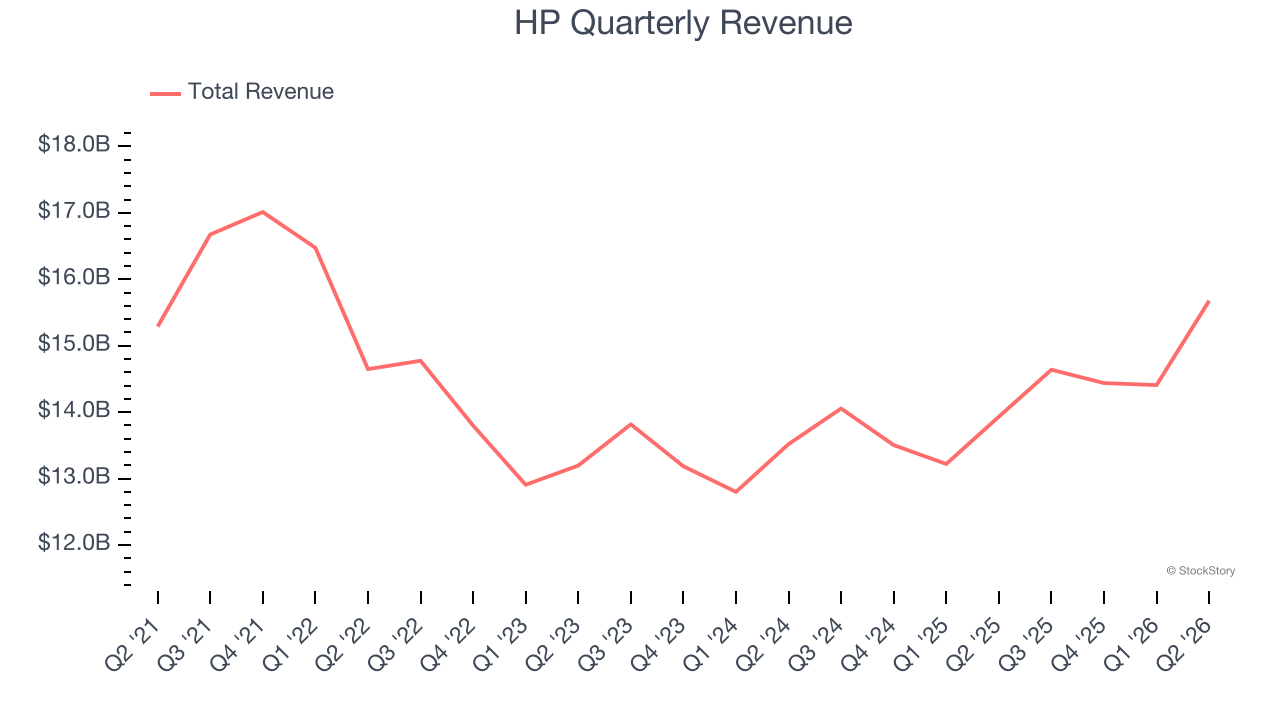
With $59.16 billion in revenue over the past 12 months, HP is a behemoth in the business services sector and benefits from economies of scale, giving it an edge in distribution. This also enables it to gain more leverage on its fixed costs than smaller competitors and the flexibility to offer lower prices. However, its scale is a double-edged sword because finding new avenues for growth becomes difficult when you already have a substantial market presence. To accelerate sales, HP likely needs to optimize its pricing or lean into new offerings and international expansion.
As you can see below, HP struggled to increase demand as its $59.16 billion of sales for the trailing 12 months was close to its revenue five years ago. This shows demand was soft, a poor baseline for our analysis.
Long-term growth is the most important, but within business services, a half-decade historical view may miss new innovations or demand cycles. HP’s annualized revenue growth of 5.3% over the last two years is above its five-year trend, suggesting some bright spots. 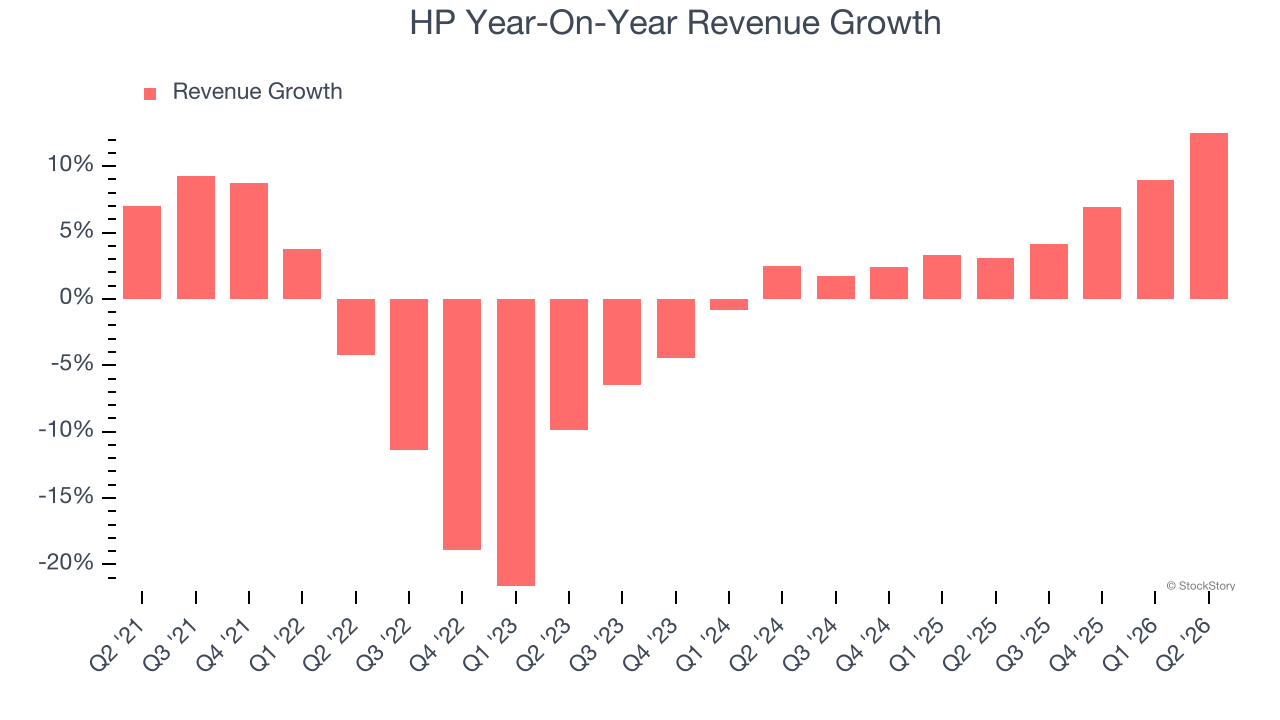
We can better understand the company’s revenue dynamics by analyzing its most important segments, Commercial Personal Systems and Commercial Printing, which are 54.7% and 25% of revenue. Over the last two years, HP’s Commercial Personal Systems revenue (desktops, laptops, etc.) averaged 10.9% year-on-year growth. On the other hand, its Commercial Printing revenue (commercial or industrial printers) averaged 2.6% declines. 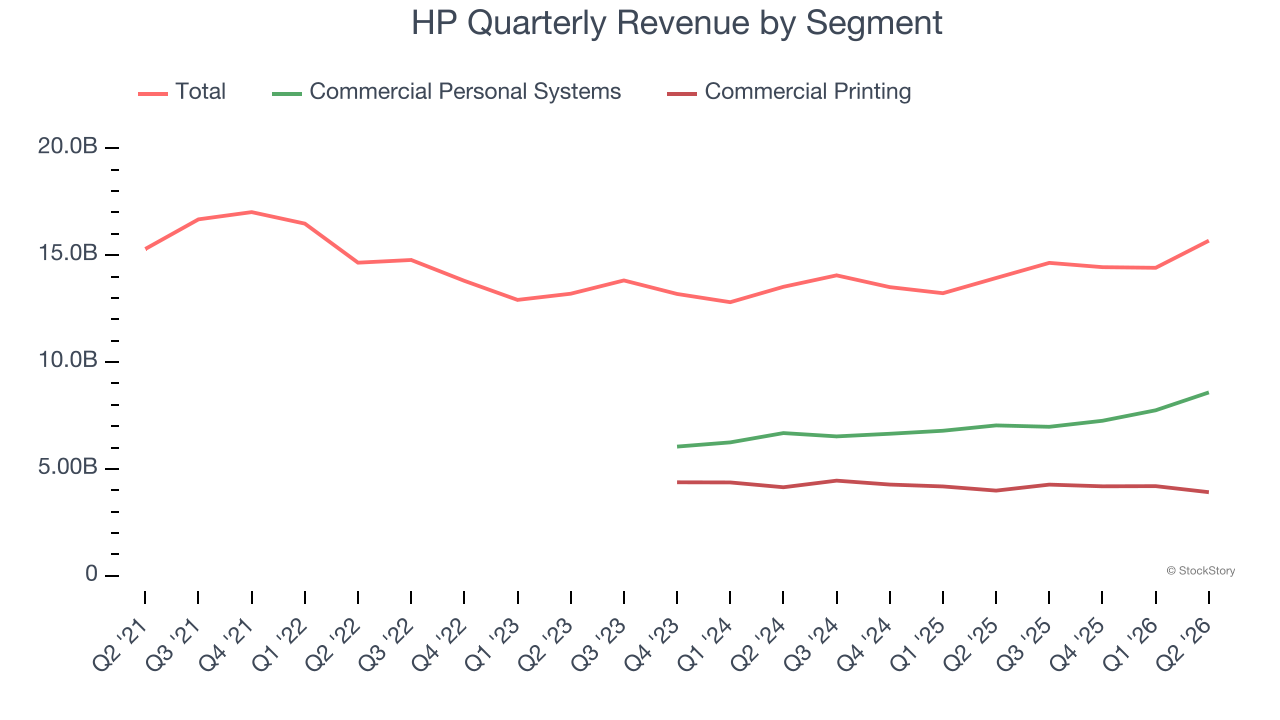
This quarter, HP reported year-on-year revenue growth of 12.5%, and its $15.68 billion of revenue exceeded Wall Street’s estimates by 7.5%.
Looking ahead, sell-side analysts expect revenue to decline by 3.2% over the next 12 months, a deceleration versus the last two years. This projection doesn’t excite us and implies its products and services will face some demand challenges.
ALSO WORTH WATCHING: Nvidia’s Quiet Partner. Nvidia’s chips cost a hundred grand. The connectors that make them work cost even more. One company makes them all.
Every AI server needs specialized infrastructure the chip companies don’t make. High-speed cables. Power connectors. Thermal sensors. This 90-year-old company built a monopoly on it. The AI boom just started. This stock is still flying under the radar. Claim The Stock Ticker Here for FREE.
Adjusted Operating Margin
HP was profitable over the last five years but held back by its large cost base. Its average adjusted operating margin of 8% was weak for a business services business.
Looking at the trend in its profitability, HP’s adjusted operating margin decreased by 1.5 percentage points over the last five years. HP’s performance was poor no matter how you look at it – it shows that costs were rising and it couldn’t pass them onto its customers.
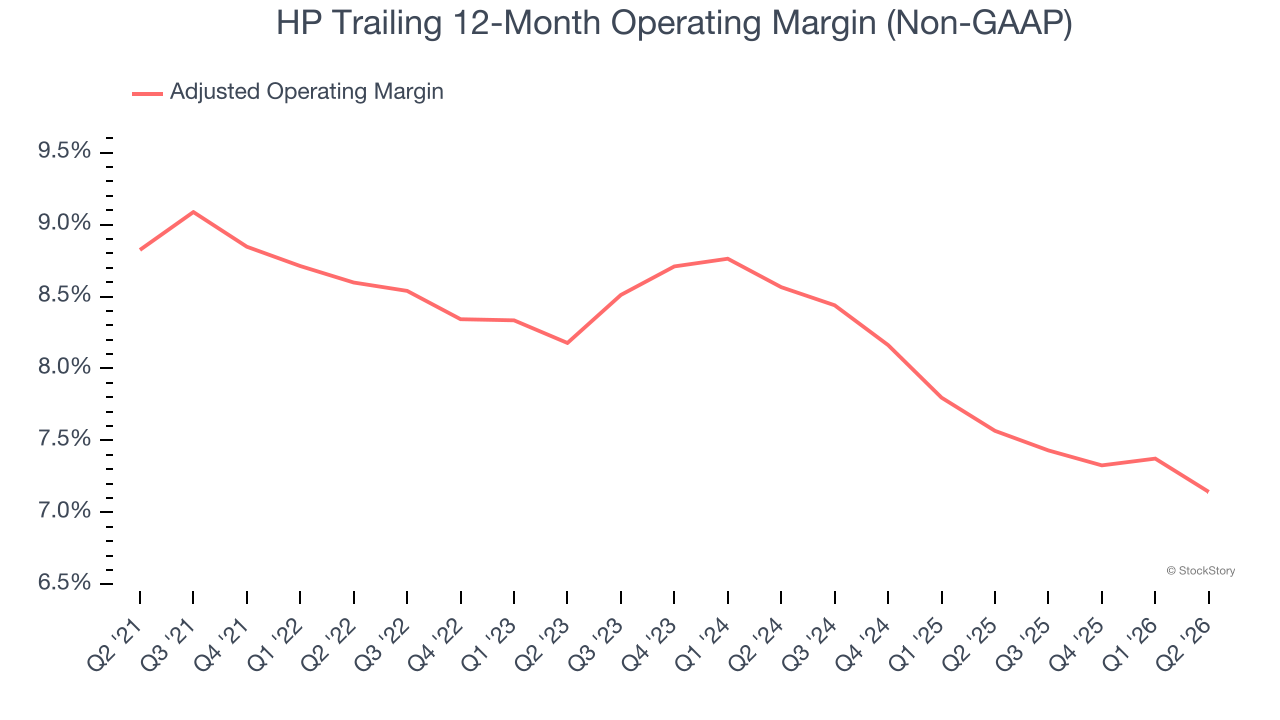
In Q2, HP generated an adjusted operating margin profit margin of 6.3%, in line with the same quarter last year. This indicates the company’s overall cost structure has been relatively stable.
Earnings Per Share
We track the long-term change in earnings per share (EPS) for the same reason as long-term revenue growth. Compared to revenue, however, EPS highlights whether a company’s growth is profitable.
HP’s EPS was flat over the last five years, just like its revenue. This performance was underwhelming across the board.
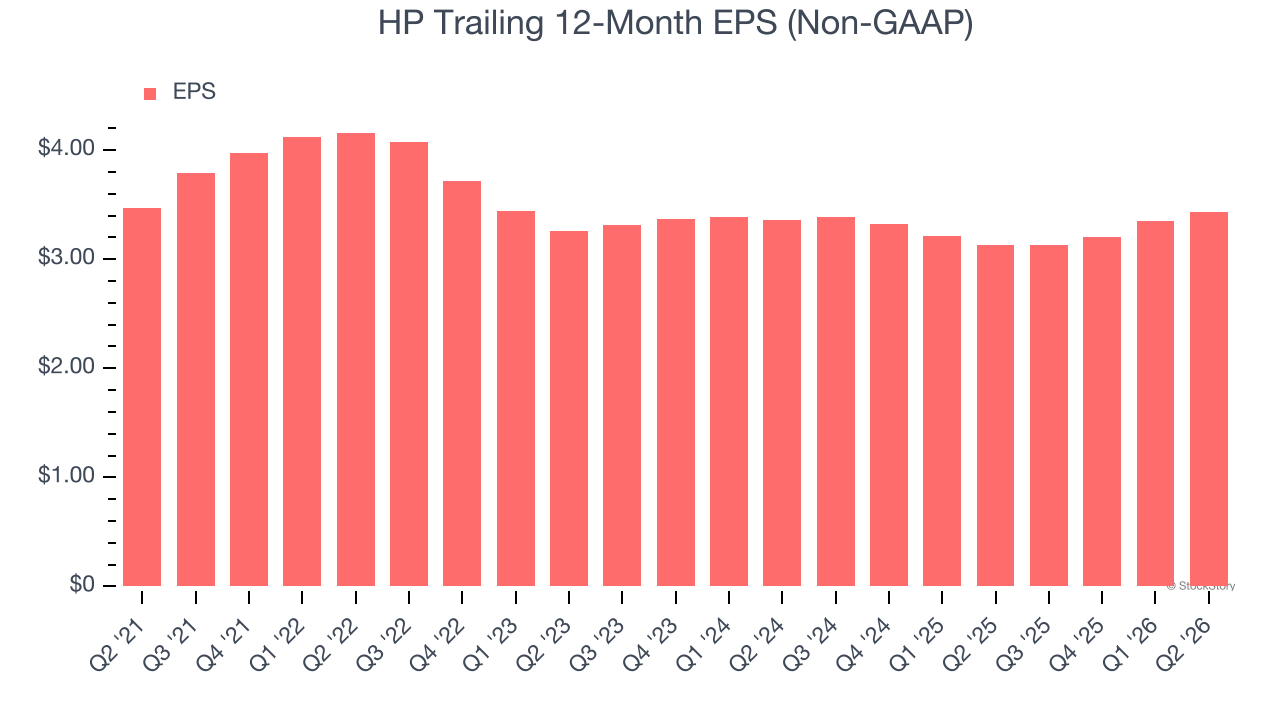
Like with revenue, we analyze EPS over a more recent period because it can provide insight into an emerging theme or development for the business.
HP’s two-year annual EPS growth of 1% was subpar and lower than its 5.3% two-year revenue growth.
Diving into the nuances of HP’s earnings can give us a better understanding of its performance. While we mentioned earlier that HP’s adjusted operating margin was flat this quarter, a two-year view shows its margin has declined. This was the most relevant factor (aside from the revenue impact) behind its lower earnings; interest expenses and taxes can also affect EPS but don’t tell us as much about a company’s fundamentals.
In Q2, HP reported adjusted EPS of $0.83, up from $0.75 in the same quarter last year. This print easily cleared analysts’ estimates, and shareholders should be content with the results. Over the next 12 months, Wall Street expects HP’s full-year EPS to shrink by 17.9% from $3.43 to $2.82.
Key Takeaways from HP’s Q2 Results
It was good to see HP beat analysts’ EPS expectations this quarter. We were also excited its EPS guidance for next quarter outperformed Wall Street’s estimates. Zooming out, we think this was a solid print. Investors were likely hoping for more, and shares traded down 8.6% to $27.89 immediately after reporting.
So do we think HP is an attractive buy at the current price? When making that decision, it’s important to consider its valuation, business qualities, as well as what has happened in the latest quarter. We cover that in our actionable full research report which you can read here (it’s free).
Source link
Author

- Ytv Market News
- Share-market news writer and analyst with deep experience covering equities, commodities, forex, and cryptocurrencies for readers in the USA, UK, Canada, and Australia. Ytv Market News delivers timely market updates, practical trading insights, and clear explanations of macro and company-level catalysts that move prices. Combines on-the-ground financial reporting with technical analysis, using concise charts and actionable ideas to help investors and traders make smarter decisions.
Latest entries
 CanadaAugust 26, 2026OverActive Media Reports Second Quarter 2026 Results; Operating Expenses Narrow 17%, Gross Margin Expands to 52% Year-to-Date
![Volume Tide [JOAT] — Indicator by officialjackofalltrades — TradingView](https://ytvmarketnews.com/wp-content/uploads/2026/08/hGGxsbCv_big-1200x675.png) Trading IndicatorsAugust 26, 2026Volume Tide [JOAT] — Indicator by officialjackofalltrades — TradingView
Trading IndicatorsAugust 26, 2026Volume Tide [JOAT] — Indicator by officialjackofalltrades — TradingView Crypto NewsAugust 26, 20262 Important Binance Updates Concerning ETH and Other Altcoin Traders
 Crypto NewsAugust 26, 2026China-Supported Botnet Seized: FBI Halts Espionage on Fed and NASA