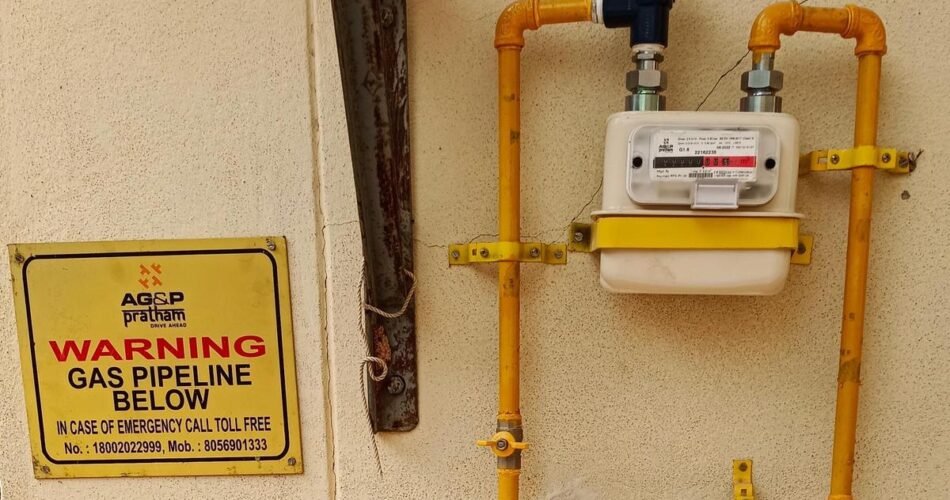

India currently has about 17.4 million domestic PNG connections.
The government will offer city gas distributors an additional 200 standard cubic metres (SCM) of lower-priced domestic natural gas for every new billed household piped-gas connection, stepping up incentives for companies to accelerate the switch from LPG to piped gas to household kitchens for cooking.
The incentive, approved by the government and effective from September 1, will apply to incremental domestic piped cooking gas, or piped natural gas (PNG), connections above a threshold set for each geographical area.
The scheme is aimed at turning inactive, unbilled connections into working ones and expanding PNG networks into new areas, according to an official statement issued by the oil ministry.
India currently has about 17.4 million domestic PNG connections.
The additional allocation of domestically produced, lower-priced APM (administered price mechanism) gas will allow eligible city gas distribution companies to substitute some of the costlier Liquefied Natural Gas (LNG) they currently procure for their Compressed Natural Gas (CNG) transport business, lowering their overall gas-sourcing costs.
The resulting savings are expected to cut the payback period on capital spending for domestic PNG connections to about three years from around 10 years, strengthening the financial incentive for distributors to expand household connections, the government said.
The scheme will be implemented in two six-month tranches.
The move is part of a broader government push to increase household access to PNG, which it describes as a cleaner, safer and more convenient alternative to LPG cylinders and traditional cooking fuels.
The push to expand PNG gained momentum during the West Asia crisis earlier this year, when disruptions to LPG supplies prompted the government to seek ways to reduce dependence on cylinders, particularly in the commercial sector. While domestic household LPG supplies were prioritised, the government encouraged city gas distributors to accelerate PNG connections and offered incentives for consumers and businesses to switch.
Since March, more than 5 lakh PNG connections have been gasified, while over 5.7 lakh customers have registered for new connections, according to government data. The government also required consumers with PNG connections to surrender their domestic LPG connections and launched a campaign to promote the shift to piped gas.
The government has also sought to reduce regulatory hurdles for gas infrastructure, standardise right-of-way charges and encourage states to lower VAT on natural gas to 5 per cent. Several states have already reduced the tax, according to the statement.
A nationwide PNG Drive 2.0 includes awareness campaigns, efforts to convert LPG-using housing societies and a facility for households to surrender LPG cylinders. A unified digital portal for applying for and tracking new PNG connections is also under development.
The incentive scheme is intended to make household PNG expansion more financially attractive for city gas distributors, while encouraging more consumers to shift to piped cooking gas.
Under the scheme, eligible CGD companies will receive an additional 200 SCM of domestically produced APM gas for every incremental billed domestic PNG connection achieved above the threshold set for their respective geographical area during the performance period.
The programme will be implemented in two six-month tranches.
The additional allocation of relatively cheaper domestic gas is intended to replace more expensive liquefied natural gas that CGD (city gas distribution) companies currently procure for their compressed natural gas transport business, reducing their overall gas-sourcing costs, the ministry said.
The savings are expected to cut the payback period on capital expenditure for domestic PNG connections to about three years from roughly 10 years, providing CGD companies with a stronger financial incentive to expand household connections, according to the government.
The initiative is part of a broader government effort to expand access to natural gas and encourage households to shift toward piped cooking fuel.
Unlike LPG cylinders, PNG is supplied continuously through pipelines and is billed according to metered consumption. The government says the fuel can also improve household convenience and safety by reducing the need to store and handle cylinders.
PNG is also a cleaner-burning fuel than several conventional cooking fuels, potentially reducing indoor pollutants and carbon emissions.
The latest incentive scheme, covering both APM and non-APM gas allocations, is intended to strengthen the financial case for CGD companies to activate existing connections and accelerate the creation of new household connections as India expands its piped gas network.
Published on August 19, 2026
Source link