

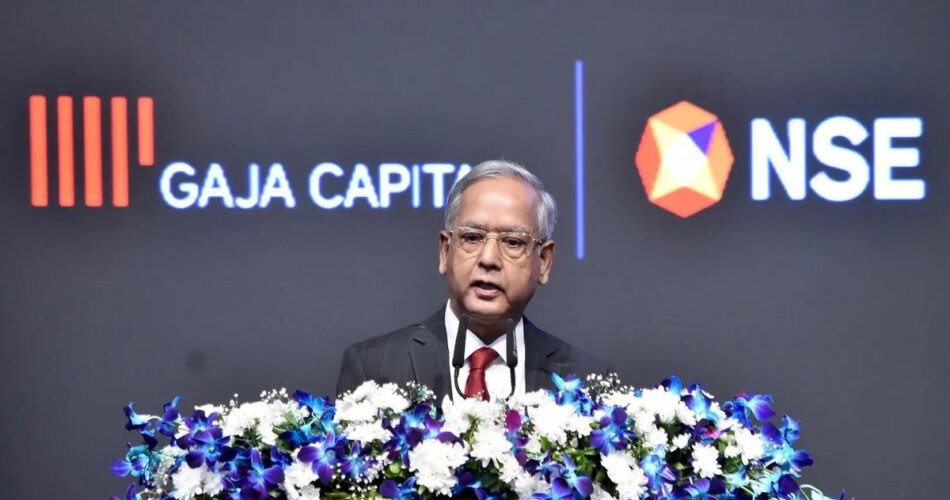
Gaja Alternative Asset Management, which operates under the Gaja Capital brand, made its market debut on Wednesday at a premium of about 16 per cent to its ₹160 issue price. The ₹550-crore IPO was subscribed 31.33 times. The company’s fresh issue of ₹450 crore is to be used mainly for sponsor commitments to existing and proposed funds and repayment of a bridge loan. In an interview with businessline, UK Sinha, Non-executive chairman of Gaja Alternative Asset Management and former SEBI chairman, speaks about the evolution of the AIF industry, exits for private-market investors and the implications of Gaja’s listing.
What does Gaja’s listing change for an alternative asset manager?
An alternative asset management company like Gaja, has basically three streams of business. One is the management fees that they get. Second is the return that they get on their invested companies above a certain hurdle, called carry. And third is a sponsor commitment.
SEBI regulations mandate asset managers to invest minimum 2.5 per cent of the size of your fund, in order to have skin in the game.
So, this listing gives enough firepower to Gaja and any company which gets listed in future that they can make a sponsor contribution, removing the growth constraint. Of course, you have to have the capacity and manpower to be able to float two to six funds at a time, but the capital part is taken care of.
Do you expect other AIFs to list?
I want to congratulate SEBI and commend them for their decision to allow this listing of Gaja Alternative. This is a very far-sighted move, a very forward-looking move. It also shows SEBI’s confidence that the regulations surrounding listed companies are tight and strong enough to give them confidence. The quarterly reporting, the rules regarding prevention of insider trading, disclosure norms, all those things are now proven in India to be very tight.
That has given SEBI the confidence that even if an alternative asset manager is getting listed today, so far as the interest of the retail investor is concerned, there is enough protection. I personally feel that based on what happened here today with regard to Gaja, many AIFs will try to get listed. And that will give them additional support or firepower to invest in the innovation economy.
How do you see the first AIF listing in the history of financial-sector businesses getting listed?
Allowing financial services companies to get listed and get money from retail has been a policy dilemma and a policy challenge all the time. Banks were allowed to list because banks need capital. Then several broking firms got listed after rules were put in place around segregation of client and proprietary money and disclosure requirements. Mutual fund asset management companies also had to address the question of whether listing could create a conflict with scheme investors, but safeguards were put in place. Depositories have been listed and then came exchanges. When this matter came before me at SEBI, I was very determined that we have to move forward. So, I came out with this idea of no self-listing. Bombay Stock Exchange is listed on NSE. MCX is listed on other exchanges.
Listing should not be taken as something which is not to be touched with a barge pole. Listing is something which is part of natural growth. If anything, listing should ideally make any company more transparent to investors.
How important is the alternatives industry to funding innovation and startups?
The government is very worried about the development of the innovation sector in the country. We know what China is doing, what the rest of the world is doing, and how the future lies in technology and innovation across sectors.
The government itself has set up fund-of-funds programmes and is putting money into funds floated by AIFs. Look at the need of the country and the realisation that there is a need even at the highest levels in government.
What Gaja’s listing does for the industry is in institutionalising alternatives AMCs which is a win-win because they can raise institutional capital and in turn make more investments in innovation through their AIF funds. So, in my view, it will give a serious boost to the start-up ecosystem.
Does listing raise any risks because the asset manager will now have public shareholders?
My position is that in the Indian market, safeguards are already in existence through the Prevention of Insider Trading Regulations, listing obligations and disclosure requirements. They are quite serious and stringent.
If anything market-sensitive or unpublished price-sensitive information is happening with your company, you have to inform the exchange. Those who fail to disclose suffer consequences. SEBI is very strict on that.
Then there is the constitution of the board, independent directors, auditors, proxy firms and other gatekeepers. I am not saying that nothing will go wrong in any listed company tomorrow. What I am saying is that if anything goes wrong in a listed company, they will be seriously penalised.
How has the AIF industry changed since 2012?
Prior to 2012 in India, we did not have a proper framework. We had venture capital regulations, but that also had serious problems. There were foreign venture capital regulations and most of the people who wanted to invest in India from abroad were following the FDI policy. So, it was all very confusing and the market was not growing.
SEBI came out with the AIF regulations and the beauty is that all possible scenarios were examined and taken into consideration. So, we have AIF I, AIF II and AIF III. When AIF regulation was floated, many financial sector companies in India decided that this is a very well laid-out regulation and they would like to come under this. The AIF industry has contributed a lot towards the growth of the startup ecosystem.
What has changed on exits for AIF investors?
There used to be one worry in the minds of foreigners and also other experts that, well, we are investing in this industry but does India offer an exit or not?
So, in 2023 and in 2024, there were a number of exits which took place. If you are a foreign investor or domestic investor in an AIF or in any company where AIF had invested money, those companies could then get listed and the earlier investors, the institutional investors, got an opportunity to exit.
So, the full cycle was completed. You enter into an AIF, you invest in a particular company, the company grows, you nurture it and then the company is mature enough, it is getting listed, you can get an exit. If you want to stay, you can. But India was earlier criticised or understood to be a market where exit is very difficult, so that was proven wrong.
Source link
Author

- Ytv Market News
- Share-market news writer and analyst with deep experience covering equities, commodities, forex, and cryptocurrencies for readers in the USA, UK, Canada, and Australia. Ytv Market News delivers timely market updates, practical trading insights, and clear explanations of macro and company-level catalysts that move prices. Combines on-the-ground financial reporting with technical analysis, using concise charts and actionable ideas to help investors and traders make smarter decisions.
Latest entries
 Stock Market VideosAugust 27, 2026Is The Silver Rally Over? Tavi Costa Breaks Down The Sell-Off
 AustraliaAugust 27, 20262 ASX mining shares Shaw and Partners says could return 150% to 250%
 Crypto NewsAugust 27, 2026SEC moves crypto custody rule forward with White House review
 Politics News TodayAugust 27, 2026Sen Josh Hawley investigates Flock Safety AI surveillance network

