

Freedom Gold Corp. Announces Closing of First Tranche of Private Placement Offering of Units
Freedom Gold Corp. has announced the closing of the first tranche of a private placement offering of units, providing the company with additional capital to support its corporate and working-capital requirements. The financing represents an important step in strengthening the company’s financial position while it continues to advance its broader resource-sector strategy.
The transaction involved the issuance of units consisting of common shares and common share purchase warrants. For investors, the financing is significant because it provides the company with immediate proceeds while also creating the possibility of additional capital if the attached warrants are exercised.
Key Details of the Private Placement
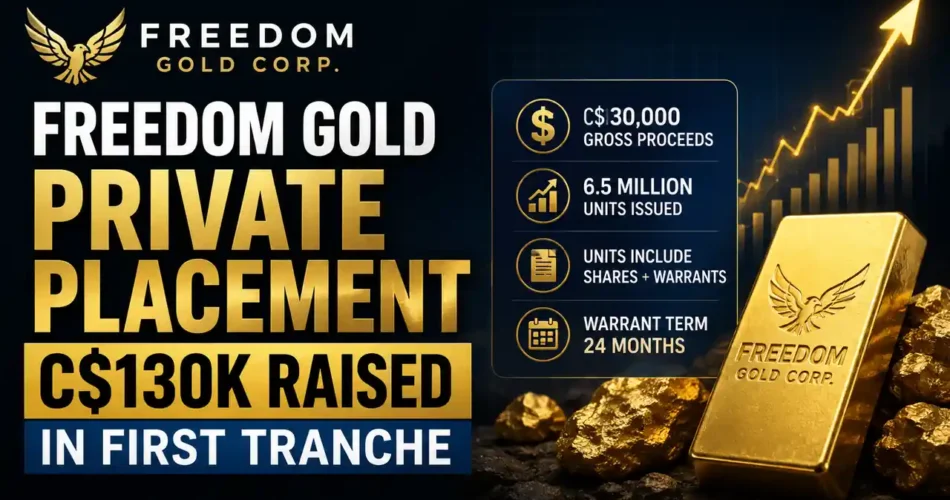
The first tranche of the offering generated approximately C$130,000 in gross proceeds. Freedom Gold issued approximately 6.5 million units at a price of C$0.02 per unit.
- Gross proceeds: Approximately C$130,000
- Units issued: Approximately 6.5 million
- Issue price: C$0.02 per unit
- Unit structure: One common share and one warrant
- Warrant exercise price: C$0.05 per share
- Warrant term: 24 months
- Insider participation: None reported
- Finder’s fees: None reported
- Use of proceeds: General working capital
Understanding the Unit Structure
A unit-based private placement allows investors to receive more than one type of security as part of a single investment. In Freedom Gold’s offering, each unit included one common share and one common share purchase warrant.
Common Shares Provide Immediate Equity Exposure
The common share component gives investors an ownership interest in the company. The issuance of new shares also increases the company’s outstanding share count, which is an important consideration for existing shareholders.
When a company raises capital through the issuance of new shares, existing investors can experience percentage dilution because their ownership represents a smaller proportion of the company’s total shares after the financing.
Warrants Could Provide Additional Capital
The warrants attached to the units give holders the opportunity to purchase additional common shares at C$0.05 per share during the 24-month exercise period.
If the warrants are exercised, Freedom Gold could receive additional funds without conducting another financing for those particular shares. However, warrant exercise is not guaranteed and depends on market conditions, the company’s share price and investors’ decisions.
Why the Financing Matters
Access to capital is particularly important for smaller resource companies because exploration, corporate administration, regulatory compliance and property development can require significant financial resources before projects generate revenue.
The proceeds from this financing are intended for general working-capital purposes. This gives Freedom Gold greater flexibility to meet ongoing corporate obligations and pursue its business plans.
While C$130,000 is relatively modest compared with the financing requirements of larger mining companies, additional working capital can still be meaningful for a junior resource issuer. Maintaining adequate liquidity can help a company continue operations while evaluating its assets and planning future activities.
No Insider Participation Reported
One notable feature of the first tranche is that the company reported no insider participation. Freedom Gold also indicated that no finder’s fees were payable in connection with the financing.
The absence of finder’s fees means the company did not have that additional financing expense associated with the completed tranche. Meanwhile, the absence of insider participation means the financing was not supported by purchases from directors, officers or other insiders, according to the company’s announcement.
Potential Shareholder Dilution
Existing shareholders should consider the potential dilution associated with the private placement.
The immediate issuance of approximately 6.5 million common shares increases the number of shares outstanding. As a result, each existing shareholder’s percentage ownership of Freedom Gold becomes smaller unless that shareholder’s ownership increases proportionally.
The warrants create a second potential source of dilution. If all of the warrants associated with the first tranche are exercised, additional common shares could be issued at C$0.05 per share.
Based on 6.5 million warrants, full exercise could potentially provide approximately C$325,000 in additional gross proceeds. At the same time, the company’s outstanding share count would increase further.
Use of the Financing Proceeds
Freedom Gold intends to use the net proceeds for general working-capital purposes. Such funds can support a range of activities, including corporate administration, professional expenses, regulatory costs, property-related work and strategic planning.
Investors should note that a private placement does not necessarily indicate that a specific exploration program or production milestone will be funded entirely by the proceeds. Junior resource companies often require additional financing as projects move through exploration and development stages.
Resale Restrictions on the Securities
The securities issued under the financing are subject to applicable Canadian securities laws and exchange policies. Private-placement securities generally cannot be freely resold immediately following issuance.
The applicable statutory hold period and other resale restrictions are important considerations for investors because they can affect the liquidity of securities received through a private placement.
Freedom Gold’s Broader Strategy
The financing should also be viewed in the context of Freedom Gold’s broader corporate direction.
The company was previously known as SPOD Lithium Corp. and has subsequently moved toward a gold-focused strategy. Its more recent corporate activities have included initiatives involving mineral properties in Nova Scotia.
This transition means investors should distinguish between historical financing announcements and the company’s current strategic objectives. A financing completed under the company’s former name may have been associated with a different stage of its corporate development.
Importance of Future Exploration Activities
For a resource company, the ultimate value of its assets depends on exploration results, geological potential, permitting, capital availability, development costs and broader commodity-market conditions.
Consequently, the successful completion of a private placement should not be interpreted as evidence that a particular mineral project will ultimately become commercially successful.
What Investors Should Watch Next
Following the financing, investors may want to monitor several developments affecting Freedom Gold.
- Future exploration results and technical updates
- Progress on mineral-property agreements
- Additional private placements or other financing activities
- Changes in the company’s outstanding share count
- Potential exercise of outstanding warrants
- Cash requirements and working-capital levels
- Changes to the company’s strategic direction
These factors can influence both the company’s financial position and the potential investment outlook.
Investor Takeaways
The closing of the first tranche gives Freedom Gold additional working capital while allowing participating investors to receive both common shares and warrants.
The financing has several potential advantages for the company. It provides immediate liquidity, avoids the need to rely solely on existing cash resources and gives the company an opportunity to continue pursuing its corporate objectives.
At the same time, investors should consider the potential disadvantages. New share issuance creates dilution, while future warrant exercises could increase the share count further. The relatively small size of the financing also means that Freedom Gold may need additional capital depending on its future exploration and corporate requirements.
Conclusion
Freedom Gold Corp.’s closing of the first tranche of its private placement represents a new source of working capital for the company. The transaction involved approximately C$130,000 in gross proceeds through the issuance of approximately 6.5 million units at C$0.02 per unit.
Each unit included one common share and one warrant, with the warrants exercisable at C$0.05 per share for 24 months. If exercised, the warrants could provide additional capital while also increasing the company’s outstanding share count.
For investors, the key issues are the company’s use of the funds, its ability to maintain sufficient liquidity, potential future dilution and progress under its current resource strategy. The financing improves near-term financial flexibility, but future performance will ultimately depend on the company’s ability to advance its assets and create shareholder value.
Frequently Asked Questions
What is the Freedom Gold private placement?
It is a private financing in which Freedom Gold issued units containing common shares and common share purchase warrants to raise capital for the company.
How much money did Freedom Gold raise?
The first tranche generated approximately C$130,000 in gross proceeds.
How many units were issued?
Approximately 6.5 million units were issued in the first tranche at C$0.02 per unit.
What does each unit contain?
Each unit consists of one common share and one common share purchase warrant.
What is the warrant exercise price?
The warrants are exercisable at C$0.05 per common share during their 24-month term.
Will the financing dilute existing shareholders?
Yes. The issuance of new shares increases the total number of outstanding shares, which can reduce existing shareholders’ percentage ownership of the company.
Can the warrants create additional dilution?
Yes. If the warrants are exercised, additional common shares will be issued, increasing the company’s outstanding share count.
How will Freedom Gold use the proceeds?
The company plans to use the net proceeds for general working-capital purposes and corporate requirements.
Did company insiders participate?
No insider participation was reported for the first tranche.
What should investors monitor after the financing?
Investors should monitor exploration results, property developments, future financing requirements, warrant exercises, changes in the company’s share count and progress on its broader resource strategy.

