
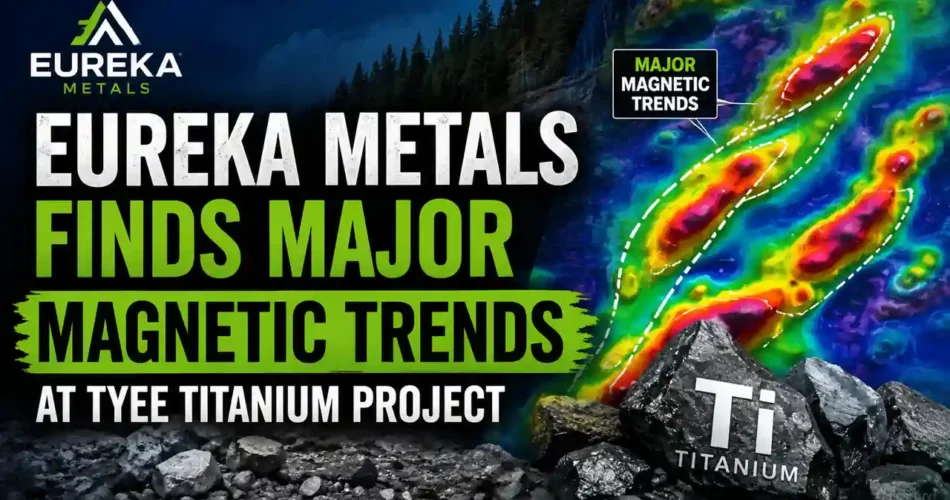
Eureka Metals Identifies Broad Magnetic Trends Across Tyee Titanium Project from High-Resolution Airborne Survey
Eureka Metals Highlights District-Scale Magnetic Trends at Tyee Titanium Project
Eureka Metals Corp. (CSE: ERKA) (OTCQB: UREKF) (FSE: S580) has released initial results from its 2026 high-resolution airborne magnetic and VLF-EM survey over the Tyee Titanium Project in Quebec’s Côte-Nord region. The new geophysical data reveal broad, continuous magnetic trends that host the company’s principal titanium exploration targets, providing a stronger framework for prioritizing follow-up work across the now 109 km² property.
Survey Design and Coverage
High-Resolution Airborne MAG/VLF-EM Program
The airborne program, flown by Novatem Inc., covered approximately 2,441 line-kilometres at 50-metre line spacing with 500-metre tie lines, delivering a modern, high-resolution magnetic and very low frequency electromagnetic (VLF-EM) dataset across the entire project. This tighter line spacing improves the definition of lithological contacts, structural features, and magnetic units compared to older regional surveys, enabling more precise target generation.
Project Expansion to 109 km²
Alongside the survey, Eureka recently expanded the Tyee project footprint to about 109 km² through additional claim staking. The larger land package positions the company to test the continuity of prospective magnetic and conductive trends beyond previously defined target areas, supporting a district-scale exploration strategy.
Key Findings from Initial Interpretation
Principal Targets Situated Within Regional Magnetic Trends
Initial interpretation shows that Eureka’s main exploration target areas lie within a broader network of regional magnetic features extending across the property. These magnetic trends align with known titanium occurrences and the six new massive ilmenite zones identified during the June 2026 prospecting program, suggesting that mineralization is controlled by larger-scale geological structures rather than isolated anomalies.
Integration with 2026 Prospecting and Historical Data
The company is integrating the new magnetic and VLF-EM data with:
- Geological mapping and surface observations from the 2026 field season
- Historical exploration results, including past sampling and geophysical surveys
- Six newly discovered massive ilmenite occurrences across multiple target zones
This integrated approach is intended to refine the geological model, clarify the controls on titanium-vanadium-scandium mineralization, and rank targets for subsequent ground work and potential drilling.
VLF-EM Adds Structural and Conductive Context
The VLF-EM component highlights conductive trends and structural corridors that complement the magnetic data. When combined, the two datasets help distinguish between magnetic lithologies, shear zones, and potential mineralized horizons, improving confidence in selecting high-priority follow-up areas.
Strategic Implications for Investors
Clearer Path to Drill-Ready Targets
The identification of continuous, district-scale magnetic trends reduces exploration risk by focusing efforts on geologically coherent corridors that already host surface ilmenite. For investors, this means a more systematic path from geophysics to drill targets, potentially shortening the timeline to define resources if subsequent work confirms grade and tonnage potential.
Leverage on High-Grade Historical Sampling
Historical grab sampling at key targets has returned strong titanium dioxide (TiO₂) averages, including:
- Big Tio: 36.07% TiO₂ (12 samples)
- NS Trend: 31.89% TiO₂ over ~2.3 km (15 samples)
- East Nugget: 34.50% TiO₂ (3 samples)
These results, now contextualized by high-resolution geophysics, support the view that the Tyee project hosts significant titanium mineralization worthy of advanced evaluation.
Optionality Across a Growing Land Package
With the property expanded to 109 km² and multiple untested EM anomalies from prior SkyTEM surveys still in the pipeline, Eureka retains considerable optionality. Successful validation of the magnetic trends could unlock additional target zones beyond the current focus areas, enhancing the project’s long-term value proposition.
Next Steps in the Exploration Program
Eureka plans to continue integrating the airborne data with field observations, historical information, and surface sampling to:
- Refine and prioritize exploration targets across the project
- Guide design of future ground programs, which may include detailed mapping, trenching, and geophysical ground surveys
- Generate drill targets in areas where geological, geochemical, and geophysical evidence converges
Management has indicated that the improved dataset will directly inform the next generation of exploration activities at Tyee.
Management Commentary
Danny Matthews, CEO, noted that the June field program confirmed widespread titanium mineralization across several areas and that the new survey provides a much clearer picture of the broader geophysical setting. He emphasized the scale and continuity of the magnetic trends as a standout feature, stating that the company now has a significantly improved dataset to integrate with field results as it refines and prioritizes future targets.
Qualified Person and Regulatory Notes
The scientific and technical information in this release has been reviewed and approved by Ryan Versloot, P.Geo., Technical Advisor to Eureka and a Qualified Person under National Instrument 43-101. The Canadian Securities Exchange has not reviewed, approved, or disapproved the contents of this news release.
About Eureka Metals Corp.
Eureka Metals is a Canadian mineral exploration company focused on acquiring and advancing projects in Canada. It holds a 100% interest in the Tyee Titanium Project in Quebec, prospective for titanium-vanadium-scandium mineralization, and has an option to acquire 100% of the Cabin Lake Polymetallic Project in British Columbia, prospective for silver-lead-zinc-gold mineralization.
FAQ
What did Eureka Metals’ airborne survey cover at the Tyee Titanium Project?
The 2026 high-resolution airborne survey covered approximately 2,441 line-kilometres over the entire 109 km² Tyee Titanium Project, flown at 50-metre line spacing with 500-metre tie lines, collecting magnetic and VLF-EM data.
What are the main exploration targets at Tyee?
Principal targets include areas with strong magnetic and conductive signatures that host known titanium occurrences and six newly identified massive ilmenite zones, notably Big Tio, NS Trend, and East Nugget, which have returned high historical TiO₂ grades.
How does the new geophysical data change Eureka’s exploration strategy?
The high-resolution magnetic and VLF-EM data clarify district-scale magnetic trends and structural controls, allowing Eureka to focus follow-up work on coherent corridors with surface mineralization, thereby improving target ranking and accelerating the path to drill-ready zones.
What is the significance of the magnetic trends identified?
The broad, continuous magnetic trends indicate that titanium mineralization is associated with larger geological structures rather than isolated anomalies, supporting a district-scale exploration model and increasing confidence in the potential for multiple high-priority targets across the property.
What are the next steps for the Tyee Titanium Project?
Eureka will continue integrating airborne data with geological mapping, prospecting results, and historical information to refine targets, plan future ground programs, and generate drill targets where geology, geochemistry, and geophysics align.
Who reviewed the technical information in this release?
The technical content was reviewed and approved by Ryan Versloot, P.Geo., Technical Advisor to Eureka and a Qualified Person as defined under National Instrument 43-101.
References
- Natural Resources Canada – Minerals and Mining
- Geological Survey of Canada (Natural Resources Canada)
- Atlas of Canada – Minerals and Mining
This article is an original rewrite for investor audiences and does not reproduce copyrighted text from the source press release.

