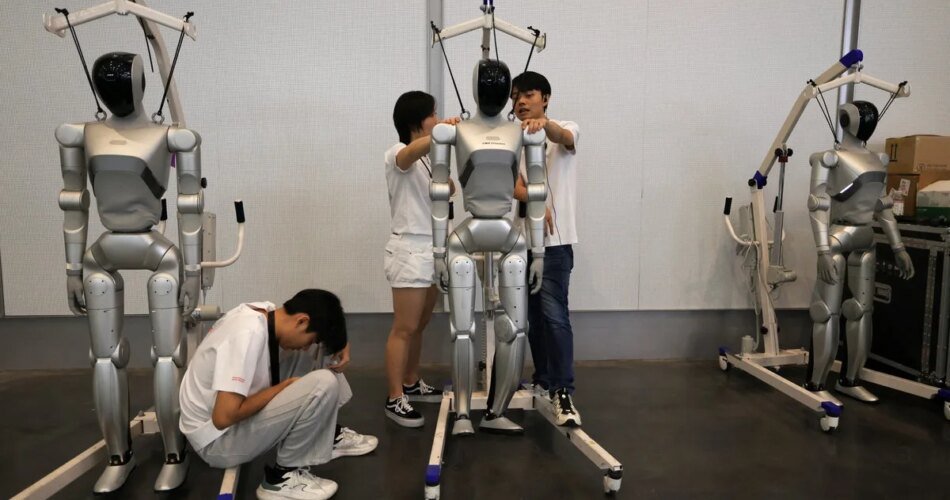
Whether you are curious to see if a robot can fold clothing, interested in acquiring a four-legged robotic dog or emotional companion, or simply keen to watch machines box and dance, Beijing is currently the capital city to visit.
China kicked off its 2026 World Robot Conference on Wednesday, with domestic firms showcasing the country’s expanding robotics sector as developers seek to transition technology beyond mere stage demonstrations and into practical factory applications.
Organisers say roughly 3,000 products will be showcased across the five-day event. Nevertheless, despite the international framing implied by the conference’s title, no foreign exhibitors were present at the venue.
One major draw on Wednesday was the display hosted by Unitree, one of China’s premier humanoid robot manufacturers, whose models boxed and danced for spectators. One unit even engaged in a ping pong match against a human.


The conference opening coincided directly with Unitree’s official stock market debut in Shanghai.
The gathering comes weeks after the US Federal Communications Commission announced a ban covering imports of new foreign-made humanoid robots and power inverters, citing national security risks in a decision targeting China. This prohibition also encompasses new imports of quadruped robots, frequently called four-legged robot dogs, with the regulatory agency asserting advanced robotics could present severe cybersecurity risks.
UBTECH, another prominent Chinese robotics firm, brought several industrial models to the conference floor. Some performed tasks such as shifting component parts around simulated factory floor spaces.


Yet among the exhibits drawing significant public attention were humanoid models built with realistic faces, promoted for emotional care.
Jiao Jichao, deputy president of UBTECH Robotics, stated that their companion model can converse, make facial expressions, rotate its neck and move its hands. It is available to individual retail buyers at a price of 168,000 yuan (over $24,000).
Despite these elaborate demonstrations, analysts note that many humanoids remain far more effective as novelty entertainers than practical workers.
Multiple firms showcased assistant robots featuring mechanical arms and hands. At one stand, a robot tried to complete a simple household task by folding a shirt, but after struggling for several minutes, it failed to complete the job.