

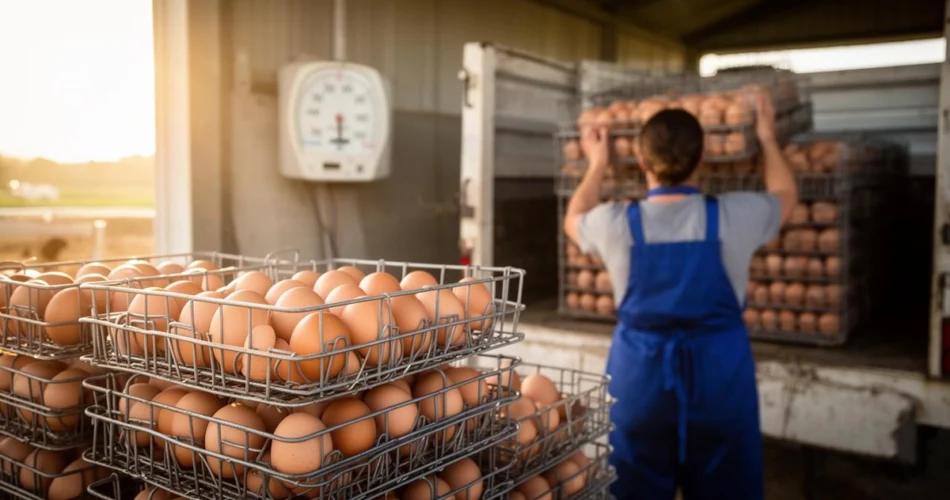
Since the start of August, egg prices across China have continued to climb, with the average price in major producing regions rising by roughly 0.81 yuan per jin within a single month—an increase of nearly 20%. At a wet market in Shanghai’s Xuhui District, retail prices for regular eggs have risen from 5.8 yuan per jin to above 6 yuan, with vendors broadly reporting that wholesale costs have been “creeping up for a full month.” Industry analysts say the rally reflects a combination of Mid-Autumn Festival stockpiling demand and supply-side contraction, and while prices are expected to remain elevated in the near term, they will most likely shift into a downtrend after the holiday.
Monitoring data from Zhuochuang Information shows that egg prices in major producing regions trended upward through early-to-mid August, with the average price peaking at 4.65 yuan per jin on August 18, up 0.81 yuan per jin from the month’s low. The price surge has boosted farm profitability, with per-jin egg profits ranging from 1.14 yuan to 1.94 yuan in early-to-mid August—a healthy margin for producers. Data from China’s National Bureau of Statistics show that egg prices rose 14.4% year-on-year in July, though they fell 1.7% month-on-month; cumulative prices for January through July were up 2.8% from a year earlier.
Mid-Autumn Stockpiling Ignites Demand
On the demand side, the onset of the Mid-Autumn Festival stockpiling cycle is the core driver of the price surge. Wang Jinyu, an analyst at Zhuochuang Information, said that with mooncake and other holiday food production entering its peak season in August, food processing companies have been steadily ramping up egg purchases, creating a clear increase in rigid industrial demand. After the start of autumn, temperatures have cooled across most of China, broadly improving market demand. Additionally, once the upward price trend became established, some traders turned bullish on the outlook and began hoarding inventory, amplifying procurement demand in the distribution chain. The combination of factory demand and trader restocking has created a confluence of buying pressure that is directly pushing transaction prices higher. Expectations of back-to-school consumption have also provided some support to market sentiment.
Zhuochuang Information data show that in the first two weeks of August, egg sales volumes at representative markets in major consuming regions held between 6,700 and 7,000 tonnes, on an upward trend. Ruida Futures noted that eggs, as a fresh product, require strict temperature and humidity controls for storage and cannot be kept for extended periods even in cold storage. Egg demand is also highly seasonal, with holidays providing a significant boost. Generally speaking, in the second half of the year, supported by Mid-Autumn Festival and National Day stockpiling, third-quarter egg prices tend to rebound and typically reach their annual peak in mid-September.
Capacity Reduction and Heat Stress Squeeze Supply
The contraction on the supply side has provided fundamental support for the sustained rally. Wang Jinyu pointed out that the industry downturn in 2025 kept egg prices depressed for an extended period, with the full-year average at just 3.17 yuan per jin and the industry posting an average loss of 0.03 yuan per jin. Persistent losses eroded farmer confidence, leading to more cautious restocking behavior and higher vacancy rates among small and medium-sized farms, which directly pushed the laying hen industry into a capacity reduction cycle in 2026. Based on calculations incorporating restocking, culling of older hens, and prior inventory levels, the theoretical laying hen inventory for August is estimated at 1.265 billion birds, down 1.56% month-on-month and 7.33% year-on-year—clearly below the same period last year.
Changjiang Futures analysis noted that laying hen inventory and egg-laying rates determine market egg supply. Strong farming profits in the second half of 2024 drove aggressive restocking, while producers also extended production cycles through forced molting. Low culling rates combined with high numbers of new layers pushed laying hen inventory to historic highs in 2025, continuously pressuring egg prices and squeezing farm margins. After the 2025 Spring Festival, the laying hen industry ended a four-year profit cycle and entered a loss-making phase, with losses the deepest since 2019. Deteriorating margins drained corporate cash flow while deepening pessimism across the industry, leading to sustained heavy culling and a reluctance to restock. These factors together created a market environment of tight egg supply and low inventory levels across all segments after the 2026 Spring Festival.
Beyond the decline in inventory, heat stress from summer’s high temperatures has further compressed egg output. Wang Jinyu said high temperatures impair laying performance, as hens entering the summer heat-dormancy period reduce feed intake and egg-laying rates decline to some degree.
| Indicator | Data | YoY/MoM Change |
|---|---|---|
| Aug 18 average egg price in major producing regions | 4.65 yuan/jin | Up 0.81 yuan/jin from month’s low |
| Per-jin egg profit, early-to-mid August | 1.14–1.94 yuan | Healthy farm margins |
| Aug theoretical laying hen inventory | 1.265 billion birds | Down 1.56% MoM, down 7.33% YoY |
| July egg prices | — | Up 14.4% YoY, down 1.7% MoM |
| Egg sales in major consuming regions (first 2 weeks of Aug) | 6,700–7,000 tonnes | Trending upward |
Note: Data sourced from Zhuochuang Information and China’s National Bureau of Statistics
Outlook: Prices Likely to Head Lower After the Holiday
Looking ahead, Wang Jinyu expects that in the short term, inventory in producing regions remains low, with inventory days in production and distribution channels holding at around one day, meaning limited pressure to offload supply. With Mid-Autumn Festival stockpiling still in full swing, rigid procurement from food manufacturers is providing strong support to the market, while school reopenings and supermarket holiday promotions are adding incremental consumption. The foundation for firm egg prices remains intact. However, after the extended rally, end-users need time to digest high-priced supply, and the pace of high-price sales is slowing, with downstream traders and supermarkets likely to adopt a wait-and-see stance in phases. On balance, egg prices are expected to remain elevated from late August through early September, with the possibility of pullbacks, though any downside is likely to be limited.
After the Mid-Autumn Festival concludes in late September, concentrated holiday stockpiling demand will fade, and market demand will shift from strong to weak, with egg prices likely to retreat from their highs. Entering October, holiday-related bullish factors will dissipate and egg consumption will enter the traditional seasonal off-season. At the same time, temperatures will gradually fall, heat stress effects will disappear, and egg-laying rates will progressively recover, boosting market egg supply. The supply-demand balance will shift from tight to loose, and the center of gravity for egg prices will continue to move lower.
Wang Jinyu advises farmers to view the current high-profit environment rationally, avoid hoarding in hopes of even higher prices, and guard against operational risks from a later market correction. Traders should control inventory turnover, purchase based on sales, and avoid chasing prices to build stockpiles. Food processing companies should prioritize securing supply for essential Mid-Autumn production during the current high-price period, arrange production schedules rationally, and scale back procurement in tandem with post-holiday order declines. End consumers need not panic-buy amid pre-holiday high prices; purchasing modestly according to need is sufficient, with normal buying to resume once prices ease after the Mid-Autumn Festival and supply loosens in October.
Source link
Author

- Ytv Market News
- Share-market news writer and analyst with deep experience covering equities, commodities, forex, and cryptocurrencies for readers in the USA, UK, Canada, and Australia. Ytv Market News delivers timely market updates, practical trading insights, and clear explanations of macro and company-level catalysts that move prices. Combines on-the-ground financial reporting with technical analysis, using concise charts and actionable ideas to help investors and traders make smarter decisions.
Latest entries
 Stock Market VideosAugust 24, 2026By The Way: Headline You May Have Missed
 UsaAugust 24, 2026$UNH stock fell 3% this week. Here’s what we see in our data.
 Crypto NewsAugust 24, 2026Jupiter is Predicted to Drop to $ 0.155608 By Aug 28, 2026
 Investing InsightsAugust 24, 2026Altcoin Market Adds $215 Billion in Three Days, But True Altseason Remains Unconfirmed — BigGo Finance


