

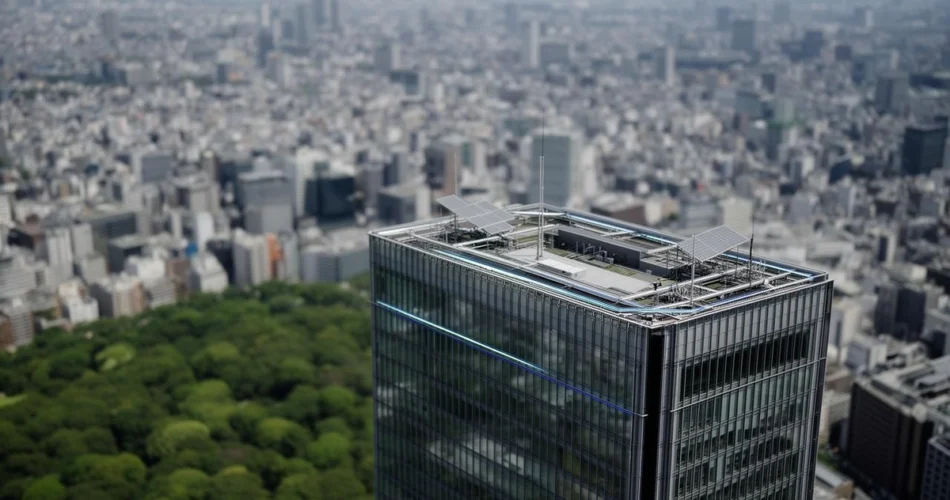
NTT Docomo and Mitsubishi Estate announced on the 24th that they will embark on joint development of a “next-generation smart city” in Tokyo’s Otemachi-Marunouchi-Yurakucho district (the Marunouchi area), building a state-of-the-art communications environment while preserving the urban landscape. Development and construction will proceed through fiscal 2026, with service launch targeted for fiscal 2027.
The target is the “Daimaruyu” district, which Mitsubishi Estate has designated as a priority development area. The plan calls for deploying cutting-edge technologies—including 5G millimeter wave (26 GHz band), Massive MIMO, and glass antennas—across the district, where high-rise office buildings stand densely packed and both foot traffic and communications demand are concentrated, to deliver a “best-in-class mobile coverage area.”
The two companies’ objective is to reconcile advanced communications quality with urban aesthetics. While millimeter wave is well-suited for ultra-high-speed, high-capacity communications, its radio waves travel in highly directional straight lines and are easily affected by obstacles such as buildings. Antennas must be installed in numerous locations with clear line-of-sight, and in Marunouchi—where historic structures and modern buildings coexist—harmonizing with the landscape poses a significant challenge.
To address this, the two companies plan to jointly develop a range of urban antenna solutions, including glass antennas and wall-mounted installations, in addition to validating antenna placement optimized for millimeter wave propagation characteristics. By combining Mitsubishi Estate’s real estate assets and infrastructure development expertise with Docomo’s communications technology, they aim to standardize deployment configurations into repeatable patterns, thereby improving installation efficiency and accelerating rollout.
The two companies refer to this next-generation infrastructure foundation as a “cluster.” In the near term, they will focus on advancing 5G communications technology for end users, but going forward they also plan to survey the needs of companies located in the Marunouchi area and explore development of services and solutions.
Leveraging Existing Infrastructure and Future Vision
Utilization of existing urban infrastructure held by the Mitsubishi Estate Group, including data centers and fiber-optic networks, is also under consideration. This would enable rapid construction of base stations equipped with advanced technologies such as millimeter wave.
Furthermore, as a future initiative, the companies are eyeing adoption of the All-Photonics Network (APN), a core technology of “IOWN,” the next-generation communications infrastructure being promoted by NTT. APN features high capacity, low latency, and low power consumption, enabling a fundamental overhaul of communications infrastructure through optical technology. The aim is to use the Marunouchi area as a proving ground to accelerate the social implementation of next-generation communications technologies.
Multi-Carrier Compatibility and Nationwide Expansion
Mitsubishi Estate has indicated that the initiative will be designed to support multiple carriers. While the first case will be a joint development with Docomo, participation from other carriers is anticipated down the line, ensuring versatility as urban infrastructure.
After validating the results and expertise gained in the Marunouchi area, the two companies aim to expand to major urban centers nationwide, including central Yokohama and Osaka. As a potential new model for urban communications infrastructure development, industry attention is focused on how far the fusion of real estate development and communications technology can advance.
This initiative goes beyond merely improving communications quality. If the companies can establish a methodology for upgrading communications infrastructure while preserving urban landscape value, it would become a highly versatile solution applicable to redevelopment projects in urban areas across Japan. Attention is now on the cross-industry collaboration between real estate and telecommunications, and what results it will yield in building the foundation for next-generation smart cities as the 2027 service launch approaches.
Source link
Author

- Ytv Market News
- Share-market news writer and analyst with deep experience covering equities, commodities, forex, and cryptocurrencies for readers in the USA, UK, Canada, and Australia. Ytv Market News delivers timely market updates, practical trading insights, and clear explanations of macro and company-level catalysts that move prices. Combines on-the-ground financial reporting with technical analysis, using concise charts and actionable ideas to help investors and traders make smarter decisions.
Latest entries
 Politics News TodayAugust 24, 2026Scottie Scheffler reveals he played through ‘pretty painful’ illness during the BMW Championship
 Market Movers TodayAugust 24, 20261 Unpopular Stock That Deserves Some Love and 2 We Avoid
 Forex NewsAugust 24, 2026Gold sits near mid-May highs as Iran risks support USD and cap gains
 IndiaAugust 24, 2026Skincare brand Be Clinical raises ₹21 cr in seed funding


