

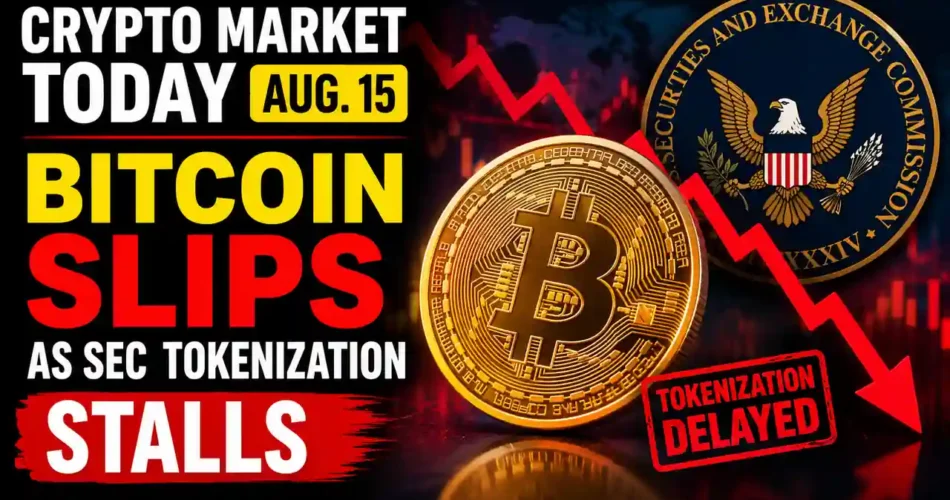
Crypto Market Today, Aug. 15: Bitcoin Slips as SEC Tokenization Progress Stalls
Crypto markets are facing renewed pressure on Aug. 15, 2026, as Bitcoin retreats and investor optimism around U.S. cryptocurrency regulation weakens. The latest move comes after the U.S. Securities and Exchange Commission (SEC) canceled a scheduled meeting that had been expected to address important cryptocurrency regulatory proposals. The delay has added another layer of uncertainty for investors who had been looking for clearer rules covering tokenization, fundraising and digital-asset markets.
Bitcoin was trading near the $62,000-$63,000 area after losing ground during the week. The decline has also weighed on several publicly traded cryptocurrency companies and digital-asset-related stocks. Investors are now watching whether regulatory uncertainty will create additional selling pressure or whether the market can stabilize as attention turns toward the next round of policy developments.
The setback is particularly important because the SEC has been working on a more structured approach to digital assets. Earlier in 2026, the agency published an interpretation covering certain crypto assets and transactions, while its staff also issued a statement explaining how tokenized securities may fit within existing securities laws.
Why Bitcoin Is Slipping Today
Bitcoin’s latest weakness is not being driven by a single factor. Instead, the market is responding to a combination of regulatory uncertainty, reduced expectations for near-term legislative progress and broader risk sentiment.
The SEC had scheduled a meeting to consider cryptocurrency-related regulatory proposals, but the agency canceled the meeting because of what it described as an unforeseen scheduling issue. No immediate replacement date was announced.
For crypto investors, the timing was significant. The meeting had been viewed as an opportunity for the regulator to advance proposals involving crypto fundraising and an innovation framework that could potentially support blockchain-based financial products.
The cancellation therefore removed a near-term catalyst that had helped support optimism across parts of the digital-asset market.
Regulatory Expectations Were Already Under Pressure
The SEC setback followed another disappointment in Washington. The U.S. Senate entered its August recess without completing action on the CLARITY Act, a proposed framework designed to establish clearer rules for digital assets and define responsibilities between financial regulators.
That delay means crypto businesses and investors may have to wait longer for comprehensive legislation. Although the bill could return to the agenda later, its timing and final provisions remain uncertain.
Markets typically react negatively when investors have positioned for a specific policy event and that event is delayed. Bitcoin’s decline therefore reflects not only the absence of fresh regulatory progress but also the adjustment of expectations that had already been priced into the market.
SEC Tokenization Plans Remain a Major Market Theme
Tokenization is one of the most closely watched developments in financial markets. It involves representing an asset, such as a stock or bond, using blockchain-based technology.
The potential advantages include faster settlement, extended trading hours, fractional ownership and greater efficiency in transferring financial assets. However, tokenized securities still have to operate within an appropriate legal and investor-protection framework.
The SEC has already provided important clarification on the subject. In January 2026, SEC staff explained that a tokenized security can remain a security under federal law even when ownership records are maintained partly or entirely on a blockchain.
The agency also distinguished between securities tokenized by or on behalf of issuers and securities tokenized by unaffiliated third parties. That distinction is important because the legal rights attached to a token can vary depending on how the product is structured.
The SEC’s formal interpretation issued in March went further by explaining that a security does not stop being a security simply because it is represented on a blockchain. This means tokenization itself does not automatically remove an asset from existing securities regulation.
Why the Delay Matters for Crypto
The regulatory debate surrounding tokenized assets has implications beyond stocks and bonds. It could influence how exchanges, brokerages, stablecoin companies, blockchain platforms and decentralized-finance businesses build their products.
A clear regulatory pathway could encourage more traditional financial institutions to enter tokenized markets. Banks and asset managers may be more willing to develop blockchain products if they can understand the compliance requirements and legal responsibilities involved.
On the other hand, continued uncertainty could slow product launches and encourage companies to develop tokenized products in jurisdictions outside the United States.
This creates an important competitive question for the U.S. financial industry: whether regulators can establish investor protections without preventing blockchain-based markets from developing quickly.
What the Crypto Market Is Watching Next
Investors are likely to focus on several developments during the weeks ahead.
1. A New SEC Meeting Date
The most immediate question is when the SEC will reschedule its canceled meeting. A new date could restore some confidence if the agency moves forward with proposals that the market has been anticipating.
However, another delay could have the opposite effect, particularly if investors conclude that regulatory changes will take longer than previously expected.
2. Progress on the CLARITY Act
Congressional action remains another major catalyst. The CLARITY Act is intended to establish a broader framework for digital assets and clarify regulatory responsibilities.
Its eventual passage could reduce uncertainty for cryptocurrency exchanges, issuers and investors. But negotiations over issues such as stablecoins, decentralized finance, enforcement and regulatory jurisdiction could still produce significant changes before any final legislation becomes law.
3. Bitcoin’s Technical and Market Position
Bitcoin’s ability to stabilize after the latest decline will also be important. A sustained recovery above recent trading levels could signal that investors view the regulatory setback as temporary.
Conversely, continued weakness could encourage traders to reduce exposure to higher-risk crypto assets, potentially putting additional pressure on major altcoins and crypto-related equities.
What It Means for Ethereum and Altcoins
Bitcoin often sets the direction for the broader cryptocurrency market, so weakness in BTC can quickly spread to Ethereum and other major digital assets.
Altcoins can be particularly sensitive to changes in risk appetite because they generally have smaller market capitalizations and greater volatility. If investors become more cautious, capital may move away from speculative tokens and toward Bitcoin, stablecoins or traditional financial assets.
At the same time, progress in tokenization could eventually benefit blockchain networks that provide the infrastructure for financial applications. Ethereum and competing smart-contract platforms remain central to the broader tokenization discussion because they can support programmable financial assets.
That long-term opportunity, however, depends on regulatory acceptance, institutional adoption, security and liquidity.
Is This a Long-Term Bearish Signal?
The latest regulatory setback should not automatically be interpreted as a long-term bearish signal for Bitcoin.
Crypto markets have repeatedly experienced periods in which regulatory expectations changed quickly. A canceled SEC meeting can delay a catalyst, but it does not necessarily eliminate the underlying policy proposals.
In addition, the SEC has already taken steps during 2026 to clarify aspects of the digital-asset regulatory framework. Its work on tokenized securities demonstrates that blockchain-based financial products remain an important part of the agency’s agenda.
The bigger issue is timing. Investors who expected rapid regulatory progress may now need to adjust their expectations.
Investor Takeaway for Aug. 15
The crypto market is entering a period in which policy developments could remain just as important as price charts.
Bitcoin’s retreat reflects a combination of weaker regulatory optimism and broader market caution. The cancellation of the SEC meeting removes a near-term event that traders had been watching closely, while the delay surrounding the CLARITY Act reinforces uncertainty over when the United States will establish a comprehensive digital-asset framework.
Nevertheless, the long-term tokenization story remains intact. The SEC has already acknowledged that blockchain technology can be used to represent securities and has provided guidance on how different tokenization structures interact with securities laws.
For investors, the key distinction is between short-term regulatory headlines and long-term industry development. A delayed meeting may affect sentiment today, but institutional interest in blockchain infrastructure, tokenized securities and digital financial markets could continue regardless.
As a result, traders should watch Bitcoin’s price action, SEC announcements, congressional developments and institutional adoption rather than relying on a single headline. Crypto remains a highly volatile asset class, and regulatory developments can produce sharp moves in both directions.
Frequently Asked Questions
Why is Bitcoin falling on Aug. 15, 2026?
Bitcoin is under pressure partly because the SEC canceled a scheduled meeting related to cryptocurrency regulation. The delay came alongside stalled congressional progress on broader digital-asset legislation, reducing near-term regulatory optimism.
What is tokenization in cryptocurrency?
Tokenization is the process of representing an asset, such as a stock, bond or fund interest, as a digital token recorded on blockchain technology. It can potentially enable faster settlement, extended trading hours and more efficient asset transfers.
Did the SEC ban tokenized securities?
No. The SEC has not generally banned tokenized securities. Instead, the agency has clarified that a security can remain subject to federal securities laws even when it is represented or recorded using blockchain technology.
What is the CLARITY Act?
The CLARITY Act is proposed U.S. legislation intended to establish a clearer regulatory framework for digital assets and define regulatory responsibilities. Its progress has been delayed, leaving some uncertainty for the cryptocurrency industry.
Could the SEC delay hurt crypto prices further?
It could affect market sentiment in the short term, particularly if traders had expected regulatory announcements to support prices. However, the eventual impact will depend on Bitcoin’s broader demand, macroeconomic conditions, institutional flows and future regulatory developments.
Is tokenization still important for the crypto industry?
Yes. Tokenization remains one of the industry’s major long-term themes because blockchain technology could change how financial assets are issued, transferred and traded. Regulatory clarity will be an important factor in determining how quickly the market develops.
Conclusion
Bitcoin’s decline on Aug. 15 highlights how closely cryptocurrency markets are tied to regulatory expectations. The SEC’s canceled meeting and the lack of immediate congressional progress have weakened the short-term outlook for regulatory clarity, creating another source of uncertainty for digital-asset investors.
However, the broader tokenization trend has not disappeared. The SEC’s existing work indicates that blockchain-based securities remain an important area of financial-market development. For investors, the focus now shifts to the next SEC timetable, future congressional negotiations and Bitcoin’s ability to absorb the latest regulatory disappointment.
Source context: U.S. Securities and Exchange Commission statements and regulatory materials, supplemented by current market reporting. This article is an original analysis and is not investment advice.

