
Financial automation platform BILL (NYSE:BILL) reported Q2 CY2026 results beating Wall Street’s revenue expectations, with sales up 13.8% year on year to $436.2 million. On the other hand, next quarter’s revenue guidance of $437.5 million was less impressive, coming in 1.4% below analysts’ estimates. Its non-GAAP profit of $0.84 per share was 18.5% above analysts’ consensus estimates.
Is now the time to buy BILL? Find out in our full research report.
BILL (BILL) Q2 CY2026 Highlights:
- Revenue: $436.2 million vs analyst estimates of $430.3 million (13.8% year-on-year growth, 1.4% beat)
- Adjusted EPS: $0.84 vs analyst estimates of $0.71 (18.5% beat)
- Adjusted Operating Income: $101.6 million vs analyst estimates of $84.7 million (23.3% margin, 20% beat)
- Revenue Guidance for Q3 CY2026 is $437.5 million at the midpoint, below analyst estimates of $443.6 million
- Adjusted EPS guidance for the upcoming financial year 2027 is $3.68 at the midpoint, beating analyst estimates by 8.8%
- Operating Margin: -7.9%, down from -5.8% in the same quarter last year
- Free Cash Flow Margin: 22.1%, up from 20.8% in the previous quarter
- Customers: 479,300, down from 493,800 in the previous quarter
- Billings: $434.2 million at quarter end, up 13.1% year on year
- Market Capitalization: $4.90 billion
Company Overview
Transforming the messy back-office financial operations that plague small business owners, BILL (NYSE:BILL) provides a cloud-based platform that automates accounts payable, accounts receivable, and expense management for small and midsize businesses.
Revenue Growth
A company’s long-term sales performance is one signal of its overall quality. Any business can have short-term success, but a top-tier one grows for years. Luckily, BILL’s sales grew at an incredible 47.3% compounded annual growth rate over the last five years. Its growth beat the average software company and shows its offerings resonate with customers.
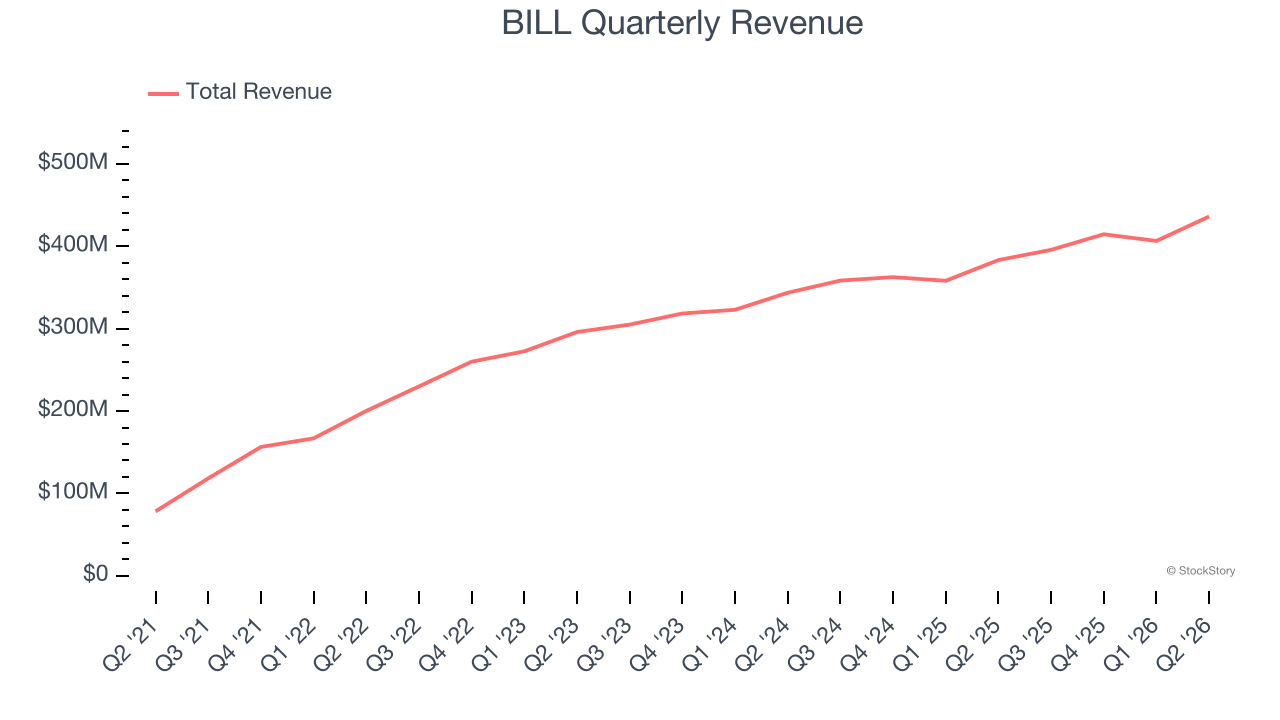
Long-term growth is the most important, but within software, a half-decade historical view may miss new innovations or demand cycles. BILL’s recent performance shows its demand has slowed significantly as its annualized revenue growth of 13.2% over the last two years was well below its five-year trend. 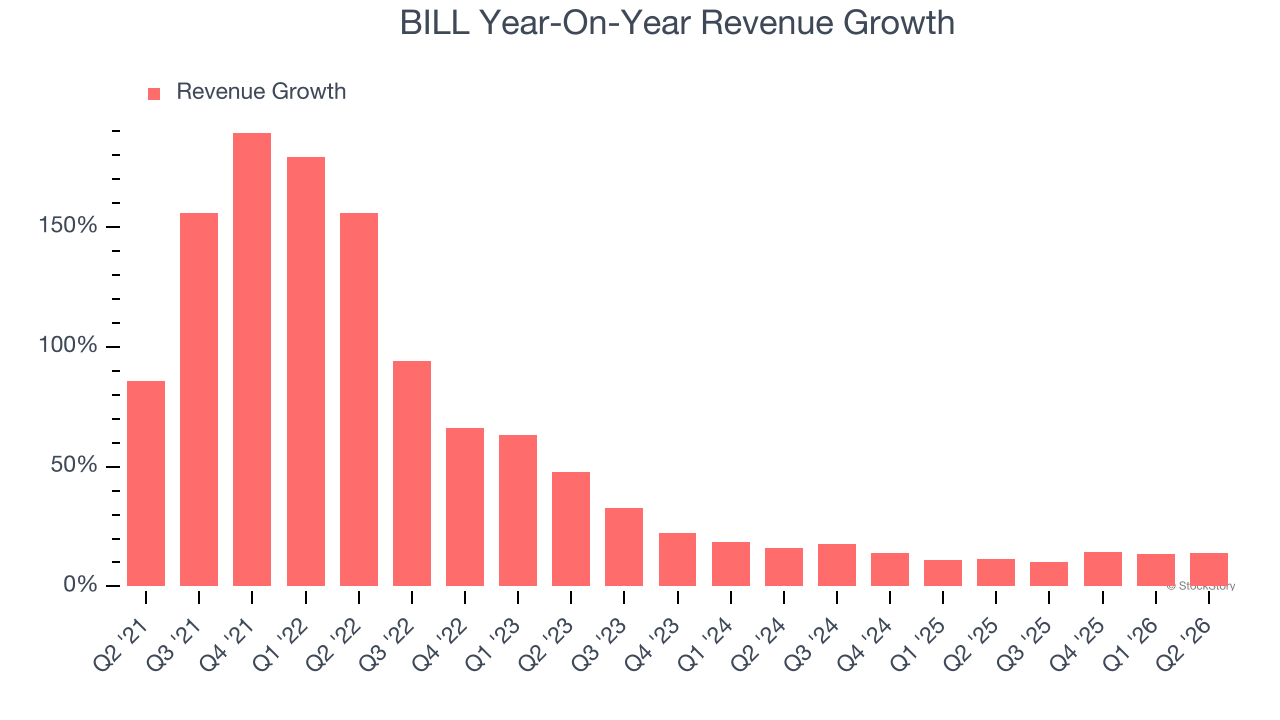
This quarter, BILL reported year-on-year revenue growth of 13.8%, and its $436.2 million of revenue exceeded Wall Street’s estimates by 1.4%. Company management is currently guiding for a 10.6% year-on-year increase in sales next quarter.
Looking further ahead, sell-side analysts expect revenue to grow 11.9% over the next 12 months, similar to its two-year rate. This projection is underwhelming and implies its products and services will face some demand challenges.
WHILE YOU’RE HERE: The Next Palantir? One satellite company captures images of every point on Earth. Every single day. The Pentagon wants it. Hedge funds are using it to beat earnings. You’ve probably never heard of it.
This is what the early days of Palantir looked like before it became a giant. Same playbook. Different technology. If you missed Palantir, you need to see this. Claim The Stock Ticker for Free HERE.
Billings
Billings is a non-GAAP metric that is often called “cash revenue” because it shows how much money the company has collected from customers in a certain period. This is different from revenue, which must be recognized in pieces over the length of a contract.
BILL’s billings came in at $434.2 million in Q2, and over the last four quarters, its growth was underwhelming as it averaged 12.7% year-on-year increases. This performance mirrored its total sales and suggests that increasing competition is causing challenges in acquiring/retaining customers. 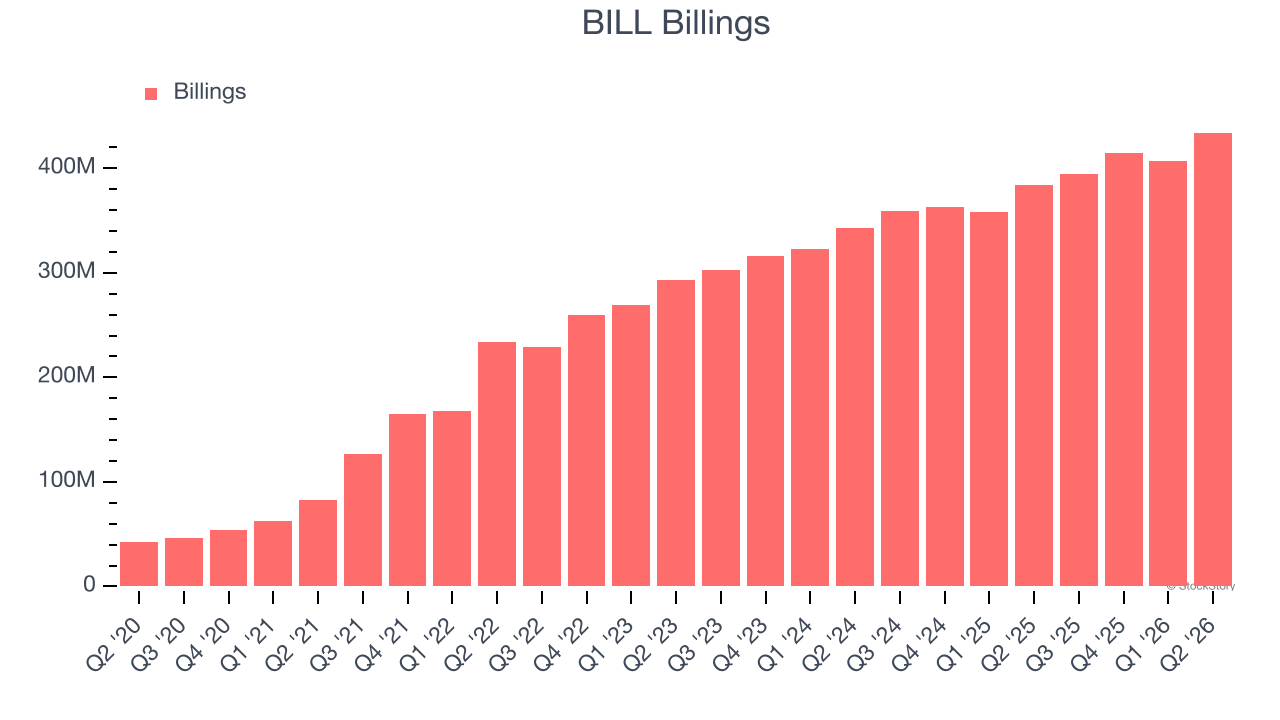
Customer Acquisition Efficiency
The customer acquisition cost (CAC) payback period represents the months required to recover the cost of acquiring a new customer. Essentially, it’s the break-even point for sales and marketing investments. A shorter CAC payback period is ideal, as it implies better returns on investment and business scalability.
BILL is extremely efficient at acquiring new customers, and its CAC payback period checked in at 5.6 months this quarter. The company’s rapid sales cycles stem from its strong brand reputation and self-serve model, where it can onboard many small customers with little to no oversight. These dynamics give BILL more resources to pursue new product initiatives.
Key Takeaways from BILL’s Q2 Results
We were impressed by BILL’s optimistic EPS guidance for next quarter, which blew past analysts’ expectations. We were also excited its adjusted operating income outperformed Wall Street’s estimates by a wide margin. On the other hand, its revenue guidance for next quarter slightly missed and its full-year revenue guidance fell slightly short of Wall Street’s estimates. Overall, this print was mixed. The stock traded up 3.6% to $49.55 immediately following the results.
So do we think BILL is an attractive buy at the current price? When making that decision, it’s important to consider its valuation, business qualities, as well as what has happened in the latest quarter. We cover that in our actionable full research report which you can read here (it’s free).