

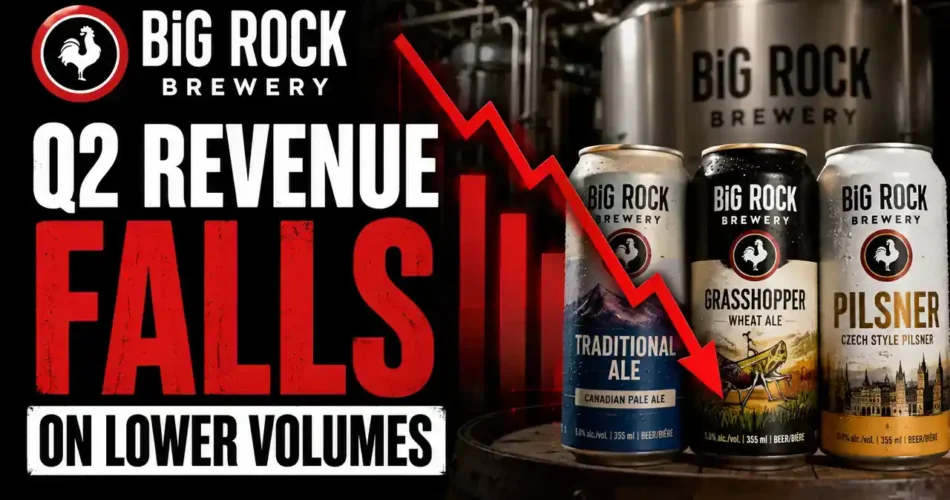
Big Rock Brewery Q2: Revenue Softens as Volumes Decline
Big Rock Brewery’s latest quarter points to a softer operating environment for the Canadian craft beer sector, with lower volumes weighing on revenue and profitability. For investors, the key question is not just the year-over-year decline, but whether the weakness reflects a temporary demand slowdown or a more persistent pressure on the business model.
Quarterly performance
The most recent figures show Big Rock’s second-quarter net revenue slipped about 1% year over year to $13.9 million, while sales volumes fell 5% to 79,045 hectolitres. Adjusted EBITDA also declined to $0.7 million from $1.0 million a year earlier, and the company reported a net loss of $0.6 million versus net income in the prior-year period.
That combination matters because it suggests the business is absorbing both lower throughput and higher cost pressure at the same time. In craft brewing, even a modest decline in volume can hit profitability harder than the revenue headline alone implies, especially when fixed production and distribution costs remain largely unchanged.
Volume pressure
The main driver of the weaker quarter was lower volume, which is a critical metric for beer makers because it directly affects production efficiency. Big Rock’s sales volumes declined by 5% year over year in the quarter, and that drop outweighed any support from pricing or product mix.
For investors, volume weakness is often more important than a small revenue decline because it can signal softer consumer demand, distribution challenges, or channel-specific pressure in retail and on-premise accounts. In a competitive craft beer market, smaller players can face disproportionate pressure when consumers trade down, switch categories, or become more selective about premium purchases.
Cost side pressure
The quarter also showed that costs moved in the wrong direction, with cost of sales rising 7.7% year over year to $9.6 million. That increase pushed profitability lower even though revenue only edged down slightly, which indicates margin compression rather than a simple top-line slowdown.
This is a meaningful signal for Canadian craft beer investors because the sector often has limited room to absorb inflation in packaging, freight, ingredients, and labour. When volumes fall at the same time that costs rise, operating leverage works in reverse and earnings can deteriorate quickly.
Canadian craft beer context
Big Rock’s results fit a broader pattern that many Canadian craft brewers have faced in recent years: slower volume growth, intense competition, and uneven consumer demand. Larger national and multinational brewers continue to have stronger scale advantages, while regional players must rely on brand loyalty, niche positioning, and efficient distribution.
The Canadian craft beer market is also sensitive to channel shifts. Retail demand, liquor board access, bar and restaurant traffic, and provincial market conditions can all influence quarterly performance, which makes revenue trends less predictable than in some other consumer sectors.
What investors should watch
Investors should focus on three things in the next few quarters: volume recovery, margin stabilization, and balance-sheet flexibility. If volume keeps slipping, even stable revenue may not be enough to protect earnings because production efficiency will remain under pressure.
It is also important to watch whether management can offset weaker demand with better product mix, pricing discipline, and tighter operating expenses. The company’s financial statements remain the best place to track those trends over time, including how cash flow, debt, and working capital evolve as the business navigates slower sales.
Risk and opportunity
The main risk is that the current softness becomes a longer-term trend rather than a one-quarter setback. Persistent volume declines would make it harder for Big Rock to sustain margins, reinvest in growth, or deliver stronger shareholder returns.
The opportunity, however, is that a small improvement in consumer demand or distribution can have an outsized effect on results because craft brewers often operate with relatively high fixed costs. If Big Rock can stabilize shipments and control costs, the earnings picture could improve more quickly than the revenue line alone suggests.
Investor takeaway
For investors, this is a cautious read rather than a crisis signal. Big Rock’s quarter shows a business that is still generating revenue, but with weaker volume trends and rising costs limiting profitability.
In Canadian craft beer, the most important near-term indicators are not just sales growth, but whether the company can defend margins while rebuilding volume. That is the key test for Big Rock’s next phase.
FAQ
Why did Big Rock’s revenue fall?
Revenue declined mainly because sales volume dropped 5% year over year in the quarter, which outweighed any support from pricing or mix.
Is the decline mostly a demand issue or a cost issue?
It is both, but volume weakness appears to be the starting point, while rising cost of sales intensified the earnings pressure.
What matters most for Canadian craft beer investors?
Volume trends, gross margin, Adjusted EBITDA, and cash flow matter most because they show whether the business can grow efficiently and fund operations.
Should investors worry about Big Rock’s outlook?
The quarter suggests caution, not panic. The key issue is whether lower volumes are temporary or part of a longer structural slowdown in the craft beer market.
What should investors track next?
Investors should watch volume recovery, margin trends, cash flow, and whether management can control operating costs while maintaining brand strength.
Reference links:
- Canada Revenue Agency – Adjusted Rates of Excise Duty on Beer
- Canadian Food Inspection Agency – Alcoholic Beverages Guidance
- Canadian Food Inspection Agency – Labelling Requirements for Alcoholic Beverages
- Government of Canada – Getting Business Support and Financing
- Department of Finance Canada – Alcohol Excise Duty Relief

