

Avicanna Q2 2026 Revenue Falls as VAC Reimbursement Changes Pressure Sales
Canadian biopharmaceutical company Avicanna Inc. reported lower revenue for the second quarter of 2026 as changes to Veterans Affairs Canada (VAC) reimbursement rates affected demand through its medical cannabis platform. However, the company also delivered stronger gross margins, increased sales of proprietary products and continued commercial expansion, providing investors with a mixed but potentially constructive quarterly picture.
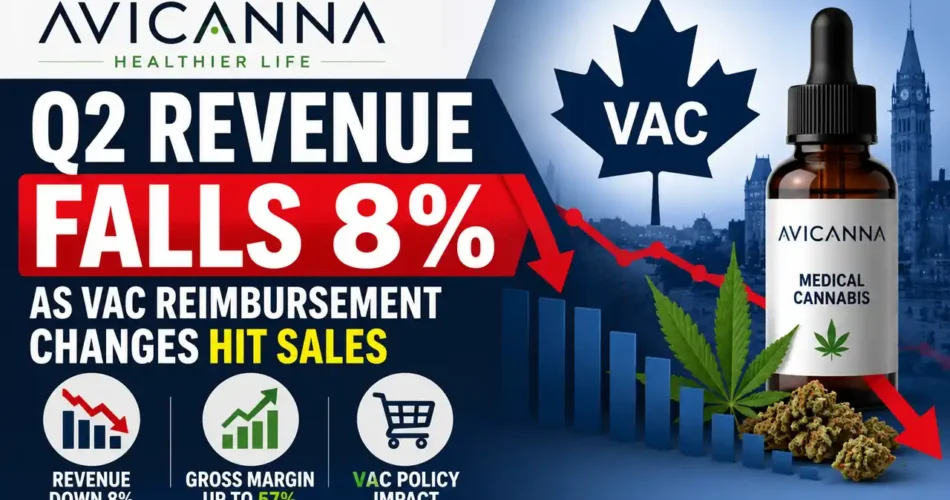
Avicanna reported revenue of approximately $5.64 million for the three months ended June 30, 2026, representing an 8% decline from the same period a year earlier. Revenue for the first six months of the year reached approximately $12.32 million, down 1% compared with the corresponding period in 2025. The company attributed the quarterly decline primarily to changes in VAC reimbursement rates that took effect April 1, along with timing differences associated with revenue from its various business units.
Why Avicanna Revenue Declined in Q2
The key issue during the quarter was a change in the reimbursement environment for Canadian veterans receiving eligible medical cannabis products. According to the company’s financial update, the reduction in VAC reimbursement rates created pressure on spending through MyMedi.ca, Avicanna’s medical cannabis care platform.
The reimbursement changes included an approximately 30% reduction in the maximum VAC reimbursement rate. Avicanna said this was accompanied by an 11.3% decrease in average patient cart size. These changes help explain why revenue weakened despite continued underlying growth in the company’s patient and order activity.
MyMedi.ca Faces a New Reimbursement Environment
MyMedi.ca had previously been an important growth channel for Avicanna. The platform connects patients with medical cannabis products and related services, making reimbursement policy an important factor in purchasing behaviour.
The second quarter represented a change in that growth pattern. After several quarters of sequential expansion, the platform experienced a decline as patients adjusted to the new reimbursement limits. For investors, the distinction between lower underlying demand and lower reimbursement-supported spending is important.
The company indicated that patient and order metrics continued to show positive momentum even as the reimbursement changes reduced the amount spent per patient. This suggests that the policy adjustment, rather than a complete deterioration in customer interest, was a major factor behind the weaker quarterly revenue.
Gross Margin Improves Despite Lower Revenue
One of the more positive aspects of Avicanna’s Q2 results was its improvement in profitability at the gross-profit level.
The company generated approximately $3.19 million in gross profit during the quarter. Gross margin increased to 57%, compared with 51% in Q2 2025. That represents an improvement of roughly six percentage points, or 600 basis points. The company also reported a 57% gross margin for the first half of 2026.
The margin improvement was supported by a greater contribution from higher-margin proprietary products. This is significant because stronger margins can help offset some of the pressure created by fluctuations in overall revenue.
Proprietary Products Continue to Gain Traction
Avicanna’s proprietary product portfolio showed particularly strong momentum during the quarter. Sales of proprietary products increased to 67,174 units, up approximately 33% year over year. On a sequential basis, proprietary product sales rose 48% from the 45,419 units recorded in the first quarter of 2026.
The company also reported growth in sales of Avicanna-branded products through MyMedi.ca. That growth is important because proprietary products generally provide an opportunity for the company to capture more value from its commercial portfolio than lower-margin activities.
Avicanna ended the quarter with a broader commercial offering, including 56 commercial SKUs and 172 commercial listings across its medical and adult-use channels, according to the company’s reported Q2 update.
What the Results Mean for Avicanna’s Business Model
The Q2 numbers highlight both the opportunities and risks associated with Avicanna’s integrated business model.
The company operates across cannabinoid-based pharmaceutical development, medical cannabis products, proprietary commercial products and international activities. This diversification can provide multiple sources of growth, but it also means that changes in reimbursement policies, product launches and revenue timing can produce meaningful quarterly fluctuations.
The latest results demonstrate that revenue growth alone does not tell the entire story. Although sales declined year over year, the company’s gross margin improved significantly. At the same time, proprietary product volumes increased substantially.
For investors, the important question is whether higher-margin proprietary products can continue expanding quickly enough to compensate for reimbursement-related pressure in the medical channel.
QUIX Portfolio Adds a Potential Growth Catalyst
Another development attracting attention is Avicanna’s progress with its QUIX technology and product portfolio.
The company has been preparing a QUIX rapid-onset medical cannabis portfolio for commercial launch. Avicanna said the portfolio was positioned for a third-quarter 2026 launch and had secured more than 35 commercial listings.
Why the QUIX Launch Matters
A successful product launch could provide Avicanna with another avenue for growth beyond the reimbursement-sensitive portion of its existing business.
The strategic value of QUIX also extends beyond immediate sales. Avicanna has described the technology as an example of its ability to translate research and intellectual property into differentiated commercial products. If the new portfolio gains market acceptance, it could strengthen the company’s proprietary product mix and potentially support margins.
However, investors should distinguish between secured listings and realized revenue. Commercial listings create distribution opportunities, but actual financial performance will depend on product adoption, reorder rates, pricing, market access and execution.
Profitability Remains a Key Investor Focus
Avicanna’s improved gross margin is encouraging, but the company continues to face the challenge of converting that improvement into sustainable bottom-line profitability.
Reported adjusted EBITDA remained negative during the quarter, with the company recording an adjusted EBITDA loss of approximately $0.36 million, compared with an adjusted EBITDA loss of approximately $0.25 million in the prior-year quarter.
This means investors will likely continue watching operating expenses, cash generation and the pace at which higher-margin products contribute to the overall business.
Margin Expansion Could Become Increasingly Important
If Avicanna can continue expanding proprietary product sales while maintaining or improving gross margins, the business could become less dependent on revenue growth from any single reimbursement channel.
That could create a more resilient financial structure over time. The opposite scenario would occur if reimbursement pressure persists while proprietary product growth slows, leaving the company with limited revenue growth and continued operating losses.
Canadian Medical Cannabis Market Remains Important
Avicanna’s results also illustrate how regulatory and reimbursement decisions can influence the economics of Canada’s medical cannabis market.
Patients who depend on third-party reimbursement can be particularly sensitive to changes in coverage limits. Even when patient numbers remain stable, lower reimbursement ceilings can reduce average order values and alter purchasing patterns.
For companies operating in this market, maintaining a diversified product portfolio and controlling costs can therefore be just as important as expanding patient numbers.
What Investors Should Watch in the Second Half of 2026
Several factors could determine whether Avicanna’s second half is stronger than its first half.
1. Recovery in Medical Cannabis Sales
Investors will want to see whether MyMedi.ca stabilizes after patients and the company adjust to the new VAC reimbursement structure. A stabilization in average cart sizes would be a positive indicator.
2. Proprietary Product Growth
The 48% sequential increase in proprietary product sales provides an important growth signal. Continued expansion could help offset reimbursement-related pressure and improve the company’s overall revenue mix.
3. QUIX Commercial Execution
The third-quarter launch of the QUIX portfolio is another major milestone. The number of commercial listings, initial sales and repeat purchases will provide early evidence of market acceptance.
4. Gross Margin and Cash Flow
The 57% gross margin reported for Q2 is a significant improvement from the prior year. Investors will want to know whether this level can be sustained as the company scales and expands its product portfolio.
Overall Investor Takeaway
Avicanna’s second-quarter results present a story of revenue pressure combined with improving business quality. The 8% decline in quarterly revenue is clearly a headwind, and the change in VAC reimbursement rates shows how external policy decisions can affect the company’s medical cannabis operations.
At the same time, the results contain several encouraging indicators. Gross margin rose to 57%, proprietary product sales increased strongly, and the company continued expanding its commercial portfolio. The upcoming QUIX launch could add another growth opportunity during the second half of 2026.
The central issue for investors is therefore not simply whether Avicanna can return to revenue growth. It is whether the company can build a larger, higher-margin proprietary business while adapting to changes in reimbursement-driven medical cannabis demand.
Avicanna’s latest filings and company announcements are available through its investor-relations resources.
Frequently Asked Questions
Why did Avicanna’s Q2 2026 revenue decline?
Avicanna’s Q2 revenue declined primarily because of changes to Veterans Affairs Canada reimbursement rates that took effect April 1, 2026. Revenue timing from other business units also contributed to quarterly variability.
How much revenue did Avicanna report in Q2 2026?
Avicanna reported approximately $5.64 million in revenue for the three months ended June 30, 2026. This represented an 8% year-over-year decline.
Did Avicanna’s gross margin improve?
Yes. Gross margin increased to 57% in Q2 2026 from 51% in the same quarter of 2025, an improvement of approximately 600 basis points.
How did Avicanna’s proprietary product sales perform?
Proprietary product sales increased approximately 33% year over year to 67,174 units. They also increased 48% compared with the first quarter of 2026.
What is the QUIX portfolio?
QUIX is Avicanna’s rapid-onset medical cannabis technology and product portfolio. The company was preparing the portfolio for a Q3 2026 commercial launch and reported more than 35 commercial listings secured.
What should investors watch next?
Key indicators include recovery or stabilization in MyMedi.ca activity, proprietary product growth, the commercial performance of QUIX, gross-margin sustainability, operating expenses and progress toward positive cash flow and profitability.
Note: This article is an independently written analysis based on publicly available company disclosures and current reporting. It is not investment advice, and investors should review Avicanna’s official filings before making financial decisions.
External References
- Health Canada – Cannabis for Medical Purposes: General Information
- Health Canada – Regulations Under the Cannabis Act
- Health Canada – Data on Cannabis for Medical Purposes
- Health Canada – Health Products Containing Cannabis: Regulatory Guidance
- Health Canada – Cannabis Promotion: Prohibitions and Permissions

