If you’ve been an active investor in the ASX mining sector, there’s a very good chance that you learned about the commodity price cycle from lithium’s gyrations over the last 10-odd years. The commodity price cycle is a concept that describes how a sudden spike in demand for a commodity can, in an environment of limited supply, send prices soaring – only to see them come crashing down again when supply eventually arrives.
Stocks producing that commodity generally ride the same rollercoaster, turning its passengers into geniuses overnight, then leaving them wondering how it all went wrong as they hold all the way back down again. Don’t worry, I’m not laughing at you, I’m laughing with you. Yes, I’ve ridden a commodity price cycle or two over the years!
Lithium’s booms and busts are legendary on the ASX, and if you believe the lithium bulls, the critical battery metal could be setting up for another legendary run. Or at least it seemed that way until May – when prices peaked after a three-fold expansion from the 2025 low, then capitulated over 30%.
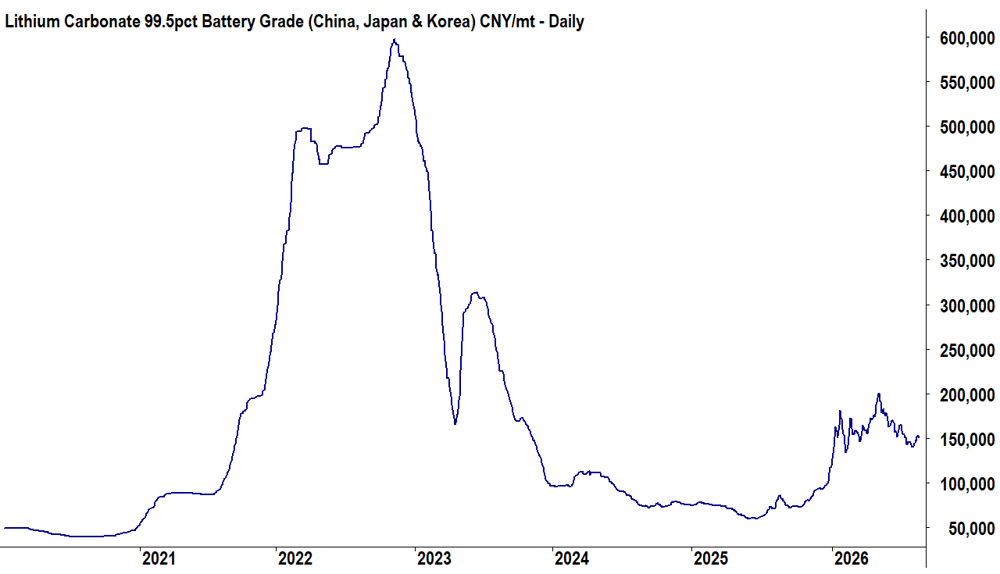
GFEX lithium carbonate futures, benchmark front month contract. Source: SMM, author’s own data
I’ve written extensively on some of the reasons for the latest downturn, often drawing the ire of die-hard lithium supporters with nary a mention of the word “sodium”! In this article, I’ll run that gauntlet again to bring you up to date on what’s shaping the lithium price today, but more importantly – what’s shaping it into the end of the decade and beyond. Strap in, the lithium roller coaster is departing! 🎢
How the Middle East conflict is changing battery industry dynamics
Most ASX lithium investors have never had a reason to care about sulphur. But events in the Middle East have thrust this key ingredient in the battery manufacturing process into the spotlight.
Roughly four out of every five batteries built today use a lithium iron phosphate (“LFP”) cathode. It won the market because it drops nickel and cobalt from its chemistry entirely, making batteries cheaper and less susceptible to combustion.
By weight, an LFP cathode is close to three-quarters phosphoric acid. That means it’s a phosphate product with lithium in it, not the other way round. But that phosphoric acid has to be extraordinarily pure, with contaminants measured in parts per million because a stray iron ion will shorten a cell’s life.
The cheapest way to make this pure phosphate is to dissolve phosphate rock in sulphuric acid. Sulphuric acid is made from sulphur, and here’s the bit that matters: sulphur is not mined. Almost all of it is a by-product stripped out of crude oil and gas at refineries, which means the world produces exactly as much as refining activity yields.
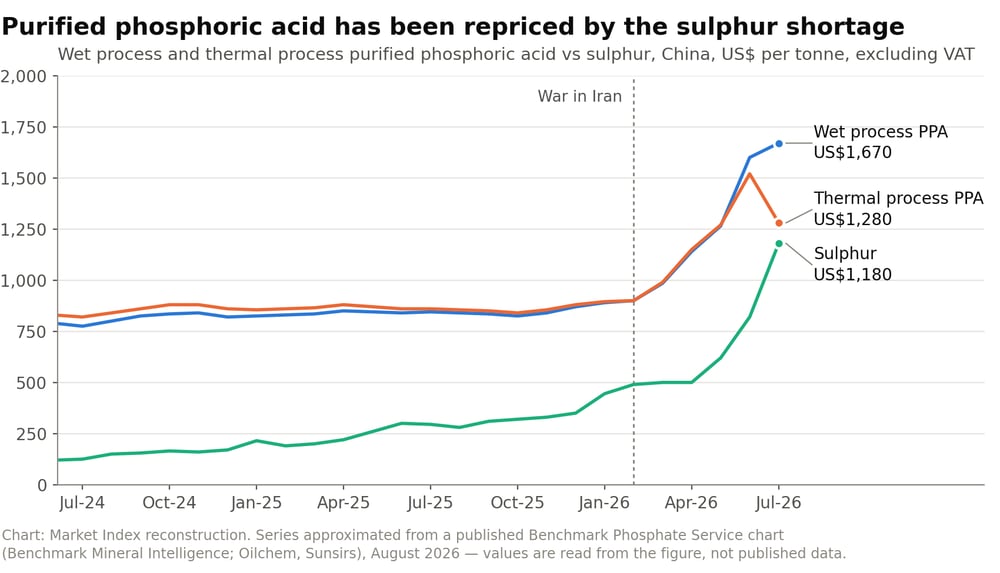
So, when the Strait of Hormuz closed and Russian gas plants started taking drone hits, roughly half the world’s traded sulphur went with it. The cost of one tonne of sulphur has run from around US$50 in 2020 to above US$500 this year. The knock-on is that the price of the acid that goes into making LFP cathodes has risen 85% since March.
Here’s where it hits the lithium price. There are two ways to make battery-grade phosphoric acid: the cheap route using sulphuric acid, and an expensive electricity-intensive route that has always commanded a premium. This year the cheap route became the expensive one. The squeeze lands on the cathode makers who buy that acid by the tonne, and they have almost no room to wear it. Lithium expert Benchmark Mineral Intelligence (“BMI”) has cathode material stocks across China down to 1.7 weeks of consumption.
Data source for chart: UBS
Chinese battery makers have responded by writing phosphoric acid into the formulae they use to negotiate cathode prices – a line item that until this year simply tracked lithium. For an investor in ASX lithium stocks, that’s the single most important structural change: the cost of an LFP battery now moves on two commodities. Every dollar phosphate takes is a dollar that isn’t there to buy lithium.
Latest lithium demand-side factors
Let’s check out what the experts have said about the critical demand-side factors in the lithium market since my last update on 21 July. I’ve tagged each factor for what it means for the lithium price over the next twelve months: bullish 🐂, bearish 🐻, or cuts both ways ⚖️.
Bigger batteries are doing the work that car sales used to: Shanghai Metals Market (“SMM”), one of China’s largest battery-chain consultancies, expects global EV unit sales growth to slow to around 10% a year through 2030 as China matures at roughly 60% penetration and subsidies wind back. But it also expects average battery size to rise about 30% in 2026 and 2027, as exports grow to markets that favour bigger formats and commercial vehicles. The result is demand for battery capacity growing at roughly double the rate of car sales – around 20% a year to 2030. 🐂
Grid batteries become the swing buyer: SMM expects demand from battery energy storage systems – the grid-scale installations that firm renewables and increasingly back data centres – to grow around 60% this year and average 23% a year to 2030, lifting storage from 25% to 40% of all lithium-ion battery demand. This shift appears bullish for lithium, but it moves the marginal buyer from a carmaker, who can absorb an input cost rise inside a $40,000 vehicle, to a project developer bidding a fixed price per megawatt hour. SMM’s own view is that a significant proportion of Chinese storage projects become uneconomic with lithium carbonate around RMB200,000 a tonne. This is the difference between storage and vehicles as a demand base, and it is not a small one. Storage demand is elastic – push the price far enough and the projects simply do not get built. EV demand never had that brake, because lithium is a far less noticeable portion of a car’s price. ⚖️
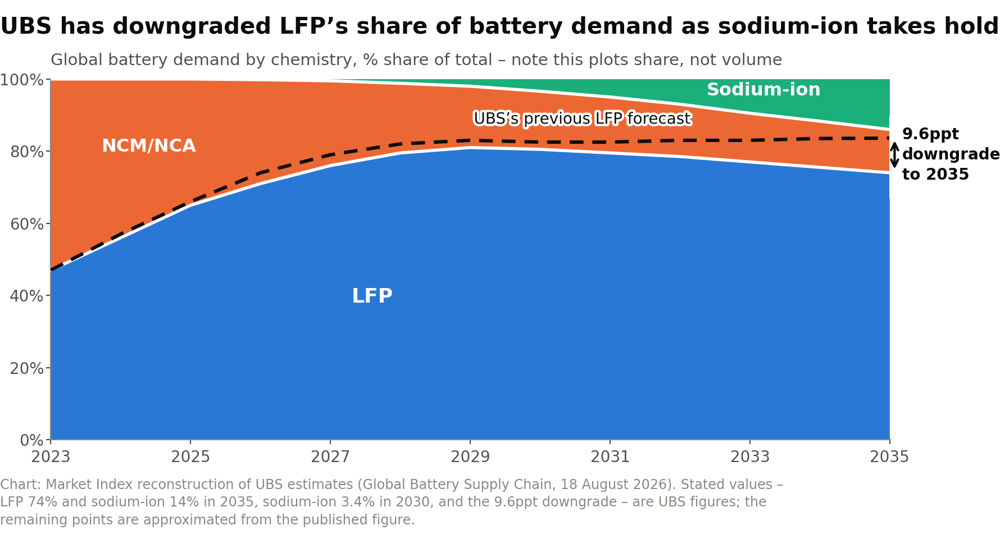
Sodium-ion is no longer on the drawing board – and it’s only going to grow: In a research note published last week, UBS raised its forecast for sodium-ion’s share of global battery demand to 3.4% by 2030 and 14% by 2035 – the latter a 10 percentage point upgrade – with grid storage accounting for around 80% of the volume. It correspondingly cut its 2035 forecast for LFP’s share by 9.6 percentage points, to 74%. UBS puts the remaining cost premium of sodium-ion cells over LFP at US$7–11 per kilowatt hour, down from around US$28. The cost-gap continues to narrow, but it must be noted that sodium-ion will be a complementary battery chemistry to LFP, not a replacement (check my last update for more information!).
Data source for chart: UBS
Note that the chart above plots share, not volume. Global battery demand is heading towards roughly 4.2 terawatt hours by 2030 on UBS’s numbers, so LFP falling from a peak of about 81% share in 2029 to 74% by 2035 still describes the battery chemistry growing strongly in absolute terms.
What we’re seeing is the extent of UBS’s prediction for sodium-ion vs LFP displacement. It supports the prevailing complementary technology thesis – but how much further will future updates show ongoing encroachment of the green area into the blue? Arguably, the gap between the blue area and the dashed line is likely at least a contributing factor to recent lithium price weakness – more so if other houses reach the same conclusion.
Consider that on Market Index’s calculation, the two to three percentage points UBS has already taken off LFP’s share by 2030 removes something like 45,000 to 68,000 tonnes of lithium carbonate equivalent a year from the demand side. It’s incremental, but it does change forecasts and forecasts change prices. 🐻
Six weeks of unsold cars are six weeks of lithium already bought: BMI reports Chinese EV dealer inventory at approximately 1.2 million units against a typical 160,000 – about six weeks of sales where dealers normally hold six days. China Passenger Car Association data has electric vehicle retail sales down 12% over the first seven months of 2026, a seventh straight month of decline, and production hasn’t followed them down. On Market Index’s calculation, those cars hold roughly 31,000 tonnes of lithium carbonate equivalent already consumed. So, if carmakers choose to cut build rates rather than prices, any slowing in the cell order book could temporarily crimp lithium demand. 🐻
Latest lithium supply-side factors
Before the supply side makes sense, it helps to know who does what. Australian miners dig up spodumene – a hard rock containing lithium – and crush it into a concentrate, then ship almost all of it to refineries in China known as converters, which cook it into lithium carbonate: the white powder that actually goes into a battery. Converters buy the rock and sell the powder, and they live on the difference between the two.
Supply is not standing still: SMM forecasts lithium supply growth of around 30% across 2026 and 2027, and from a notably wider set of sources than the last cycle – Australian restarts, Chinese brine expansion, Sichuan spodumene, and continued African growth. Africa comes with strings: Zimbabwe banned unprocessed ore exports in 2022 and will permit only lithium sulphate from January 2027, forcing miners there to build processing capacity or strike tolling deals. UBS notes this does not appear to have dented brownfield “expansion appetite”. 🐻
The refiners, not the miners, are the choke point: that difference has been closing. BMI has the price of lithium carbonate delivered into Asia down 5.0% in a week against a 3.3% fall in spodumene – the powder is getting cheaper faster than the rock it comes from – and Chinese converters have responded by shutting plants for maintenance. Every converter that goes dark stops buying rock and stops making powder – and since most Australian spodumene ends up in a Chinese converter, the shutdowns tightening the market for the powder are the same ones cutting demand for the rock ASX miners sell. ⚖️
Sulphur is adding a cost nobody has in their model: Turning spodumene into lithium chemicals is an acid process – the concentrate is roasted with concentrated sulphuric acid at well above the minimum chemically required. On Market Index’s calculation that works out to roughly 1.35 tonnes of acid for every tonne of lithium carbonate produced. With acid moving from around US$100 a tonne to above US$500, that is close to an additional US$550 a tonne of cash cost, landing on precisely the tier of the industry that is already shutting for maintenance. 🐂
Lepidolite is the swing supply, and it is the most exposed: China’s lepidolite – a lower-grade lithium mica mined mainly in Jiangxi – has been the market’s swing producer for three years, and CATL’s Jianxiawo mine remains offline pending formal approval of its safety permit. SMM expects it back in September or October, with other Jiangxi assets restarting through the first half of 2027. Because lepidolite is low grade, it needs far more acid per tonne of lithium than spodumene does, which means the sulphur shock hits the industry’s swing supply hardest. ⚖️
Stocks across the chain are running down, not building: SMM’s data has Chinese lithium carbonate inventories at 22 days of consumption against a roughly 30-day average, and EV and storage battery inventories at under one month against a typical two. Thin inventories are what turn an ordinary supply disruption into a price spike, because there is no buffer between a shutdown and a buyer who needs material this month. 🐂
On supply alone, the near-term case is the strongest it has looked in two years. So, does this set a floor under the lithium price? Not quite. It sets one under the converter’s margin, and that is a different thing.
Cathode makers holding 1.7 weeks of stock, on BMI’s numbers, cannot wait out a long shutdown, so if converters stay dark the buyers have to bid the powder price up to bring them back. On Market Index’s calculation, SMM’s RMB180,000–200,000 peak would support a rock price of roughly US$2,675–3,050 a tonne, against US$2,300 today. UBS’s US$3,300 forecast sits above that range, which implies either a carbonate price beyond SMM’s peak or converter margins compressing as idle plants restart and bid for concentrate. 🐂
But a squeezed margin can be repaired from either end. Converters restart just as happily if the rock gets cheaper. There is a floor under conversion economics. There is no floor under the lithium price – and if the market repairs the margin from the rock end, it is the Australian miner who pays for it. 🐻
Latest expert lithium price forecasts
SMM expects lithium carbonate to peak at RMB180,000–200,000 a tonne in the second half of 2026 – against a spot price nearer RMB160,000 – on chemical deficits, plant maintenance, and low inventories, before easing to average around RMB150,000 through 2027 as supply catches up. More significantly, SMM sees the market moving from deficit to balance across 2027–29, and only returning to deficit in 2030. For a market that spent this year being told a structural deficit was arriving imminently, that is a three-year deferral.
On UBS’s arithmetic, SMM’s outlook implies spodumene concentrate of around US$2,000 a tonne in 2027. However, UBS’s own forecast for 2027–29 is substantially more bullish at US$3,300 a tonne. Both numbers sit against a spot price near US$2,300.
Now put SMM’s bull case next to the sodium-ion threshold. UBS says sodium-ion reaches cell-level cost parity with LFP in 2027 if lithium carbonate holds above somewhere in the US$21–29 a kilogram range, with pack-level parity a year later. SMM’s RMB180,000–200,000 peak is roughly US$25.30–28.10 a kilogram – inside that range.
And the sulphur shock is closing that gap from the other end. On Market Index’s calculation the increase in purified phosphoric acid prices adds roughly US$1.40 per kilowatt hour to the cost of an LFP cell if fully passed on. Set against the US$7–11 per kilowatt hour that UBS says still separates sodium-ion from LFP, a shortage of sulphur has closed somewhere between 13% and 20% of sodium-ion’s remaining cost disadvantage – without sodium-ion improving at all.
ASX lithium stocks latest broker consensus
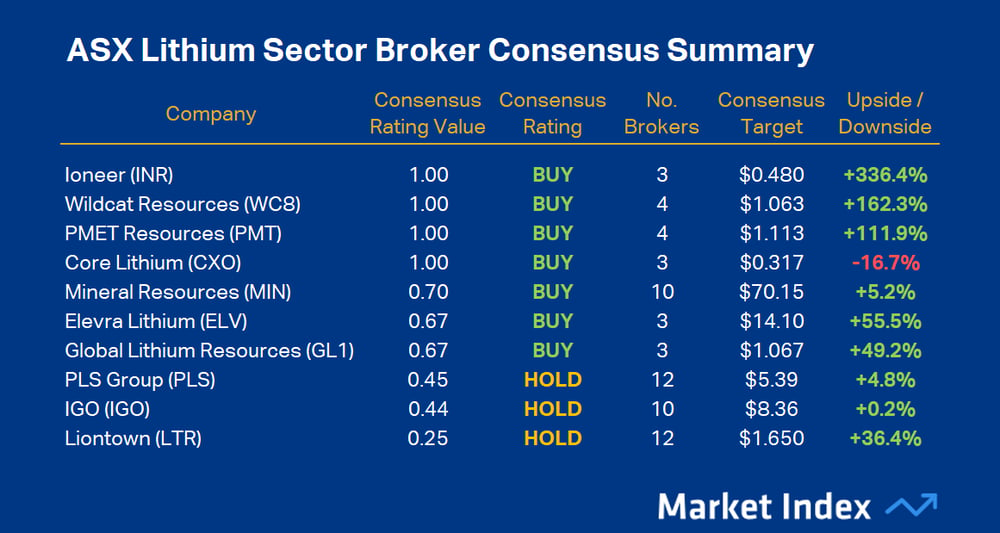
ASX Lithium Sector Broker Consensus Summary 25 August 2026. Source: Market Index Broker Consensus. To obtain a stock’s Broker Consensus Rating, we assign a value of +1 to any rating better than HOLD / NEUTRAL / MARKETWEIGHT, a value of 0 for any rating equivalent to HOLD / NEUTRAL / MARKETWEIGHT, and a value of -1 to any rating worse than HOLD / NEUTRAL / MARKETWEIGHT. We then take the average of all assigned rating values and assign a Broker Consensus Rating of BUY to values of +0.5 or greater, a rating of HOLD for values from -0.5 to below +0.5, and a rating of SELL for values less than -0.5. The Broker Consensus Target is simply the average of the target prices we have on file for each broker. Typically, brokers define their target prices as a 12-month forecast. Each target price is based on fundamental valuation assumptions. Upside/Downside data based on closing prices 25 August 2026.
Generally, brokers are positive towards ASX lithium stocks, with seven consensus buys and three consensus holds among stocks receiving three or more broker ratings over the past three months. Consider that consensus ratings based on fewer broker opinions may be less reliable, while outdated price targets can contribute to blowouts in upside percentages – particularly if a stock’s price has experienced a large recent decline.
PLS Group (PLS) was rated a consensus buy prior to its FY26 results, but downgrades from Morgans (from hold to trim) and Ord Minnett (from buy to accumulate) have just swung the consensus to what is still arguably a “strong hold”. The same can be said for IGO, which also copped downgrades from JP Morgan (from overweight to neutral) and UBS (from buy to neutral).
Of the lithium stocks covered by ten or more brokers, only Mineral Resources (MIN) has earned a consensus buy, although its 5.2% consensus upside target is modest. Of those covered by fewer than ten brokers, sector laggards Ioneer (INR), Wildcat Resources (WC8) and PMET Resources (PMT) show somewhat dubious triple-digit consensus target upsides. Ironically, recent share price performance leader Core Lithium (CXO) shows the greatest consensus target downside of the cohort.
Conclusion: mind the ceiling
Tally the factors above and the scoreboard reads four bulls, four bears, and three that cut both ways. That looks like a dead heat – until you notice the case for and the case against are running on different clocks.
Every bull is a near-term one: warehouses running empty, converters sitting idle, and a sulphur bill that lands on every tonne refined. Every bear is more structural: supply growing faster than demand, a chemistry losing share to a cheaper rival, and a deficit that will not now arrive until 2030.
Which is why it matters that two independent houses, working from different evidence, arrived at the same cap on the lithium price: somewhere near RMB200,000 a tonne. Above that level storage projects stop making financial sense, and sodium-ion becomes cheap enough in the applications it suits to displace enough tonnes of lithium to matter.
So, the rally has room to run from here, but to the ceiling – not through it. That leaves ASX lithium investors with one question: what does their stock earn at a lithium price of RMB200,000 a tonne?
This article draws on institutional research from UBS (August 2026), price assessments and market data from Benchmark Mineral Intelligence and Shanghai Metals Market (August 2026), vehicle sales data from the China Passenger Car Association (August 2026), and original Market Index quantitative research. Charts are Market Index reconstructions – see the source line on each.
Notes on Market Index calculations: LFP share downgrade (45,000–68,000 tonnes LCE a year at 2030): UBS’s 4.2 terawatt hours of 2030 battery demand, a 2–3 percentage point gap read off UBS’s Figure 1 rather than stated by UBS, and 0.54 kilograms of lithium carbonate equivalent per kilowatt hour of LFP. Lithium in excess dealer inventory (about 31,000 tonnes LCE): 1.04 million vehicles above BMI’s typical level, at an assumed 50 kilowatt hour average pack and 0.6 kilograms of lithium carbonate equivalent per kilowatt hour for China’s chemistry mix. Weeks of sales: CPCA retail sales of 5.675 million units over January to July 2026, or about 811,000 a month. Sulphuric acid in conversion (about 1.35 tonnes per tonne of lithium carbonate, near US$550 a tonne of added cost): stoichiometry at the 140% dosing ratio used in industry practice, against acid moving from about US$100 to above US$500 a tonne. Phosphoric acid in an LFP cell (about US$1.40 per kilowatt hour, 13–20% of sodium-ion’s remaining cost gap): 0.73 tonnes of 85% acid per tonne of cathode material and 2.3 kilograms of cathode per kilowatt hour, against an acid price move of about US$820 a tonne. Rock price implied by a carbonate price (US$2,675–3,050 a tonne at SMM’s peak): 7.5 tonnes of spodumene concentrate per tonne of lithium carbonate at roughly 90% recovery, with all-in conversion cost and margin set at US$5,270 a tonne – the figure implied by today’s carbonate and spodumene prices rather than an assumption.
Source link
Author

- Ytv Market News
- Share-market news writer and analyst with deep experience covering equities, commodities, forex, and cryptocurrencies for readers in the USA, UK, Canada, and Australia. Ytv Market News delivers timely market updates, practical trading insights, and clear explanations of macro and company-level catalysts that move prices. Combines on-the-ground financial reporting with technical analysis, using concise charts and actionable ideas to help investors and traders make smarter decisions.
Latest entries
 Company Press ReleasesAugust 26, 2026Invesco Ltd: Form 8.3 – Segro Plc; Public dealing disclosure
 Company NewsAugust 26, 2026Die Movado-Group-Aktie steht vor Quartalszahlen und Analysten setzen auf stabile Dividende
 Stock Market VideosAugust 26, 2026Anthropic in Talks to Buy AI Startup Decart for $6 Billion
- UkAugust 26, 2026UK says GBP10 billion allocated to councils to boost affordable homes