

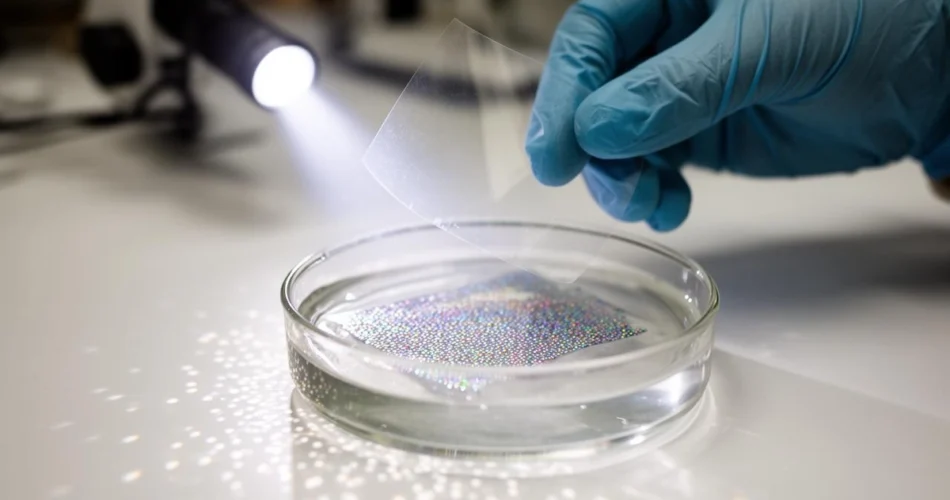
Just as people are identified by their fingerprints, all products and devices are expected to have their own unique “artificial fingerprints” in the future. Simply shining a flashlight will allow authenticity verification, raising security management to a new level.
A research team led by Professor Kim Sang-wook of KAIST’s Department of Materials Science and Engineering, together with Professor Kwon Seok-joon of Sungkyunkwan University’s School of Chemical Engineering, announced on the 26th that they have developed a new foundational security technology utilizing randomly generated nano patterns. The technology uses the arrangements that nanoparticles happen to create as artificial fingerprints for products.
The research team caused round particles measuring several hundred nanometers (nm)—tens of thousands to hundreds of thousands of times thinner than a human hair—to self-assemble on water. The key is that the positions and orientations at which particles gather differ each time, naturally forming distinct patterns. It follows the same principle as shaking a sand tray never producing the same pattern twice. Reproducing an arrangement with exactly identical particle positions and orientations is, probabilistically speaking, virtually impossible.
The research team leveraged this characteristic as an artificial fingerprint to verify product authenticity. Because the method is physically impossible to replicate, it is also safe from password hacking by artificial intelligence (AI) or quantum computers. It is, in effect, a precision security code that is difficult to both hack and replicate.
The artificial fingerprint utilizes all three-dimensional information, including the position and orientation of nanoparticles. According to the research team, when a white LED is shone on the pattern, light passes through and creates a diffraction pattern, with the number of possible patterns reaching 10 to the power of 20. Additionally, when a green laser with a wavelength of 542 nm is directed at the pattern, the number of possible patterns reaches 10 to the power of 164. Combined, the two produce a total of 10 to the power of 184 cryptographic combinations—a number that overwhelmingly exceeds the number of stars in the entire universe and is effectively close to infinity.
Existing security codes often require expensive microscopes or specialized equipment for verification. As codes became increasingly precise to make replication difficult, identification became equally challenging. In contrast, the newly developed artificial fingerprint has the advantage of being verifiable with nothing more than a smartphone flashlight.
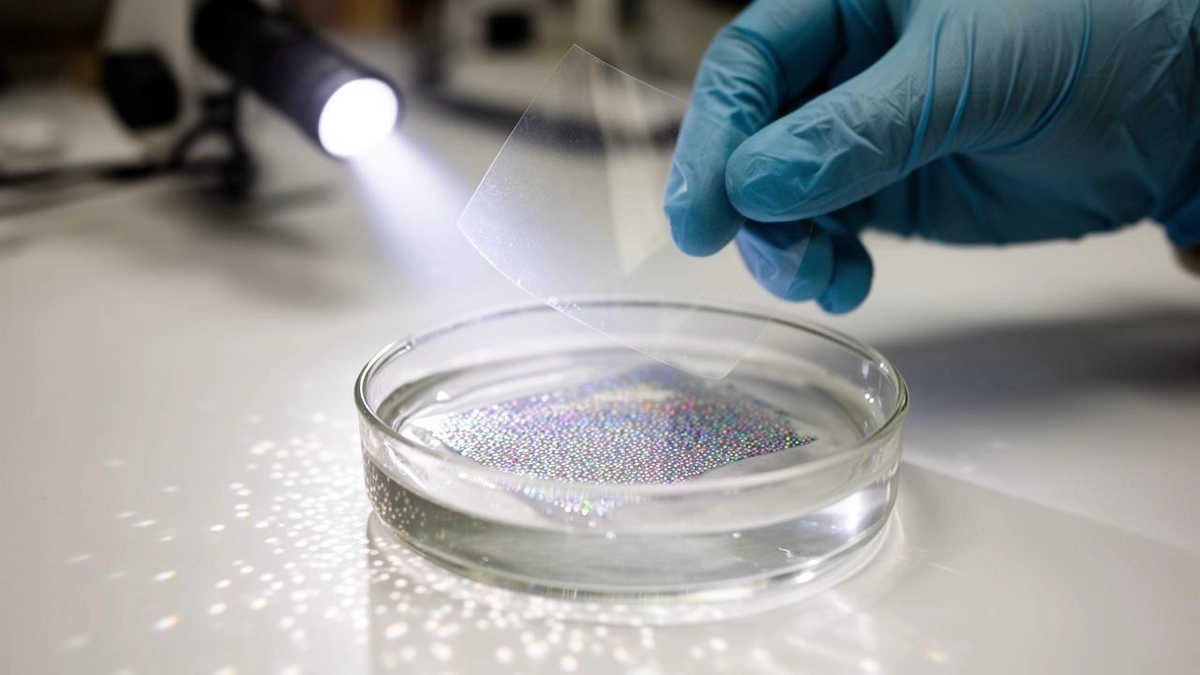
When a flashlight is shone on the pattern, unique colors and reflective patterns appear depending on how the nanoparticles are arranged. When a laser pointer is directed at it, the light encounters the fine particle structures and scatters in multiple directions, producing yet another unique light pattern. Because each artificial fingerprint is different, the light patterns are all different as well.
By utilizing both light patterns, the artificial fingerprint can be verified in duplicate. Rather than directly registering the microscopic artificial fingerprint structure itself, registering only the light patterns visible to the naked eye on the product enables authenticity verification. Even if one pattern is discovered, the other remains completely unknown, further enhancing security. It is a system in which forgery, replication, and hacking are fundamentally impossible at the source.
The reason devices and products need such artificial fingerprints is that the number of electronic devices is expected to increase dramatically in the future. Mobile devices such as smartphones have become a basic premise of daily life, and AI products are also on the rise. Industry projections estimate that Internet of Things (IoT) connected devices will exceed 39 billion units by 2030. As the number of devices grows, the importance of security technology capable of distinguishing authenticity becomes even greater.
Artificial fingerprints can be printed onto labels and attached to various surfaces such as plastics and metals. The research team also succeeded in transferring the nanostructures onto flexible plastics, metals, transparent films, hydrogels, and other diverse surfaces. The technology is expected to be applied to authenticate genuine products across electronics, luxury goods, artworks, and pharmaceuticals. The ability to create the patterns on transparent films without obscuring product design is another advantage.
Professor Kim Sang-wook stated, “The key is that a structure that is difficult to replicate can be verified for authenticity simply. It could develop into a next-generation security technology that is easily utilized in everyday life, such as electronic device authentication or anti-counterfeiting labels.” Regarding commercialization, he added, “We have secured foundational patents through basic research. Once demand is identified, practical application is highly anticipated.”
Dr. Yang Geon-guk of KAIST’s Department of Materials Science and Engineering and Lim Seong-gyun, a doctoral candidate in Sungkyunkwan University’s Department of Chemical Engineering, participated as co-first authors. The research findings were published online in the international journal Nature Communications on July 23.
Source link
Author

- Ytv Market News
- Share-market news writer and analyst with deep experience covering equities, commodities, forex, and cryptocurrencies for readers in the USA, UK, Canada, and Australia. Ytv Market News delivers timely market updates, practical trading insights, and clear explanations of macro and company-level catalysts that move prices. Combines on-the-ground financial reporting with technical analysis, using concise charts and actionable ideas to help investors and traders make smarter decisions.
Latest entries
 UsaAugust 26, 2026Press Release: Don Beyer Criticizes Trump Tariffs on Canada
 Crypto NewsAugust 26, 2026How Ethereum’s new 2,048 ETH staking rule could lock up user rewards longer than expected
 Commodities NewsAugust 26, 2026Iran’s Tanker Blacklist Raises New Risks for Gulf Oil
 Investing InsightsAugust 26, 2026‘Artificial Fingerprint’ Created from Nanoparticle Arrays… Authenticity Verification with Just a Flashlight — BigGo Finance
