

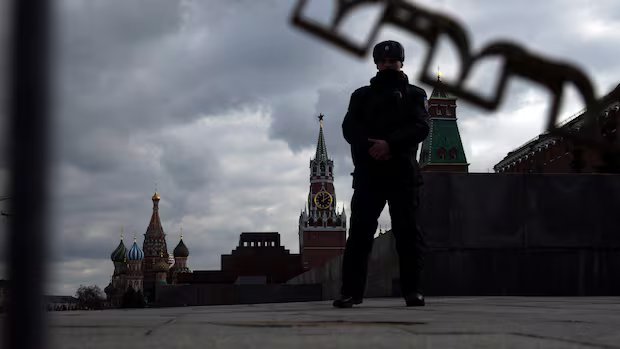
It would be fair to say this summer has been the season of fear and loathing in Eastern Europe, as more signs emerge that Russia could be ready to further test NATO solidarity in the hopes of breaking it.
Poland and Romania have witnessed a series of Russian drone intrusions and at least one missile strike since the spring.
The idea that the Kremlin is preparing some kind of incursion drove speculation surrounding the CIA director’s surprise visit to Moscow last week.
What is worrying officials in Poland and the Baltic states is not the prospect of Russian armoured divisions suddenly crossing the frontier.
The concern is that Moscow may believe it can carry out a deliberately ambiguous, limited act of violence — large enough to frighten or destabilize NATO, but small and deniable enough to make invoking the Western military alliance’s self-defence clause, Article 5, politically difficult.
In late July, a Russian cruise missile crashed into Poland’s Lublin province after travelling deep into Polish territory during a massive strike against Ukraine. Multiple drones have also approached or tested Polish airspace in the weeks since.
A Polish defence expert who specializes in the Russian military and politics said the war in Eastern Europe is rapidly approaching a critical turning point where the Kremlin has reached the conclusion that the only way to defeat Ukraine is to politically break NATO.
“There is frustration [over the] inability to break Ukrainian armed forces and to defeat Ukrainians in the field,” said Withold Rodkiewicz, a security expert at the Center for East European Studies at the University of Warsaw.

The Russian “elite,” as Rodkiewicz calls them, know they’re not winning the war, and Ukraine’s increasingly effective attacks on oil and commercial infrastructure have the potential to destabilize the Kremlin’s grip on power.
“The analysis that’s around in Moscow is that the main reason that Ukrainians are able to resist is because they are supplied from the West,” he said, adding that nothing short of total victory in Ukraine will satisfy the Kremlin.
“They’re not looking for a way out. They are not looking for … an off-ramp,” he said. “When they are thinking what to do next, an escalation is an obvious thing.”
Rodkiewicz said he believes the time will be right for Moscow sometime in September, either before or after Russia’s parliamentary elections.
There is mounting evidence of Russian risk-taking, but there is no consensus that Russian President Vladimir Putin has decided to start a conventional war with NATO. Estonia’s foreign intelligence service, for example, still assesses that Russia does not presently intend to attack a NATO country militarily in the coming year.
Do I think they’ll do something that is so clearly aimed at shaking NATO decision-making and political cohesion? Absolutely.– Kerry Buck, Canada’s former ambassador to NATO
At the same time, throughout the summer, U.S., Polish and Baltic warnings about a provocation have become considerably more specific.
In late June and July, reporting emerged that Western intelligence services had picked up indications that Russia could be preparing some form of action against Poland or the Baltic states, designed specifically to test NATO cohesion.
The Guardian newspaper in the U.K. reported that intelligence received by Latvia pointed toward a possible Russian military provocation, and subsequent reporting said the United States had warned Poland about the possibility of an armed incident on Polish territory.
By early August, the warning sharpened even further. U.S. intelligence was reportedly telling Poland and the Baltic countries that Putin could be prepared to authorize provocative action against NATO while the Ukraine war is still underway, rather than waiting for Russia to regenerate its conventional forces after the war.
That is a significant change in the threat conversation.

Canada’s former ambassador to NATO, Kerry Buck, said Russia has been out to destroy the alliance since its invasion of Crimea in 2014, and the conditions have only improved since U.S. President Donald Trump returned to power last year.
The constant berating of allies, the new fiscal demands placed on them, the cutting of U.S. forces earmarked for an emergency, and now Washington’s review of American troop posture in Europe have created the conditions for a major political crisis, should there be a provocation.
It is, Buck said, “a window of opportunity where Russia was emboldened to poke NATO more, poke NATO territory, airspace and space more.”
While she doesn’t believe an outright attack on NATO is in the offing, she also believes Russia is prepared to try something ambiguous.
“Do I think they’ll do something that is so clearly aimed at shaking NATO decision-making and political cohesion? Absolutely,” Buck said.
Trump told reporters last week that he’s “not concerned at all” about Russia attacking NATO territory. He said he’s spoken to Putin and has been assured he “is not going to be attacking a NATO territory.”
At a meeting of the North Atlantic Council in Brussels last week, U.S. defense policy chief Elbridge Colby insisted Washington is not abandoning Europe. He said it wants a new vision of NATO built around European-led conventional defence.
Buck said most of what Russia is likely planning falls below the threshold of a direct attack. She also accepts at face value what Colby has said. Rather, her concern lies within the reality of NATO politics.
In the past, whenever there’s a crisis, the U.S. has stepped up to organize the allied response. Will that happen under the current administration?
“All signs from President Trump are that they are not as committed as they used to be, so who would step in and lead the preliminary response?” Buck asked.
“And would it be held up by U.S. reluctance? So we’re dealing not just with a lack of U.S. leadership, but potentially U.S. reluctance to fall into whatever it is NATO is doing or might contemplate doing.”

Just recently, Lithuanian intelligence raised another disturbing possibility: Russia using captured Ukrainian drones in a false flag operation against a Baltic country.
Lithuanian Defence Minister Robertas Kaunas said that intelligence indicated Russia might employ captured Ukrainian UAVs in an operation intended to look as though Ukraine had attacked NATO territory.
The objective would be political rather than military, creating confusion inside the alliance and undermining support for Kyiv. Russia dismissed the allegation.
But that scenario becomes more plausible because something very similar happened in Latvia last spring.
Ukrainian strike drones have repeatedly wandered into NATO airspace, apparently in some cases because Russian electronic warfare has disrupted their navigation.
The incident in Latvia caused a political crisis that cost the defence minister his job, and eventually cost the prime minister her job.
Buck said there’s a range of disturbing scenarios for Moscow to make mischief.
“It’s in their interest to do it now,” she said. “And I don’t think NATO’s quite ready to respond in a way, particularly because of the uncertainty about the U.S. response.”
Source link
Author

- Ytv Market News
- Share-market news writer and analyst with deep experience covering equities, commodities, forex, and cryptocurrencies for readers in the USA, UK, Canada, and Australia. Ytv Market News delivers timely market updates, practical trading insights, and clear explanations of macro and company-level catalysts that move prices. Combines on-the-ground financial reporting with technical analysis, using concise charts and actionable ideas to help investors and traders make smarter decisions.
Latest entries
 Commodities NewsAugust 31, 2026China’s LNG Imports Set to Drop 18% in August as Prices Soar | OilPrice.com
 Daily Stock Buy Sell IdeasAugust 31, 2026BSE Sensex Slips to 76,957.27 Amid Renewed US-Iran War and Strait of Hormuz Tensions
 Crypto NewsAugust 31, 2026Is XRP poised for a fresh breakout? | FXStreet
 Crypto NewsAugust 31, 2026BitMine Buys Another 53,501 ETH as Ethereum Stash Blows Past 5.9M

