

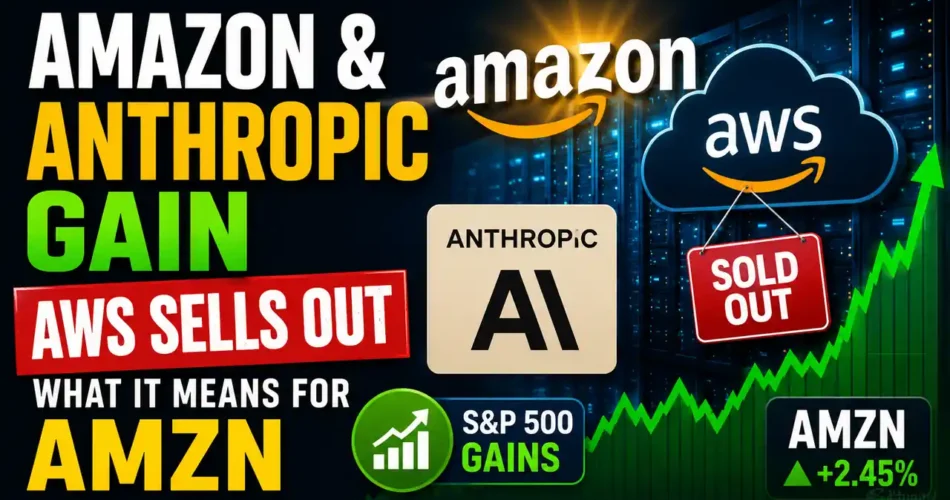
Amazon and Anthropic Gain as AWS Capacity Tightens and S&P 500 Advances
Amazon.com, Inc. and Anthropic are attracting renewed investor attention as demand for artificial intelligence infrastructure continues to reshape the technology market. At the same time, reports that Amazon Web Services capacity is effectively sold out in some areas highlight the extraordinary pace of AI-related cloud demand. The broader S&P 500 also moved higher, adding to a positive backdrop for large technology and growth stocks.
The latest developments illustrate a major theme across global markets: artificial intelligence is no longer simply a software story. It is increasingly driving demand for computing power, data centres, networking equipment, cloud services and advanced semiconductors. Companies positioned across that infrastructure chain are therefore being closely watched by investors.
Amazon Benefits From Strong AWS Demand
Amazon remains one of the most important beneficiaries of the expansion in cloud computing and artificial intelligence. Its Amazon Web Services division provides computing, storage, databases and AI-related services to businesses ranging from startups to large multinational companies.
Growing AI workloads require substantial amounts of computing capacity. Companies developing sophisticated models need access to high-performance processors, large-scale storage and reliable cloud infrastructure. That has created an environment in which cloud providers are under pressure to expand capacity quickly.
For Amazon, stronger AWS demand can have an important impact because the division has historically been a major contributor to the company’s operating profitability. If AI-related workloads continue expanding, additional cloud consumption could support revenue growth while increasing the strategic importance of AWS within Amazon’s overall business.
Why AWS Capacity Matters
Reports that AWS is sold out or facing limited availability in certain capacity categories should not necessarily be interpreted as a permanent shortage across the entire AWS platform. Cloud capacity varies by region, data centre, processor type and customer requirements.
However, capacity constraints can still provide an important signal. They suggest that demand for computing resources may be growing faster than infrastructure can be deployed in particular locations or for particular workloads.
Building new data-centre capacity is a capital-intensive process. It requires land, electricity, cooling systems, networking infrastructure and advanced computing hardware. As AI adoption accelerates, cloud providers must balance rapid expansion with the need to maintain attractive long-term returns on investment.
Anthropic Emerges as a Major AI Growth Story
Anthropic is another company at the centre of the artificial intelligence boom. The AI developer has gained attention for its Claude family of generative AI models, which are designed for tasks such as writing, coding, analysis and business automation.
Anthropic’s relationship with Amazon is strategically significant because AWS has invested heavily in supporting the company’s AI development and commercial expansion. The partnership gives Anthropic access to large-scale cloud infrastructure while strengthening AWS’s position in the highly competitive AI services market.
For Amazon, supporting a leading AI model developer can create opportunities beyond a conventional cloud customer relationship. AI companies can become major consumers of computing resources, while their models can also stimulate additional demand from businesses adopting generative AI.
The AI Cloud Competition
Amazon is competing in an increasingly crowded market. Microsoft has its relationship with OpenAI, while Google has invested heavily in its own AI models and cloud infrastructure. Other technology companies are also building specialised AI platforms and data-centre capabilities.
This competition means that cloud providers must offer more than basic computing power. Customers increasingly want integrated AI models, developer tools, security services, data management and specialised hardware.
AWS therefore has an opportunity to use its extensive enterprise customer base to make AI services easier to adopt. If businesses move from experimental AI projects to large-scale deployments, cloud consumption could increase substantially.
S&P 500 Gains Add to Positive Market Sentiment
The advance in the S&P 500 provides a broader market context for the Amazon and Anthropic developments. Large technology companies have played an important role in supporting U.S. equity markets as investors have focused on earnings growth, AI investment and expectations for continued productivity gains.
Technology stocks can have an outsized influence on major indexes because of their large market capitalisations. As a result, developments involving companies connected to AI can affect both individual stocks and broader investor sentiment.
However, a rising index does not mean every technology stock will continue moving higher. Valuations, interest rates, earnings expectations and future capital spending remain important factors.
What AWS Capacity Constraints Could Mean for Amazon
Limited AWS capacity presents both an opportunity and a challenge for Amazon.
On the positive side, strong demand can indicate that customers are willing to spend heavily on cloud computing and AI infrastructure. Higher utilisation can potentially support AWS revenue growth and strengthen Amazon’s competitive position.
The challenge is the investment required to satisfy that demand. Amazon has been spending heavily on infrastructure, including data centres and AI-related computing equipment. Large capital expenditures can put pressure on near-term free cash flow even when they are intended to support longer-term growth.
Capital Spending Becomes a Key Investor Metric
Investors are increasingly examining the relationship between Amazon’s capital expenditure and the revenue and operating profit generated by AWS.
If infrastructure spending produces strong incremental returns, investors may view the investment cycle positively. If spending rises significantly faster than cloud revenue and profitability, concerns about returns could become more prominent.
The central question is therefore not simply how much Amazon is spending. It is whether those investments create sustainable competitive advantages and attractive long-term cash flows.
Why Anthropic Could Matter to AWS
Anthropic’s growth could have implications for AWS beyond the company’s direct spending on cloud services. Successful AI applications can encourage thousands of other businesses to adopt generative AI.
As organisations deploy AI assistants, coding tools, automated customer-service systems and analytical applications, they require infrastructure capable of handling those workloads. This creates a potential multiplier effect for cloud providers.
AWS can also benefit when businesses build AI applications using its broader technology ecosystem. The more services customers use together, the greater the potential value of the overall cloud relationship.
Risks Investors Should Watch
High Infrastructure Costs
AI computing requires substantial capital investment. Data centres consume significant amounts of electricity and require specialised cooling and networking systems. Rapid expansion could pressure margins if demand does not remain strong enough.
Intense Competition
Amazon faces powerful competitors in cloud computing and AI. Microsoft, Google and numerous specialist technology companies are investing aggressively in the sector.
AI Valuation Risk
Investor enthusiasm surrounding AI has pushed expectations higher across parts of the technology market. Companies associated with AI may therefore face significant share-price volatility if growth projections are reduced.
Regulatory and Energy Challenges
The expansion of AI infrastructure also raises questions about electricity demand, environmental impact, data privacy and regulation. These issues could influence the cost and speed of future data-centre development.
Amazon Stock Outlook
Amazon’s long-term investment case increasingly depends on the performance of AWS alongside its retail and advertising businesses. AWS remains particularly important because cloud services can generate attractive margins when capacity is efficiently utilised.
If AI demand continues to accelerate, AWS could remain one of Amazon’s most important growth engines. Stronger demand for specialised computing capacity could also reinforce the company’s position in enterprise technology.
Nevertheless, investors should monitor quarterly AWS growth, operating margins, capital expenditure, free cash flow and management commentary about AI demand. These indicators can provide a clearer picture of whether today’s infrastructure boom is translating into sustainable financial returns.
What the Latest Market Move Means for Investors
The combination of Amazon’s AWS strength, Anthropic’s expanding role in generative AI and gains in the S&P 500 reflects a market increasingly focused on artificial intelligence as a long-term economic trend.
For Amazon, the opportunity is substantial. The company has a global cloud platform, a large enterprise customer base and a significant role in AI infrastructure. Anthropic adds another strategic dimension by connecting AWS with one of the prominent developers of generative AI models.
At the same time, the investment cycle is expensive and competition is intense. The biggest question for investors is whether demand for AI infrastructure can remain strong enough to justify the enormous amounts being spent on computing capacity.
Conclusion
Amazon, Anthropic and AWS are positioned at the intersection of two powerful trends: cloud computing and artificial intelligence. Reports of tight AWS capacity underscore the scale of demand facing cloud providers, while Anthropic’s growth highlights the expanding ecosystem around generative AI.
The S&P 500’s gains provide an additional sign that investors remain interested in technology-led growth. But market optimism must ultimately be supported by earnings, cash flow and productive investment.
For Amazon shareholders and prospective investors, AWS growth, AI infrastructure spending and profitability will remain critical factors to watch. The company’s ability to convert unprecedented AI demand into durable earnings could determine whether the current cloud expansion becomes one of Amazon’s most important growth opportunities.
Frequently Asked Questions
Why is Amazon gaining attention?
Amazon is attracting attention because AWS continues to benefit from strong cloud and AI infrastructure demand, while the company’s relationship with Anthropic strengthens its position in generative AI.
What does AWS being sold out mean?
AWS capacity constraints generally refer to limited availability in particular regions, infrastructure types or computing resources. They can indicate strong customer demand but do not necessarily mean that all AWS services are unavailable.
Why is Anthropic important to Amazon?
Anthropic is an important AI partner for Amazon. Its expanding use of cloud infrastructure can contribute to AWS demand while helping Amazon compete in the rapidly developing generative AI market.
Is Amazon a good AI stock?
Amazon has significant exposure to AI through AWS, cloud infrastructure, computing services and its relationship with AI developers. However, investors should evaluate valuation, earnings, capital spending and competitive risks before making an investment decision.
Why does the S&P 500 matter to Amazon investors?
The S&P 500 is a major benchmark for U.S. equities. Gains in the index can reflect improving investor sentiment, although Amazon’s individual performance will ultimately depend on its own financial results and outlook.
What should investors watch next?
Key indicators include AWS revenue growth, operating margin, capital expenditure, free cash flow, AI-related demand and management’s outlook for future cloud capacity. These factors can help investors assess whether the AI investment cycle is creating sustainable value.
Disclaimer: This article is for informational purposes only and should not be considered financial or investment advice. Investors should conduct their own research and consider their financial circumstances before making investment decisions.
External References
U.S. Federal Reserve – Monetary Policy
– Official information on U.S. monetary policy, interest rates and economic conditions. 0
U.S. Federal Reserve – Federal Open Market Committee
– Official FOMC statements, meeting information and monetary-policy decisions. 1
U.S. Bureau of Economic Analysis – Gross Domestic Product
– Official U.S. GDP data and economic growth information. 2
U.S. Department of Energy – Data Center Resource Hub
– Government information on AI, data centres, computing capacity and electricity demand. 3
U.S. Federal Reserve – Policy Rate
– Official data on the federal funds rate and its role in the U.S. economy. 4
“`5

