
Life sciences tools company Agilent Technologies (NYSE:A) reported revenue ahead of Wall Street’s expectations in Q2 CY2026, with sales up 8.1% year on year to $1.88 billion. Guidance for next quarter’s revenue was better than expected at $1.99 billion at the midpoint, 1% above analysts’ estimates. Its non-GAAP profit of $1.62 per share was 9% above analysts’ consensus estimates.
Is now the time to buy Agilent? Find out in our full research report.
Agilent (A) Q2 CY2026 Highlights:
- Revenue: $1.88 billion vs analyst estimates of $1.84 billion (8.1% year-on-year growth, 1.9% beat)
- Adjusted EPS: $1.62 vs analyst estimates of $1.49 (9% beat)
- Revenue Guidance for Q3 CY2026 is $1.99 billion at the midpoint, above analyst estimates of $1.97 billion
- Management raised its full-year Adjusted EPS guidance to $6.20 at the midpoint, a 2.4% increase
- Operating Margin: 23.6%, up from 20.7% in the same quarter last year
- Free Cash Flow Margin: 23.4%, up from 14.9% in the same quarter last year
- Organic Revenue rose 7.3% year on year (beat)
- Market Capitalization: $43.71 billion
Company Overview
Originally spun off from Hewlett-Packard in 1999 as its measurement and analytical division, Agilent Technologies (NYSE:A) provides analytical instruments, software, services, and consumables for laboratory workflows in life sciences, diagnostics, and applied chemical markets.
Revenue Growth
A company’s long-term sales performance can indicate its overall quality. Even a bad business can shine for one or two quarters, but a top-tier one grows for years. Unfortunately, Agilent’s 3.7% annualized revenue growth over the last five years was tepid. This fell short of our benchmark for the healthcare sector and is a poor baseline for our analysis.
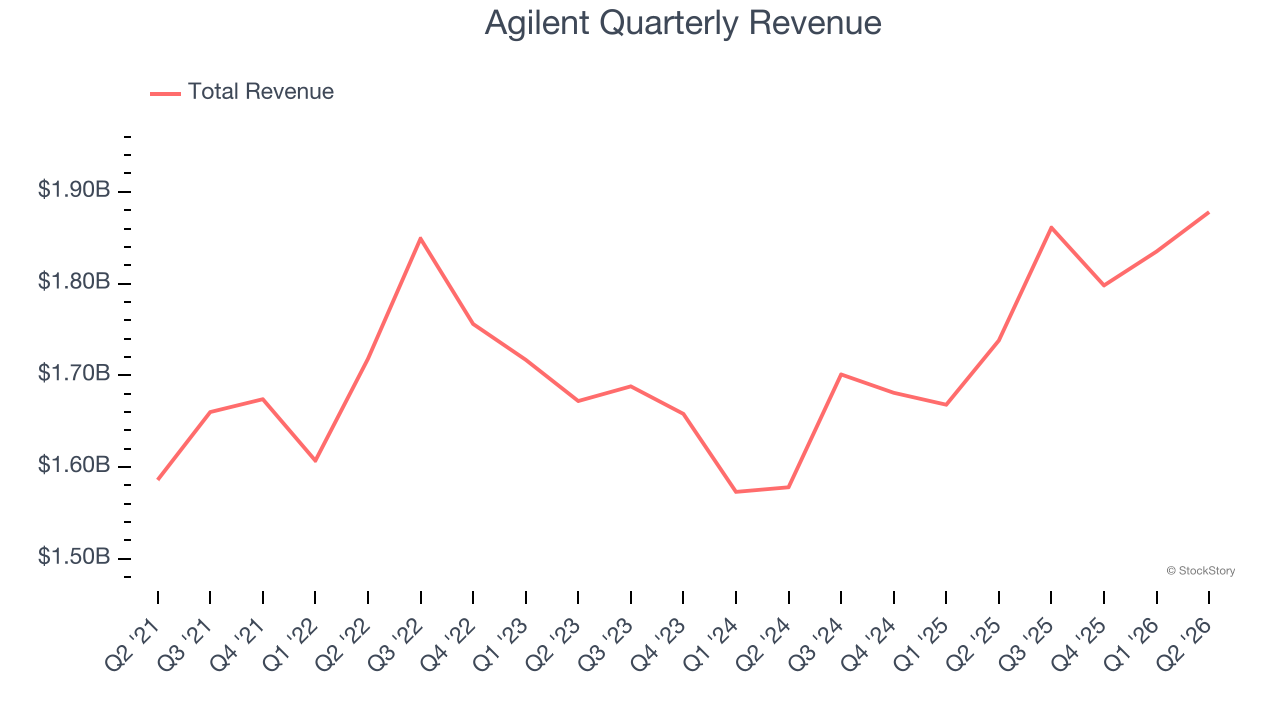
Long-term growth is the most important, but within healthcare, a half-decade historical view may miss new innovations or demand cycles. Agilent’s annualized revenue growth of 6.5% over the last two years is above its five-year trend, which is encouraging. 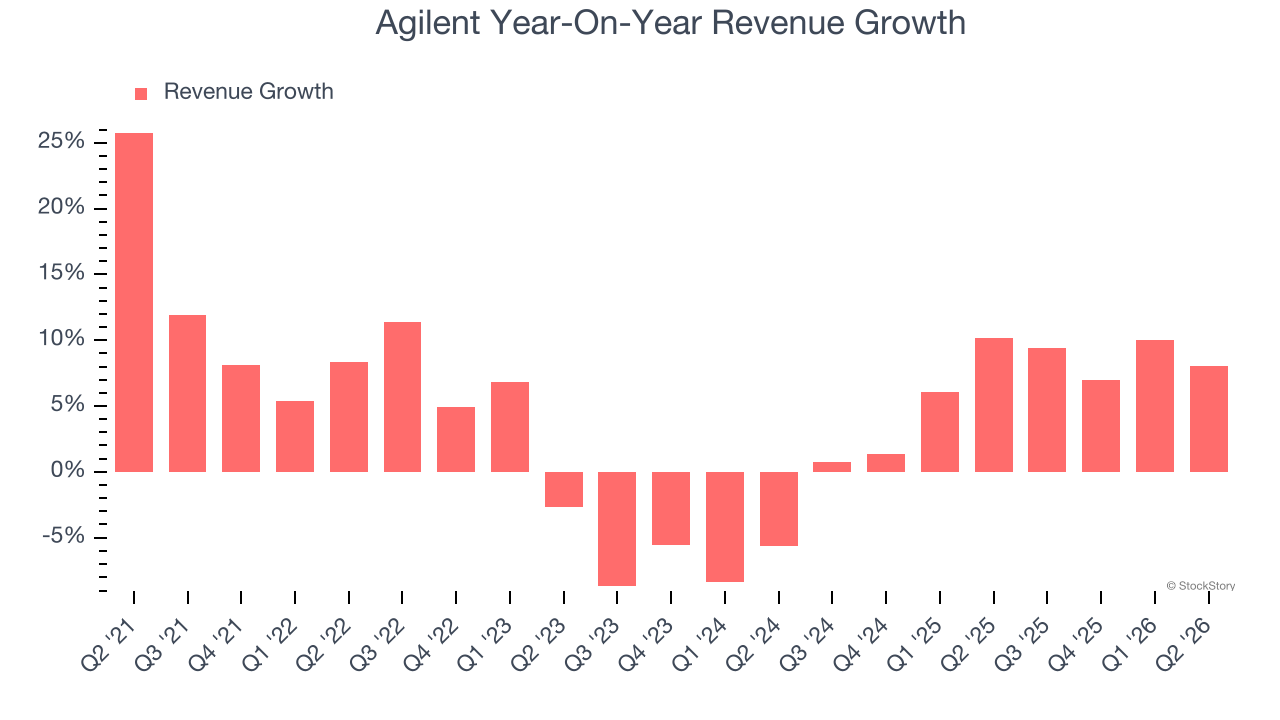
We can dig further into the company’s sales dynamics by analyzing its organic revenue, which strips out one-time events like acquisitions and currency fluctuations that don’t accurately reflect its fundamentals. Over the last two years, Agilent’s organic revenue averaged 4.4% year-on-year growth. Because this number is lower than its two-year revenue growth, we can see that some mixture of acquisitions and foreign exchange rates boosted its headline results. 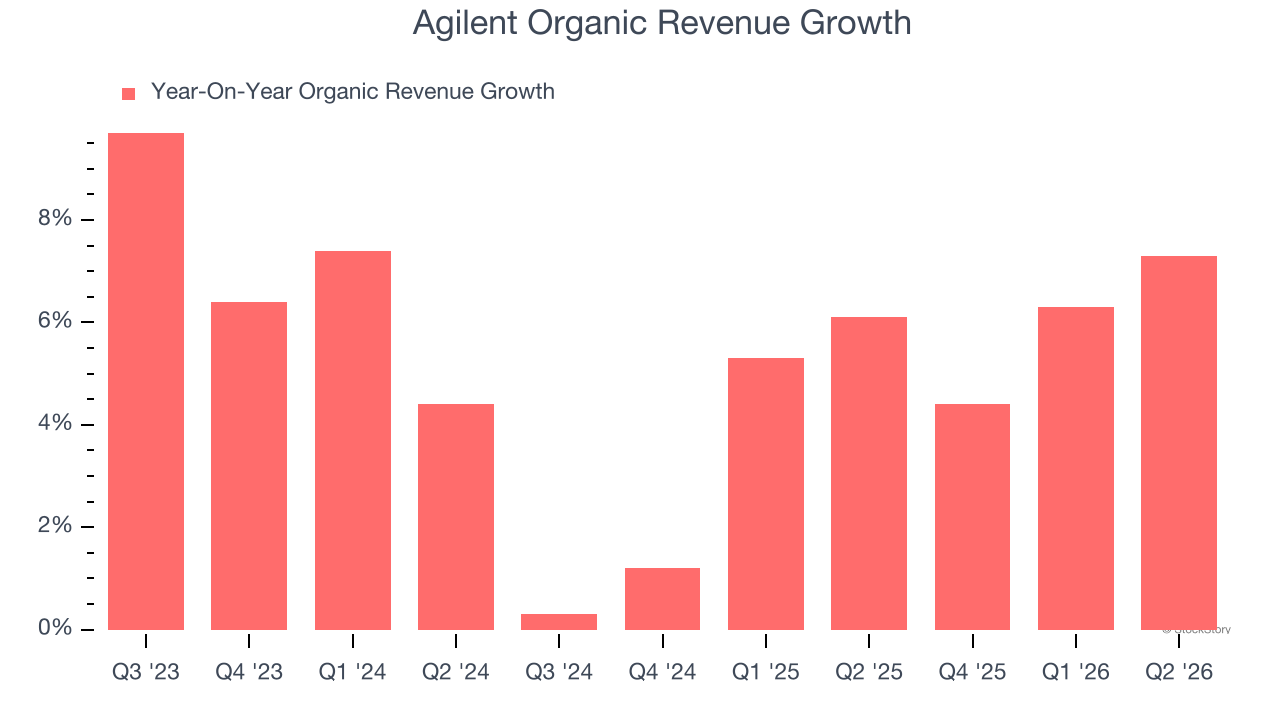
This quarter, Agilent reported year-on-year revenue growth of 8.1%, and its $1.88 billion of revenue exceeded Wall Street’s estimates by 1.9%. Company management is currently guiding for a 6.9% year-on-year increase in sales next quarter.
Looking further ahead, sell-side analysts expect revenue to grow 5.4% over the next 12 months, similar to its two-year rate. Still, this projection is above the sector average and suggests the market is forecasting some success for its newer products and services.
ONE MORE THING: 3 Hidden Platforms Growing 3X Faster than Amazon, Google, and PayPal. Amazon, Google, and Meta all followed the same playbook: Dominate an ignored market. Build an unbeatable moat. Scale until you’re unstoppable.
These three platforms are running that exact playbook right now. The early investors in Amazon made fortunes. The early investors in these could do the same. Get All 3 Stocks Here for FREE.
Adjusted Operating Margin
Agilent’s adjusted operating margin has more or less stayed the same over the last 12 months , averaging 26.5% over the last five years. This profitability was top-notch for a healthcare business, showing it’s a well-run company with an efficient cost structure.
Analyzing the trend in its profitability, Agilent’s adjusted operating margin might have fluctuated slightly but has generally stayed the same over the last five years. This raises questions about the company’s expense base because its revenue growth should have given it leverage on its fixed costs, resulting in better economies of scale and profitability.
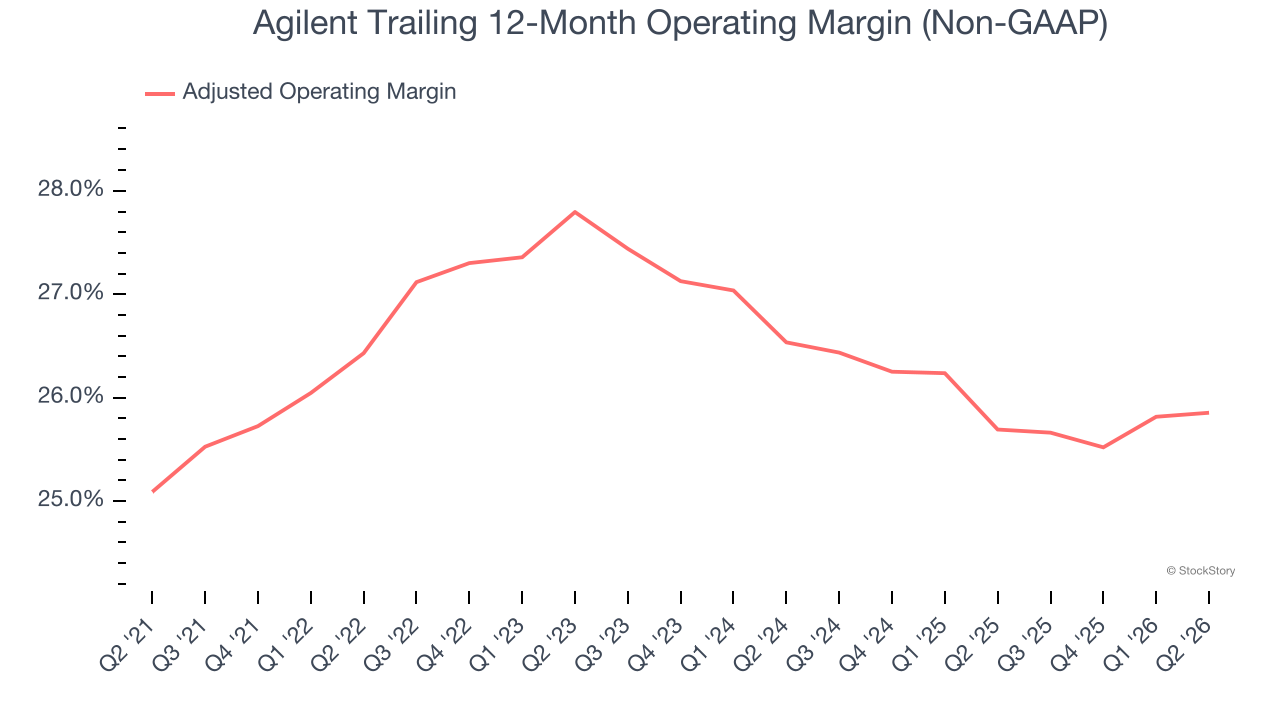
In Q2, Agilent generated an adjusted operating margin profit margin of 25.3%, in line with the same quarter last year. This indicates the company’s overall cost structure has been relatively stable.
Earnings Per Share
We track the long-term change in earnings per share (EPS) for the same reason as long-term revenue growth. Compared to revenue, however, EPS highlights whether a company’s growth is profitable.
Agilent’s EPS grew at 8.1% compounded annual growth rate over the last five years, higher than its 3.7% annualized revenue growth. However, this alone doesn’t tell us much about its business quality because its adjusted operating margin didn’t improve.
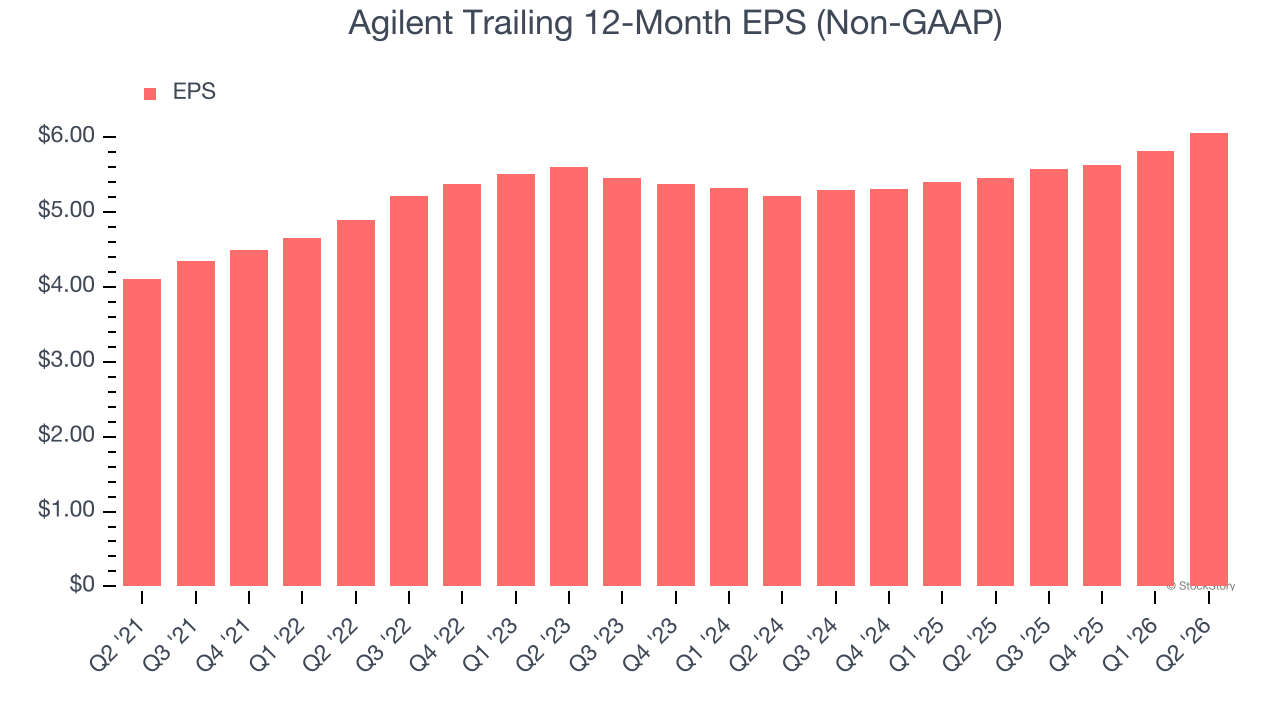
Diving into Agilent’s quality of earnings can give us a better understanding of its performance. A five-year view shows that Agilent has repurchased its stock, shrinking its share count by 7.5%. This tells us its EPS outperformed its revenue not because of increased operational efficiency but financial engineering, as buybacks boost per share earnings. 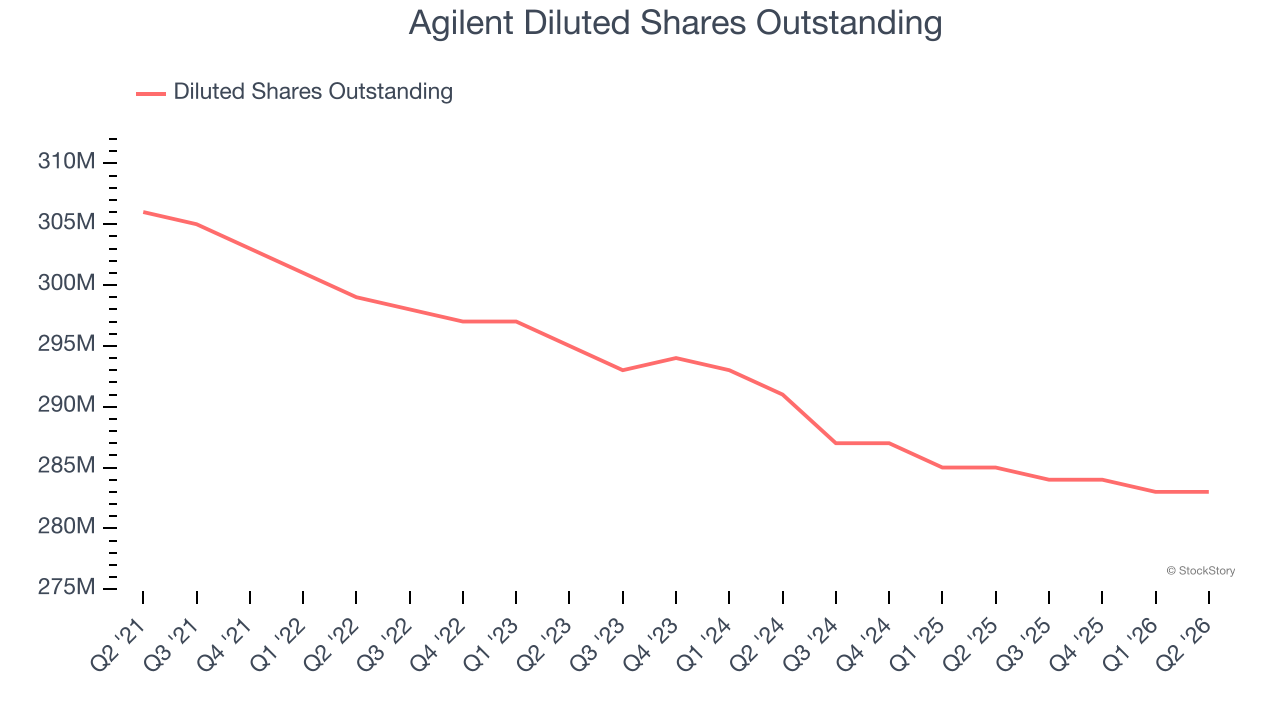
In Q2, Agilent reported adjusted EPS of $1.62, up from $1.37 in the same quarter last year. This print beat analysts’ estimates by 9%. Over the next 12 months, Wall Street expects Agilent’s full-year EPS to grow 6.5% from $6.06 to $6.45.
Key Takeaways from Agilent’s Q2 Results
We enjoyed seeing Agilent beat analysts’ organic revenue expectations this quarter. We were also happy its full-year EPS guidance outperformed Wall Street’s estimates. Overall, we think this was a decent quarter with some key metrics above expectations. The stock traded up 2.1% to $158.43 immediately after reporting.
Agilent put up rock-solid earnings, but one quarter doesn’t necessarily make the stock a buy. Let’s see if this is a good investment. If you’re making that decision, you should consider the bigger picture of valuation, business qualities, as well as the latest earnings. We cover that in our actionable full research report which you can read here (it’s free).
Source link
Author

- Ytv Market News
- Share-market news writer and analyst with deep experience covering equities, commodities, forex, and cryptocurrencies for readers in the USA, UK, Canada, and Australia. Ytv Market News delivers timely market updates, practical trading insights, and clear explanations of macro and company-level catalysts that move prices. Combines on-the-ground financial reporting with technical analysis, using concise charts and actionable ideas to help investors and traders make smarter decisions.
Latest entries
 Stock Market VideosAugust 26, 2026They Have Better Margins Than Google | Tavi Costa on the Rebirth of Mining
 UsaAugust 26, 2026Beam Global (BEEM) Q2 2026 Earnings Call Transcript
 AustraliaAugust 26, 2026Tasmea posts strong FY26 earnings, upgrades FY27 guidance
 Crypto NewsAugust 26, 2026Bitcoin price could reach $150K by mid-2027: Bernstein