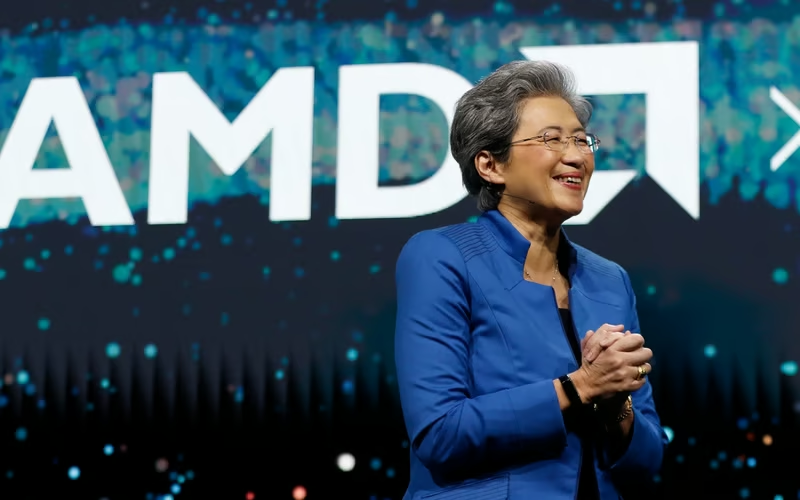
“In server CPUs with very strong customer demand and improved supply, we now expect server revenue to grow more than 80% year-over-year in the second half of 2026 and more than 70% for the full year 2027, off a much higher base,” said AMD (AMD -4.27%) CEO Lisa Su on the company’s second-quarter earnings call in early August.
The remarkable part of that forecast is what the numbers are attached to. They describe AMD’s server CPU business (the EPYC processors that run ordinary computing workloads), not the Instinct accelerators that are the company’s direct play on artificial intelligence (AI).
The traditional side of AMD’s data center segment, in other words, is now guided to grow at rates investors usually associate with the AI build-out itself.
And there’s a third number I’d keep separate from those two. Su said the company now expects total data center segment revenue, which contains both businesses, to more than double year over year in 2027.

Image source: Advanced Micro Devices Inc.
Two businesses, one segment
AMD’s second quarter of 2026 shows the scale involved. Company revenue rose 50% year over year to a record $11.5 billion. Data center segment revenue climbed 107% to $6.7 billion — 58% of everything AMD took in during the period.
That segment contains two different businesses. GPU sales more than doubled year over year as the MI350 Series ramped.
The server CPU side has a streak going. Not only did server CPU revenue set a record for the fifth consecutive quarter, but cloud and enterprise sales each grew more than 70% year over year, ahead of the company’s own outlook. AMD also said it gained x86 server revenue share. And Su noted the growth came from double-digit increases in both unit shipments and average selling prices, with units contributing more.
Of course, AMD doesn’t disclose the dollar split between the two businesses, so the server CPU side can’t be sized precisely from the outside. But a business setting revenue records five quarters running and growing 70%-plus is a big piece of that $6.7 billion.
The company’s upcoming server chips suggest the momentum can continue. Su said on the call that customer demand for Venice, AMD’s next EPYC generation, is stronger than for any prior generation, and that the company expects to keep gaining share in cloud and enterprise in the coming quarters.
AI is pulling ordinary computing along
Part of the explanation is AI itself. Accelerator deployments still need conventional processors running alongside them.
Su told analysts that AMD sees agentic AI workloads (AI systems that carry out multistep tasks on their own, largely on conventional processors) becoming the largest and fastest-growing piece of a server CPU market the company projects will reach about $220 billion by 2030. That projection is a management estimate, not a market fact. But it reframes a product category most of AMD’s recent growth headlines have had little to do with.
The near-term guidance is more concrete. For the third quarter, AMD guided to about $13 billion of revenue, plus or minus $300 million. At the midpoint, that would be about 41% year-over-year growth.
The second-half server outlook (that more-than-80% figure) includes that quarter. And the 2027 server CPU outlook builds on that second half, “off a much higher base.”
The distinction between the two businesses matters for durability. Accelerator demand depends on a handful of AI giants sustaining enormous budgets. Server CPU demand is spread across a much broader set of cloud and enterprise customers, and it’s growing on unit volume, not just pricing.
If AI spending ever cools, the two could cool at very different speeds.

Today’s Change
(-4.27%) $-21.61
Current Price
$484.39
Key Data Points
Market Cap
Day’s Range
$474.98 – $491.81
52wk Range
$149.22 – $584.73
Volume
23.5M
Avg Vol
29.8M
Gross Margin
50.37%
What is the quiet half worth?
At about $514 per share as of this writing, AMD trades at about 132 times earnings over the past year, and about 46 times what analysts expect it to earn over the coming one.
Profits are catching up fast. Set aside about $800 million of charges AMD booked a year earlier, and adjusted earnings per share rose 82% year over year in the second quarter. However, a forward multiple in the mid-40s bakes in years of execution from both halves of the data center segment.
Su’s numbers make AMD’s growth arguably better than the AI-accelerator headlines suggest — broader, and less tied to a single spending cycle. Ultimately, though, the guidance changes what investors are getting for today’s price. It doesn’t make the stock any cheaper.
Source link