

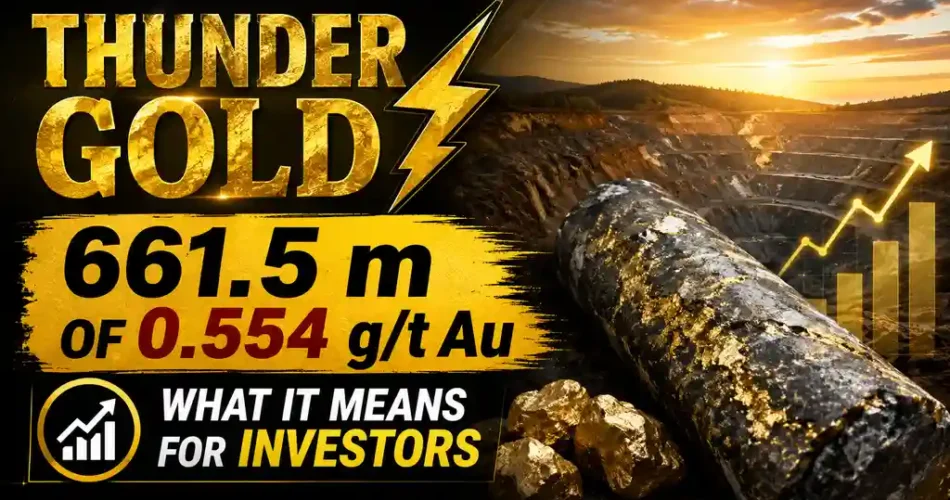
Thunder Gold Reports 661.5 m of Continuous Gold Mineralization Averaging 0.554 g/t Au
Thunder Gold has announced a major drilling result: a continuous intersection of 661.5 metres of gold mineralization with an average grade of 0.554 grams per tonne (g/t) gold. This discovery represents a meaningful step forward for the company’s exploration program and could materially change the perceived potential of the target area. The following article explains the significance of the result, how it was obtained, and what it may mean for Thunder Gold’s next steps.
What the Result Means
A continuous intercept of 661.5 metres implies a large, uninterrupted zone in which gold occurs at detectable grades. While 0.554 g/t Au is not high compared with high-grade underground deposits, it is notable for an open-pit or bulk-tonnage target where volume can compensate for lower grade. In bulk-mining scenarios, even grades around 0.3–1.0 g/t can be economically attractive if the mineralization is continuous and amenable to large-scale, low-cost extraction.
This result increases the likelihood that the deposit could be classified as a bulk-tonnage target requiring open-pit mining methods. Continuity is one of the most important features for early-stage resource evaluation: it lowers geological risk, improves confidence in future resource estimation, and supports planning for larger, more efficient mining operations.
Why continuity matters
- Predictable tonnage: continuous mineralization simplifies estimating the quantity of ore.
- Lower mining cost per tonne: uniform grade zones allow steady processing throughput.
- Easier resource classification: continuity helps move from inferred to indicated and measured categories with additional drilling.
How the Intercept Was Obtained
Thunder Gold’s exploration team used a systematic drilling program focused on extending and infilling previously identified mineralized zones. Drill holes were oriented and spaced to test both depth and lateral continuity. The 661.5-metre interval reflects composite data from one or more contiguous holes that collectively demonstrate uninterrupted gold-bearing rock over that length.
Sampling followed standard protocols: core recovery measurement, logged lithology and alteration, and interval sampling at predefined lengths. Samples were sent to accredited laboratories for assay using accepted techniques such as fire assay with atomic absorption or ICP finish, depending on lab procedures. Quality control measures, including blanks, standards, and duplicate samples, were reportedly incorporated to ensure data integrity.
Typical steps in confirming a long intercept
- Geologic logging and core photography.
- Systematic sampling at consistent intervals.
- Laboratory assays with QA/QC supervision.
- Geostatistical review to confirm continuity and homogeneity.
Geological Context and Interpretation
The mineralized zone appears hosted within favourable lithologies that may include altered volcanics, intrusive contacts, or sedimentary successions—common hosts for disseminated or structurally controlled gold. Alteration minerals (for example, silica, sericite, or carbonate overprinting) and sulphide presence often accompany gold mineralization and assist geologists in tracing mineralized corridors.
A 0.554 g/t average grade over such an extended interval suggests a dispersed or disseminated style of mineralization rather than narrow veins of very high-grade gold. This typically aligns with large-scale systems formed by hydrothermal fluids migrating through permeable strata or along structural conduits, depositing gold over broad zones.
What geologists will investigate next
- Mineralogical studies to determine gold occurrence (free gold, sulphide-hosted, refractory).
- Structural mapping to define controls on mineralization.
- Geochemical and geophysical surveys to trace the mineralized system laterally and at depth.
- Step-out and infill drilling to expand and upgrade the resource.
Economic Implications
Economic viability will depend on several factors beyond average grade: metallurgy and recoveries, strip ratio for open-pit extraction, infrastructure and access, environmental and permitting issues, and commodity prices. Bulk-tonnage deposits can be profitable at modest grades if metallurgical recovery is high and mining costs are low.
A continuous 661.5 m zone of 0.554 g/t Au gives Thunder Gold leverage when planning follow-up programs, as the company can design targeted drilling to delineate a maiden resource. If confirmatory drilling demonstrates consistent grade and thickness across a large area, the project could attract strategic partners or junior-to-mid-tier miners interested in developing an open-pit operation.
Next Steps for Thunder Gold
Thunder Gold is likely to pursue several parallel activities to advance the discovery:
- Additional infill drilling to convert inferred resources into higher-confidence categories.
- Step-out drilling to determine the lateral and vertical extent of mineralization.
- Metallurgical testwork to evaluate gold recovery and processing options.
- Preliminary economic assessment (PEA) to model potential project economics and sensitivity to gold price.
- Environmental baseline studies and community engagement to prepare for permitting.
These actions will refine resource estimates and help quantify the project’s economic potential. Successful metallurgical results and favourable strip ratios would strengthen the case for moving toward prefeasibility and feasibility studies.
Risks and Considerations
While the news is encouraging, several risks remain:
- Grade variability: Extended averages mask internal variability, including intervals of lower or higher grade.
- Metallurgical complexity: If gold is refractory (locked in sulphides or finely disseminated), recoveries could be lower and processing costs higher.
- Geotechnical and hydrological challenges: Open-pit feasibility depends on stable pit walls and manageable water inflow.
- Regulatory and community risks: Permitting and social license are critical and can slow timelines.
Investors and stakeholders should look for follow-up drill results, metallurgical findings, and any resource estimates or economic studies that provide a clearer picture of project viability.
Example scenario: How this could translate to a maiden resource
Assume Thunder Gold defines a contiguous volume averaging 0.554 g/t over a large area with reasonable continuity and a bulk density typical for host rocks (for example, 2.6 t/m³). With sufficient lateral and vertical extent, the company might outline tens of millions of tonnes of material. At current gold prices, such a mass could represent a substantial contained metal inventory, though economic extraction would depend on recovery rates and mining costs.
This simplified thought experiment shows why wide, continuous intercepts are significant: they underpin the scale that makes bulk mining attractive.
Frequently Asked Questions
What does 0.554 g/t Au mean in plain terms?
It means that, on average, each tonne of rock in the intersected zone contains 0.554 grams of gold. For bulk-tonnage operations, lower grades can be economic if the volume is large and mining/processing costs are low.
Is a 661.5-metre intercept unusual?
Long continuous intercepts are noteworthy because they show persistent mineralization. They aren’t everyday finds, and a continuous span of this length is especially meaningful for large-scale targets.
Will this result immediately make Thunder Gold profitable?
Not immediately. This result is an exploration milestone. Profitability depends on later-stage studies: resource definition, metallurgy, mining costs, permitting, and gold prices.
What additional data should I watch for?
Look for infill and step-out drilling results, a maiden resource estimate, metallurgy test reports, a PEA, and any news on permitting or partnerships.
Could this be mined by open-pit methods?
Potentially, yes. Continuous, near-surface mineralization at modest grades often suits open-pit mining, but final determination requires detailed geotechnical, hydrological, and economic studies.
Here are 3 authoritative Canadian government reference links you can add to your article for context on mining, exploration data, and regulations:
Natural Resources Canada – Mining data, statistics and analysis
https://natural-resources.canada.ca/minerals-mining/mining-data-statistics-analysis
Use for: General background on Canada’s minerals sector, exploration trends, and official statistics.
Natural Resources Canada – Canadian Mineral Exploration Information Bulletin (April 2026)
https://natural-resources.canada.ca/minerals-mining/mining-data-statistics-analysis/minerals-mining-publications/canadian-mineral-exploration-information-bulletin
Use for: Up‑to‑date figures on exploration spending, provincial breakdowns, and industry context for gold exploration in Canada.
Justice Laws Website – Metal and Diamond Mining Effluent Regulations (SOR/2002-222)
https://laws-lois.justice.gc.ca/eng/regulations/SOR-2002-222/index.html
Use for: Regulatory context on environmental standards and effluent rules that apply to metal mining operations in Canada.

