


Crude oil has once again become a hostage of geopolitics. Attacks in the Persian Gulf region and increasing restrictions on transit in the Strait of Hormuz have pushed demand fundamentals into the background. Although backwardation at the short end of the oil market curve is not as strong as it was 5 months ago, this same short end is currently trading significantly higher. The geopolitical premium in the oil market is priced at at least a dozen dollars per barrel and it does not seem likely to dissipate anytime soon.
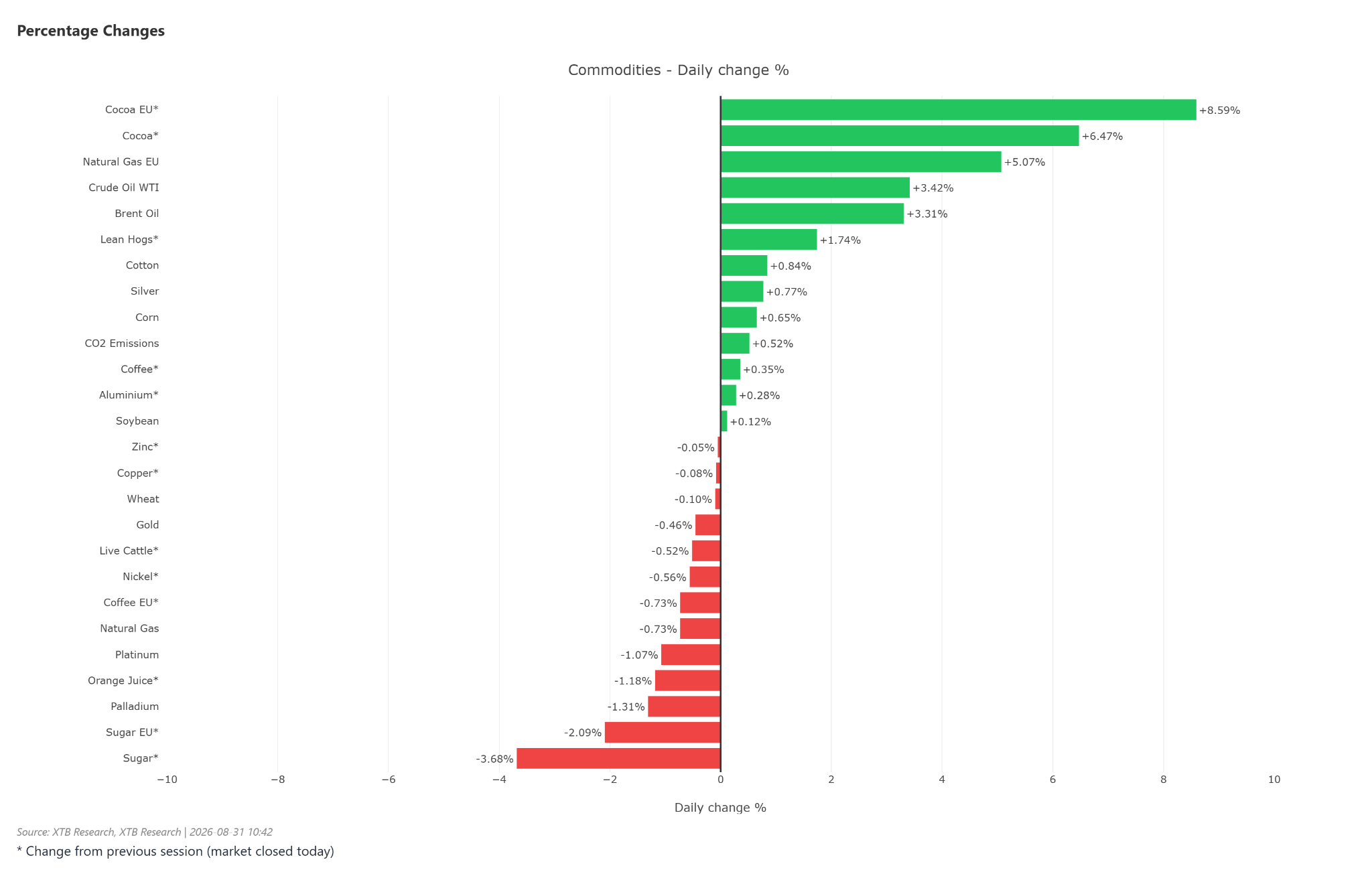 Leaving aside the strong price changes in cocoa from Friday, oil and gas are the strongest commodities today. Source: XTB
A decomposition of the factors affecting the price of crude oil clearly indicates that geopolitical risk became the main driver of price increases in August. While the impact of demand remains slightly negative, according to the Bloomberg Economics price impact model, and other supply factors have stabilized, mounting military tensions in the Middle East region have led to a risk premium reaching a dozen dollars per barrel.
Key factors affecting crude oil prices
- Physical availability of oil restricted in the Strait of Hormuz: The direct exchange of missile strikes between US and Iranian forces around Larak Island and the retaliatory attack on bases in Jordan led to a jump in Brent oil prices above 91 USD/bbl, and WTI to around 86 USD/bbl. Before the war, 20 million barrels per day flowed through Hormuz. In the meantime, levels as low as 6-8 million barrels per day were reached, while currently this number may be even twice as low.
- Extreme backwardation on the forward curve: The term structure of Brent oil contracts is characterized by a steep drop in prices in subsequent months and years (deep backwardation). Contracts for the coming months are priced significantly higher than series for delivery in 2027–2028 (where the valuation drops to 70–80 USD/bbl). This reflects market concerns about an immediate, physical shortage of the raw material “right now,” with no concerns about long-term resource depletion.
- Refining bottlenecks and jump in fuel prices: Rising raw material prices combined with attacks on refining infrastructure in Russia and the Middle East led to a strong increase in distillate margins. Retail diesel prices in the US have risen as much as 60% this year, while in September diesel rates in the United Arab Emirates jumped by over 13% m/m.
- Political pressure before the US elections: The rise in market fuel prices directly impacts the political situation in the United States ahead of the November Congressional elections. The correlation between the rising average gasoline price in the US (exceeding 4 USD/gallon) and the decline in the Republican Party’s chances of maintaining control of the House of Representatives (falling to approx. 11% on prediction markets) shows that the political cost of the conflict for the White House is becoming critical.
- Protective and diplomatic actions: In response to the crisis, Washington announces weekly tightening of financial sanctions on institutions handling trade with Iran. Parallel steps are being taken to secure long-term supply resources – including plans to take control over reserves in Venezuela (100-year concessions) for the purpose of rebuilding US Strategic Petroleum Reserves (SPR).
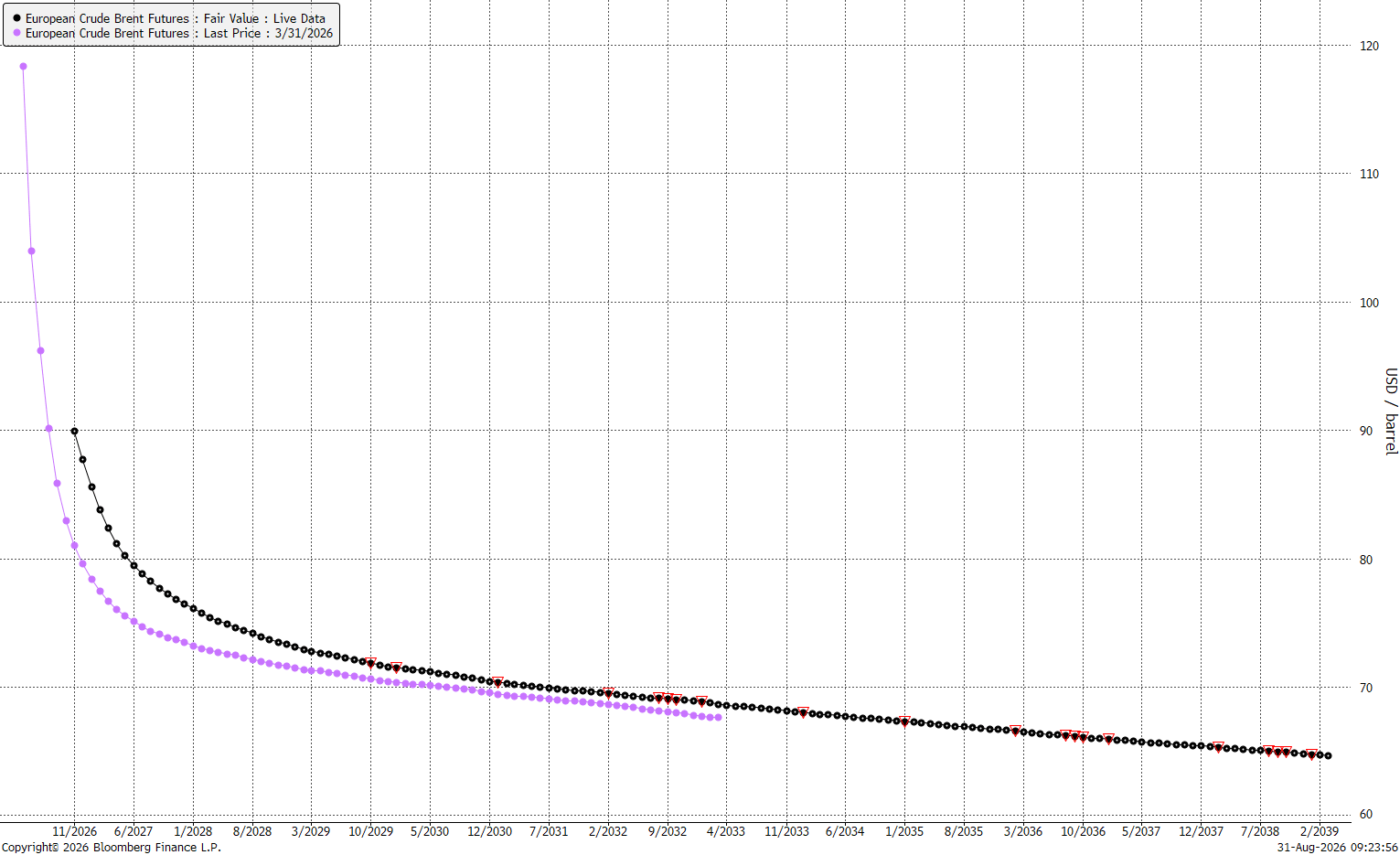 The forward curve remains in strong backwardation. Although the calendar spreads on the short end are not as large as they were 5 months ago, the entire curve is clearly higher. Source: Bloomberg Finance LP
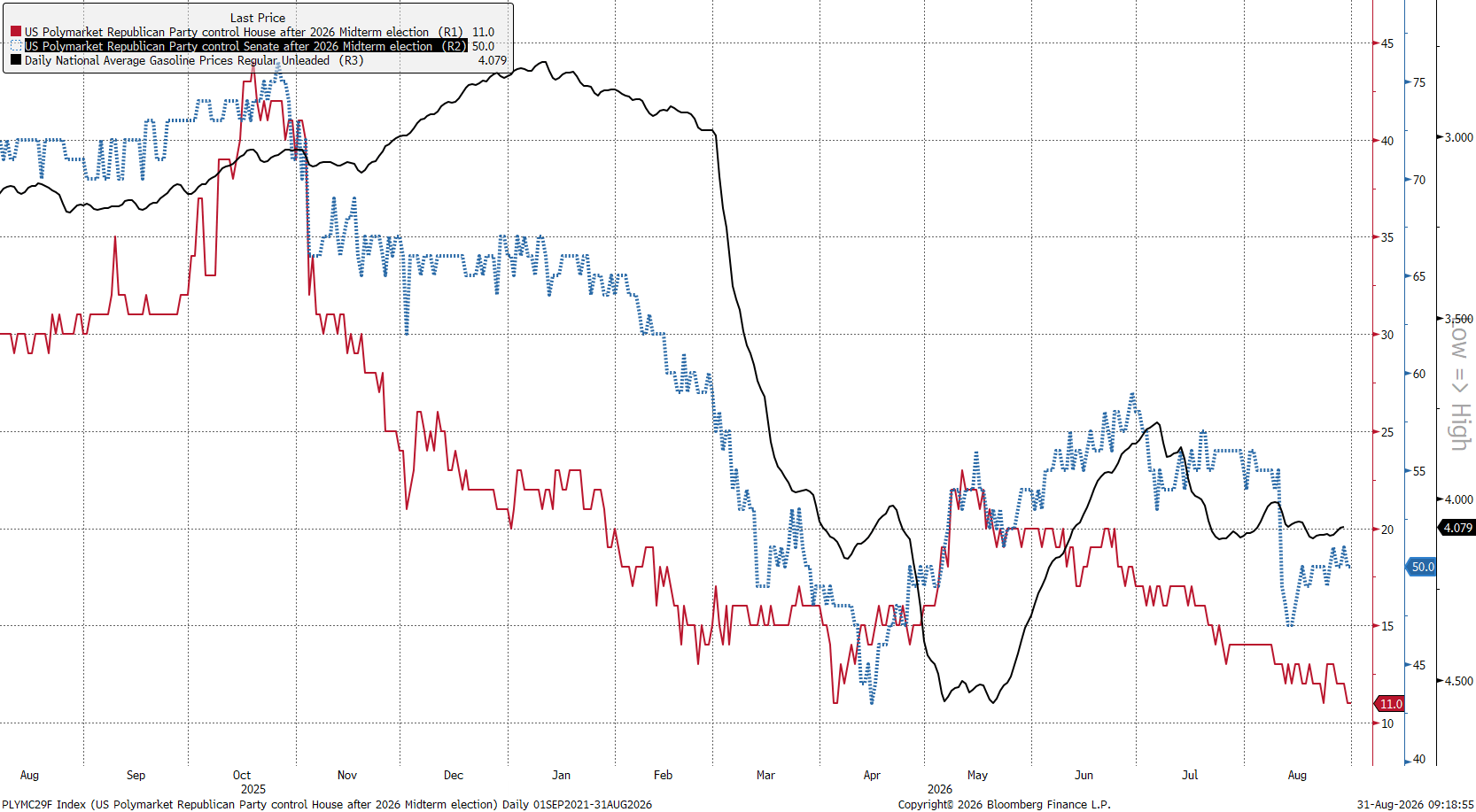 The chances of Republican Party dominance in the House of Representatives have fallen to 11%. On the other hand, there is a much clearer correlation between the probability of continued dominance in the Senate and gasoline prices in the US. If the Republicans hold the Senate, the current situation in the US will not change. Source: Bloomberg Finance LP, XTB
WTI oil prices above 100-SMA
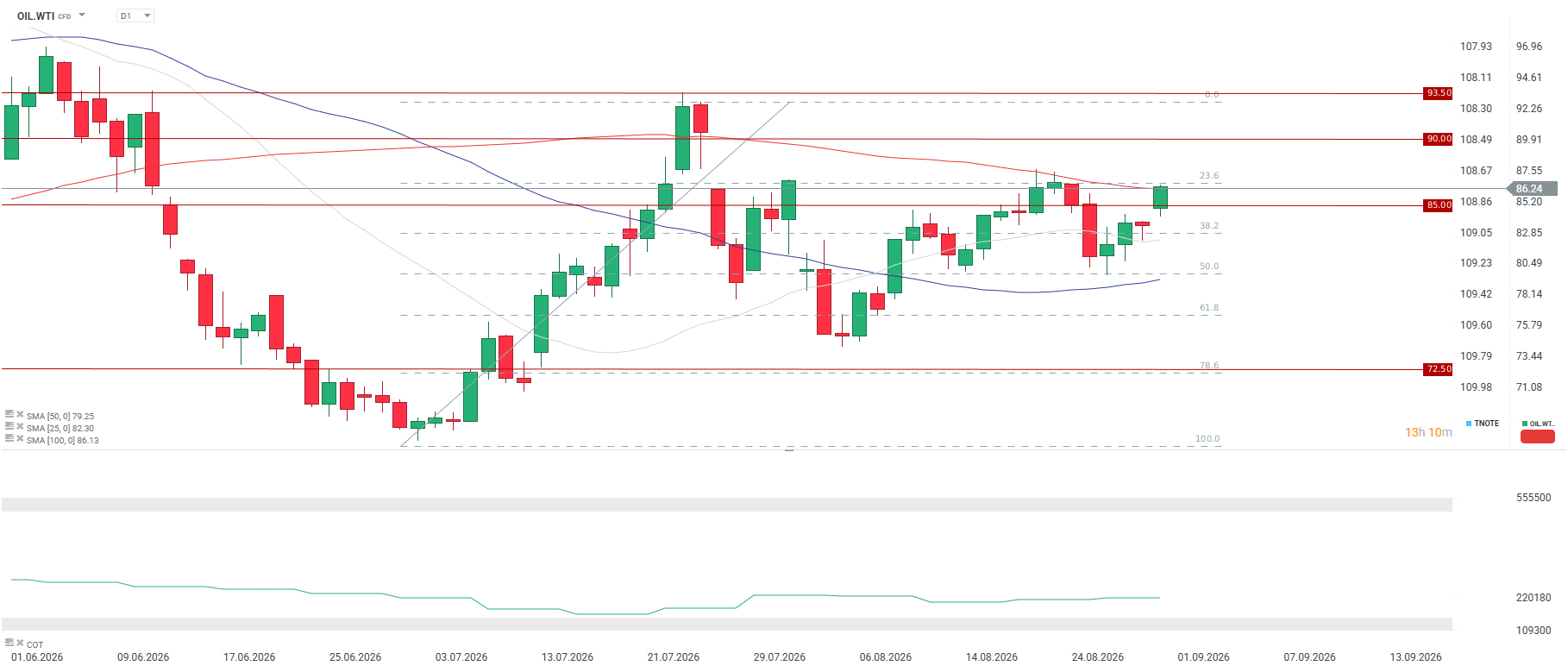
Crude oil prices opened with a clear upward gap and currently the price is testing the vicinity of the 100-period average and 23.6 Fibo retracement from recent July upward wave. Closing above the 87 USD per barrel would open a path even to 90 USD per barrel. On the other hand, with a possible deescalation in the Middle East with a halt of the fire exchange could bring down the price below 85 USD per barrel.
This content has been created by XTB S.A. This service is provided by XTB S.A., with its registered office in Warsaw, at Prosta 67, 00-838 Warsaw, Poland, entered in the register of entrepreneurs of the National Court Register (Krajowy Rejestr Sądowy) conducted by District Court for the Capital City of Warsaw, XII Commercial Division of the National Court Register under KRS number 0000217580, REGON number 015803782 and Tax Identification Number (NIP) 527-24-43-955, with the fully paid up share capital in the amount of PLN 5.869.181,75. XTB S.A. conducts brokerage activities on the basis of the license granted by Polish Securities and Exchange Commission on 8th November 2005 No. DDM-M-4021-57-1/2005 and is supervised by Polish Supervision Authority.
Source link
Author

- Ytv Market News
- Share-market news writer and analyst with deep experience covering equities, commodities, forex, and cryptocurrencies for readers in the USA, UK, Canada, and Australia. Ytv Market News delivers timely market updates, practical trading insights, and clear explanations of macro and company-level catalysts that move prices. Combines on-the-ground financial reporting with technical analysis, using concise charts and actionable ideas to help investors and traders make smarter decisions.
Latest entries
 Crypto NewsAugust 31, 2026Pi Network stages mild August recovery amid potential DEX environment test | FXStreet
 Crypto NewsAugust 31, 2026Monero (XMR) Hits a 7-Month Peak: What Happened and What’s Ahead?
 Politics News TodayAugust 31, 2026‘Jesus was a radical’: Progressives invoke Christ to sell left-wing agenda on campaign trail
 Forex NewsAugust 31, 2026WTI Oil appreciates beyond $85.50 as tensions rise in Iran | FXStreet
