

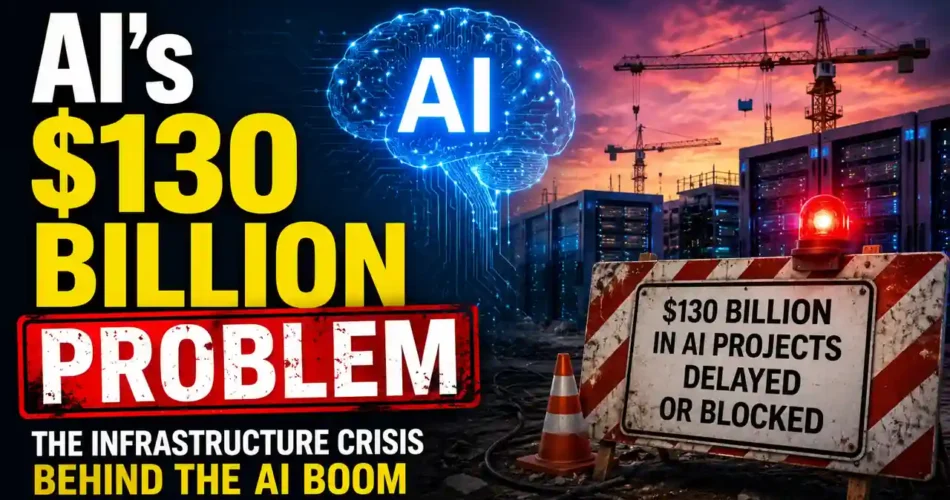
AI’s $130 Billion Problem – and the Portfolio Created to Solve It
Artificial intelligence has moved from a promising technology theme to one of the biggest investment stories in global markets. Companies are spending enormous sums on chips, data centers, power infrastructure, networking equipment and software in an effort to capture the next phase of AI growth.
But the rapid expansion has created a problem of its own: infrastructure. The AI boom requires extraordinary amounts of capital, electricity, computing capacity and physical space. At the same time, some proposed data-center projects are facing delays, permitting challenges and resistance from local communities. Recent reports indicate that more than $130 billion of AI data-center projects in the United States were delayed or blocked during the first quarter of 2026.
That bottleneck is changing the investment opportunity. Instead of focusing exclusively on the companies developing AI models, investors are increasingly looking at the businesses that provide the infrastructure required to make AI possible.
The Real Problem Behind the AI Boom
AI models may exist in the cloud, but the computing power behind them is very physical. Training and running sophisticated models requires specialized processors, enormous data centers, high-speed networks and reliable electricity.
This creates a capital-intensive ecosystem. Hyperscalers and technology companies have been increasing capital expenditure rapidly as they compete to expand AI capacity. Estimates reported in 2026 suggested that major technology companies could collectively spend hundreds of billions of dollars on AI-related infrastructure during the year.
The challenge is not simply finding money. Infrastructure also has to be built in locations where sufficient electricity, land, cooling systems, fiber connectivity and regulatory approvals are available.
Power Is Becoming a Strategic Asset
Electricity may ultimately become one of the most important constraints on AI expansion. A modern AI data center can require enormous and continuous power supplies, making access to reliable electricity just as important as access to advanced processors.
This has created investment opportunities beyond traditional technology stocks. Utilities, power producers, grid-equipment manufacturers, data-center operators and infrastructure developers can all potentially benefit from rising demand for AI computing capacity.
Why $130 Billion Matters
The $130 billion figure is important because it illustrates the difference between demand for AI and the ability to physically deliver that demand.
AI companies can announce ambitious expansion plans, but those plans ultimately depend on infrastructure. If a data center cannot receive permits, connect to the electricity grid or secure sufficient power, billions of dollars in planned investment can remain on paper.
That creates a potential investment theme: companies that already possess suitable infrastructure may have an advantage over businesses attempting to build everything from scratch.
Recent market analysis has also highlighted the enormous financing requirements associated with AI infrastructure. Investors are increasingly considering private credit, infrastructure finance and other funding mechanisms as the AI build-out becomes more capital intensive.
The Portfolio Built Around the Bottleneck
A portfolio designed to address AI’s infrastructure problem does not necessarily need to bet on a single AI model developer. Instead, it can spread exposure across several layers of the AI ecosystem.
1. Semiconductor Leaders
The first layer is computing hardware. Advanced AI systems require powerful processors capable of handling enormous workloads.
Chip designers and manufacturers therefore remain central to the AI investment story. However, investors should remember that semiconductor companies can be cyclical and their valuations may already reflect substantial future growth.
2. Data-Center Infrastructure
The second layer includes companies involved in data centers, servers, cooling systems, networking equipment and related infrastructure.
As AI workloads grow, data centers must become larger and more sophisticated. Efficient cooling, high-speed networking and power-management technologies can become increasingly valuable.
3. Electricity and Grid Infrastructure
The third layer may prove particularly important. AI requires electricity, and electricity requires generation, transmission and distribution infrastructure.
A diversified AI portfolio can therefore include businesses positioned to benefit from rising electricity demand. This could include utilities, power-generation companies and manufacturers of electrical equipment.
4. Digital Infrastructure
Fiber networks, cloud infrastructure and connectivity are another critical component. AI systems increasingly depend on the rapid movement of huge quantities of data between users, servers and computing facilities.
Companies operating critical digital infrastructure may therefore benefit even if one particular AI model or software platform eventually loses market share.
5. Energy and Alternative Power
Energy availability could become one of the defining issues of the next AI investment cycle. Data centers require dependable power around the clock, encouraging investment in generation capacity, grid modernization and potentially alternative energy sources.
This does not mean every energy company will benefit equally. Investors still need to examine costs, regulation, capital requirements and the ability to secure long-term contracts.
Diversification Could Be the Key
The main attraction of an infrastructure-focused portfolio is diversification. Instead of trying to predict which AI application will dominate, investors can focus on the underlying requirements shared by many AI businesses.
Whether the eventual winners are search engines, AI assistants, autonomous systems, robotics platforms or enterprise applications, they will still require computing power and infrastructure.
That makes the so-called “picks and shovels” strategy appealing. During major technology cycles, investors have often looked for businesses selling essential equipment to an expanding industry rather than trying to identify the ultimate consumer winner.
But There Are Risks
An AI infrastructure portfolio is not risk-free.
The biggest concern is overbuilding. If companies construct more data-center capacity than customers ultimately need, returns on infrastructure investment could decline. AI spending is also highly concentrated among a relatively small number of technology companies.
Another risk is valuation. Many AI-related companies have already experienced substantial investor enthusiasm. Strong long-term prospects do not automatically make a stock attractive at any price.
Regulatory and community opposition is another issue. Data centers can require significant amounts of land, electricity and water, creating political and environmental concerns. The cancellation or postponement of projects demonstrates that infrastructure development cannot be separated from local realities.
What Investors Should Watch Next
Investors following the AI infrastructure theme should monitor several indicators. Capital expenditure from major technology companies is one of the most important because it provides a window into future infrastructure demand.
Power availability should also receive greater attention. Markets may increasingly reward companies with access to reliable, low-cost electricity and suitable data-center locations.
Investors should also watch financing conditions. The more capital AI infrastructure requires, the more important interest rates, credit availability and balance-sheet strength become.
The Bigger Investment Picture
The AI opportunity is no longer limited to software developers and chipmakers. It is becoming an economy-wide infrastructure story.
The reported $130 billion in delayed or blocked data-center projects demonstrates that the next phase of AI growth could be determined as much by physical infrastructure as by technological innovation.
For investors, this creates a potentially broader strategy. Rather than concentrating a portfolio entirely in headline AI companies, exposure can be distributed across semiconductors, data centers, networking, power generation, electrical equipment, utilities and digital infrastructure.
The goal is not to eliminate AI risk. Instead, it is to invest across the infrastructure bottlenecks that multiple AI companies may need to overcome.
Conclusion
AI’s next challenge may not be whether machines can become smarter. It may be whether the world can build enough infrastructure to support them.
The $130 billion in delayed or blocked projects highlights the scale of that challenge. At the same time, it points toward a potentially significant investment opportunity.
A carefully diversified AI infrastructure portfolio could allow investors to participate in the long-term expansion of artificial intelligence without relying entirely on the success of one model, platform or application. The strongest opportunities may ultimately emerge not only from the companies creating AI, but also from the businesses providing the power, hardware, networks and physical infrastructure that keep the AI economy running.
FAQ
What is AI’s $130 billion problem?
It refers to the large value of AI data-center projects that have reportedly been delayed or blocked, highlighting infrastructure, permitting, power and community challenges facing the industry.
Why are data centers important for AI?
AI models require substantial computing resources. Data centers provide the processors, storage, networking, cooling and electricity needed to train and operate these systems.
What companies can benefit from AI infrastructure spending?
Potential beneficiaries include semiconductor companies, data-center operators, networking businesses, electrical-equipment manufacturers, utilities, power producers and digital-infrastructure providers.
Is an AI infrastructure portfolio less risky than buying AI stocks?
Not necessarily. Diversification can reduce dependence on a single company, but infrastructure stocks remain exposed to valuation, interest-rate, regulatory, demand and overbuilding risks.
What should investors monitor?
Key indicators include technology-company capital expenditure, data-center construction, electricity demand, power availability, financing conditions, infrastructure utilization and regulatory developments.
Is AI infrastructure still a long-term investment opportunity?
AI infrastructure could remain a long-term theme if demand for computing continues to expand. However, investors should evaluate individual companies based on valuation, balance-sheet strength, competitive advantages and sustainable cash-flow potential rather than assuming every AI-related stock will benefit.
- U.S. Department of Energy – Artificial Intelligence
- U.S. Department of Energy – Electricity Demand Growth Resource Hub
- U.S. Department of Energy – Data Center Electricity Demand Report
- U.S. Department of Energy – National Transmission Needs Study
- U.S. Department of Commerce – CHIPS Program and AI Semiconductor Infrastructure

