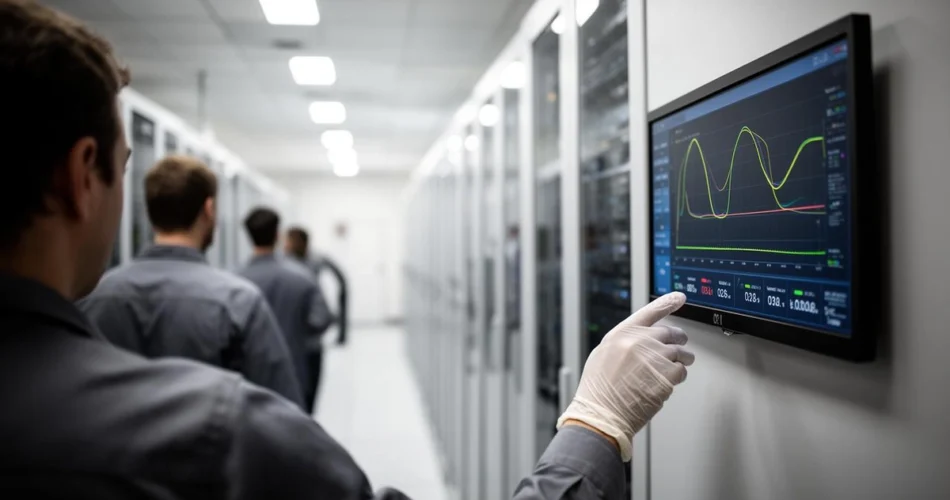
Batteries were submerged in coolant. A monitoring display showed battery temperature and voltage in real time. This was the immersion-cooled energy storage system (ESS) developed by South Korea’s G2Power in actual operation. The company publicly demonstrated the new product in action for the first time on the 26th.
Kim Dong-hyun, CEO of G2Power, introduced the immersion-cooled ESS at the company’s headquarters in Hwaseong, Gyeonggi Province, explaining: “We have fundamentally eliminated the root cause of battery thermal runaway. This is the result of 10 billion won (approximately $7.2 million) in government R&D funding over the past two years, and its strengths are superior performance and reduced fire risk compared to conventional air-cooling systems.”
The immersion-cooled ESS uses a special non-conductive insulating oil. While conventional ESS systems use air to cool batteries, G2Power’s product directly submerges battery cells in a non-conductive insulating coolant. Because the liquid directly absorbs battery heat, temperature deviation is reduced and heat can be managed more effectively. The company explained that even if thermal runaway occurs in a single cell, the design prevents heat from spreading to adjacent cells, lowering the likelihood of a large-scale fire.
Through a 500-day internal comparative test, G2Power determined that the immersion-cooled ESS reduces operating power consumption by more than 60% and extends battery lifespan by more than 20% compared to conventional air-cooled systems.
Convenience has also been enhanced. G2Power has applied its proprietary AI-based battery monitoring system (BMS) to manage battery conditions in real time. The system continuously monitors temperature conditions for each battery module and proactively performs cooling or shutdown when anomalies are detected.
AI Data Center Power Demand as Growth Driver
The primary reason G2Power is focusing on immersion-cooled ESS is tied to AI data centers. As the AI industry expands, power demand is surging, increasing the importance of stable power supply and storage technology. The International Energy Agency (IEA) projects that global data center electricity consumption will more than double from 415 terawatt-hours (TWh) in 2024 to 945 TWh by 2030. Data centers with rapidly increasing power consumption inevitably require stable power supply and high-efficiency ESS.
Financial performance is also on an upward trajectory. Last year’s revenue reached 77.4 billion won (approximately $56.1 million), up 39.6% year-over-year, while operating profit rose 139.9% to 8.8 billion won (approximately $6.4 million). First-quarter revenue this year came in at 19.17 billion won (approximately $13.9 million), up 92.3% from the same period last year. Operating profit also turned positive at 2.26 billion won (approximately $1.6 million). The solar energy business was a key growth driver, with revenue surging 286%. As of the end of March this year, the order backlog stood at 106.9 billion won (approximately $77.4 million), exceeding last year’s full-year revenue.
| Item | Last Year’s Results | Year-over-Year Change |
|---|---|---|
| Revenue | 77.4 billion won | +39.6% |
| Operating Profit | 8.8 billion won | +139.9% |
| Q1 Revenue | 19.17 billion won | +92.3% |
| Order Backlog (end of March) | 106.9 billion won | — |
Note: Order backlog is as of the end of March this year, exceeding last year’s full-year revenue.
Leap Toward Integrated Energy Provider
G2Power’s long-term vision is to grow into an integrated energy provider that supplies solar power generation, ESS, and switchgear together—producing, storing, and managing electricity. CEO Kim said: “We will further advance liquid-cooled ESS technology and internalize it as a competitive product. We will actively pursue overseas market opportunities including AI data centers and microgrids by enhancing our technology and price competitiveness in response to domestic and international market demand.”
The new product unveiling comes amid growing market concerns about ESS fire safety. Conventional air-cooled ESS systems have faced criticism for large temperature deviations between battery cells and the potential for rapid heat propagation to adjacent cells during fires. The immersion-cooling approach is evaluated as a differentiated solution that improves cooling efficiency while reducing the likelihood of large-scale fires caused by thermal runaway.
The company emphasized that its AI-based BMS further strengthens safety by continuously monitoring battery conditions, detecting anomalies in advance, and taking cooling or shutdown measures. This is seen as a strategy to meet the high reliability standards required for large-scale power infrastructure such as data centers.
Source link
Author

- Ytv Market News
- Share-market news writer and analyst with deep experience covering equities, commodities, forex, and cryptocurrencies for readers in the USA, UK, Canada, and Australia. Ytv Market News delivers timely market updates, practical trading insights, and clear explanations of macro and company-level catalysts that move prices. Combines on-the-ground financial reporting with technical analysis, using concise charts and actionable ideas to help investors and traders make smarter decisions.
Latest entries
 Investing InsightsAugust 28, 2026Intel Jumps 3.6% as Nvidia’s $5 Billion Entry Price Looks Tiny
 UsaAugust 28, 2026Why Tenable Stock Triumphed on Thursday
 AustraliaAugust 28, 2026Dicker Data delivers record H1 FY26 profit and lifts full-year guidance
 Crypto NewsAugust 28, 2026Polish Olympic chief arrested in Zondacrypto probe