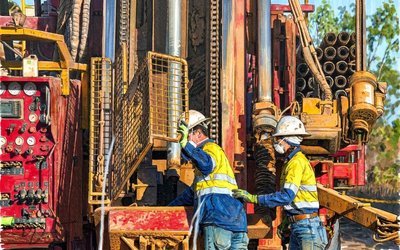
DevEx Resources (ASX: DEV) has completed the first full month of its 2026 dry-season exploration campaign at the 100%-owned Nabarlek uranium project in the Northern Territory, with drilling, target generation, and regional surveying progressing across a multi-year discovery pipeline.
The strongest early geological indications have come from the KP prospect, where drilling passed through about 100 metres of sandstone cover into strongly altered basement rocks displaying similarities to alteration associated with the nearby Nabarlek deposit.
A diamond hole at KP intersected a 10m-wide altered fault breccia above the unconformity, with follow-up drilling now targeting the projected structure where it passes below the unconformity into a structural position comparable with Nabarlek.
Elsewhere, first-pass drilling at Big Radon intersected shallow uranium mineralisation adjacent to a newly confirmed fault zone, while drilling has begun at Sandfire and new targets are emerging around Caramal.
DevEx is using the results to test whether its geological model correctly predicts the location of prospective faults, suitable host rocks, and evidence of uranium movement through the mineral system before committing to more intensive drilling.
KP Drilling Sharpens Target
The KP program is testing beneath a 2km-long radon anomaly interpreted to be associated with a north-west fault zone concealed beneath McArthur Basin sandstones.
Drilling has intersected strongly altered hematite-chlorite basement schists, while the diamond hole that targeted the interpreted KP fault encountered a chlorite-hematite altered fault breccia within the overlying sandstone.
Although that hole likely passed above the primary target, DevEx considers the alteration significant enough to justify additional diamond holes targeting the breccia where it is projected to cross beneath the unconformity.
“At KP we are drilling into altered basement rocks that look a great deal like the rocks that host Nabarlek—that is exactly the sort of information a first pass should deliver, and this data will be used to inform future activities,” managing director Marnie Finlayson said.
“We have a multi-year pipeline designed to keep targets in front of our rigs, and we are funded to work through it.”
Broader Nabarlek Pipeline
At Big Radon, seven reverse circulation and diamond holes tested the northern portion of a 3km-long radiometric and radon anomaly, identifying an approximately 20m-wide fault zone on the western side of the target.
One hole intersected 1.6m at 680 parts per million uranium equivalent (eU3O8) from 26m down-hole, including 0.4m at 1,041ppm eU3O8, with laboratory assays pending and true widths yet to be determined.
RC drilling has also started at the Sandfire Prospect to test the projected continuation of the Angularli Fault Zone, with the program expected to run for two to three weeks before drilling relocates to Nabarlek North.
At Caramal, relogging of historical core has identified a possible down-faulted northern continuation of the mineralised host breccia and dolerite at greater depth than most historical drilling reached.
A detailed airborne hyperspectral survey flown across granted Nabarlek tenements in August is expected to deliver first-pass results in September.
Source link
Author

- Ytv Market News
- Share-market news writer and analyst with deep experience covering equities, commodities, forex, and cryptocurrencies for readers in the USA, UK, Canada, and Australia. Ytv Market News delivers timely market updates, practical trading insights, and clear explanations of macro and company-level catalysts that move prices. Combines on-the-ground financial reporting with technical analysis, using concise charts and actionable ideas to help investors and traders make smarter decisions.
Latest entries
 UsaAugust 27, 2026SFL Corporation Ltd. Reports Preliminary Second Quarter 2026 Results and Declares $0.22 Quarterly Dividend
 Crypto NewsAugust 27, 2026ICP down 99.69% from $700 ATH – Biggest loser among 60 cryptos, says report
 Investing InsightsAugust 27, 2026Google Pixel 11 Pro XL vs Galaxy S26 Ultra: Speed, Durability, and the Flagship Divide — BigGo Finance
 GermanyAugust 27, 2026Swiss National Bank’s Martin backs tougher capital rules for UBS