

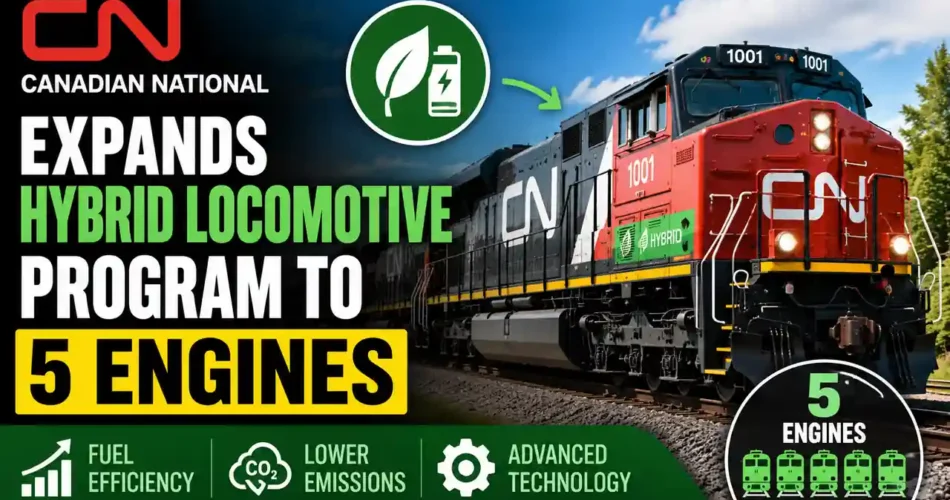
Canadian National Railway Scales Hybrid Locomotive Program to Five Engines
Canadian National Railway is expanding its efforts to test lower-emission locomotive technology, with its hybrid locomotive program now scaling to five engines. The move represents another step in the company’s broader strategy to improve fuel efficiency, reduce emissions and explore technologies that could eventually support a more sustainable freight-rail network.
For investors and the wider transportation industry, the expansion is significant because locomotive technology plays an important role in railway operating costs. Fuel is a major expense for freight railroads, while emissions targets are becoming increasingly important for companies operating across North America. Hybrid technology could offer an opportunity to address both issues, although its long-term commercial potential will depend on performance, economics, reliability and infrastructure requirements.
Canadian National Railway Expands Hybrid Locomotive Testing
Canadian National Railway, commonly known as CN, has been exploring alternative propulsion and energy-saving technologies as part of its efforts to modernize its locomotive fleet. Expanding the hybrid program to five engines provides the railway with a larger testing platform and potentially more useful operational data.
A single demonstration locomotive can provide valuable information, but a larger group of engines can reveal how a technology performs across different operating conditions. Freight trains operate through varying terrain, weather and traffic patterns, making real-world testing particularly important.
The five-engine program can therefore help CN evaluate whether hybrid technology can deliver consistent benefits rather than only performing well under controlled or limited circumstances.
Why Five Engines Matter
Scaling from an individual test unit to five locomotives can provide CN with a broader understanding of the technology. The railway can compare performance across different routes and operating environments while gathering information on fuel consumption, maintenance requirements and overall reliability.
It may also allow engineers to identify operational challenges earlier. Locomotive technologies need to function reliably under demanding conditions, including heavy loads, long distances, steep grades and extreme temperatures.
The additional engines could make it easier to determine where hybrid propulsion has the strongest potential and where conventional diesel-electric locomotives may remain more practical.
How Hybrid Locomotives Could Benefit Rail Operations
Hybrid locomotives combine conventional propulsion with additional energy-storage or energy-management technology. Depending on the system, energy can be stored and reused rather than being wasted during certain operating conditions.
One potential advantage is improved fuel efficiency. Freight locomotives consume substantial amounts of fuel, so even incremental efficiency improvements can become meaningful when applied across a large fleet.
Hybrid systems may also help reduce emissions by allowing locomotives to operate more efficiently in situations where full engine power is not necessary. Lower fuel consumption can translate into lower carbon emissions, while improved energy management may also help reduce other pollutants.
Regenerative Energy and Energy Storage
One area of interest in hybrid rail technology is the recovery of energy generated during braking. Instead of allowing all braking energy to be dissipated, a compatible system can capture some of that energy and store it for later use.
The stored energy can potentially support acceleration or other power demands. The effectiveness of this approach depends heavily on locomotive design, route characteristics and battery or energy-storage capacity.
For a large freight railroad, demonstrating that these systems can operate reliably over long periods will be critical before widespread adoption becomes commercially attractive.
Fuel Efficiency Could Be a Key Economic Driver
Environmental considerations are only one part of the business case for hybrid locomotives. Fuel efficiency could provide a direct economic incentive for railroads.
Rail freight is already one of the more fuel-efficient forms of long-distance transportation, but railway companies continue to search for ways to reduce fuel consumption. Improvements that appear modest on an individual locomotive can potentially become financially meaningful when multiplied across hundreds or thousands of engines.
However, the economics of hybrid technology must account for more than fuel savings. Battery systems, power electronics and other components can increase acquisition and maintenance costs. CN will therefore need to determine whether lifecycle savings can justify those additional investments.
Maintenance and Reliability Remain Critical
Railroads place a strong emphasis on locomotive reliability because equipment failures can disrupt freight schedules and increase operating costs. Any hybrid system introduced into regular service must therefore demonstrate durability under demanding conditions.
Battery degradation, thermal management, electronic components and additional maintenance requirements are among the factors that could influence the total cost of ownership.
The five-engine program gives CN an opportunity to gather practical information about these issues before making larger fleet decisions.
What the Program Could Mean for CN’s Long-Term Strategy
The expansion of the hybrid locomotive program should be viewed as part of a broader technology strategy rather than an immediate replacement for conventional locomotives.
Large freight railways operate complex networks, and there is unlikely to be a single technology capable of addressing every route and operational requirement. Battery-electric, hybrid, alternative-fuel and increasingly efficient diesel-electric technologies could each have roles depending on distance, terrain, infrastructure and energy availability.
CN’s testing program can help the company determine where hybrid locomotives make the most operational and financial sense.
Technology Testing Reduces Adoption Risk
Scaling a technology gradually can allow a railway to learn before committing substantial capital. The five-engine deployment provides a middle ground between a small demonstration project and full fleet conversion.
Data collected from the locomotives can potentially influence future purchasing decisions, maintenance planning and infrastructure investments. It could also help CN establish performance benchmarks against conventional equipment.
Environmental Considerations for Investors
Railroads are frequently positioned as a lower-emission alternative to long-haul trucking, particularly for bulk and high-volume freight. Nevertheless, locomotives still consume significant quantities of fuel, creating an incentive to improve their environmental performance.
Hybrid locomotives could complement CN’s existing efficiency initiatives by reducing fuel use on suitable operations. For investors, this may become increasingly relevant as customers, regulators and capital markets place greater attention on emissions and sustainability.
That said, investors should distinguish between a technology demonstration and a proven commercial rollout. A larger hybrid program does not automatically mean that CN will convert its entire fleet to hybrid propulsion.
Challenges Facing Hybrid Locomotive Adoption
Despite the potential benefits, hybrid locomotives face several challenges. The first is cost. New propulsion and energy-storage systems can require substantial upfront investment.
Another challenge is operational suitability. A technology that works effectively on one type of route may deliver different results elsewhere. Freight railroads must manage long-distance operations, heavy loads and diverse geographic conditions.
Energy-storage technology is also evolving rapidly. Improvements in battery capacity, durability and charging could change the economics of hybrid rail over time. CN therefore has an incentive to continue testing while monitoring developments across the broader transportation technology sector.
Infrastructure Could Influence Future Expansion
Infrastructure requirements are another consideration. Depending on the hybrid system, rail operators may need specialized facilities, charging capabilities, maintenance equipment or upgraded electrical systems.
For this reason, successful locomotive deployment involves more than the engine itself. The railway must consider how new equipment fits into its existing network and operating model.
Investor Takeaway
CN’s decision to scale its hybrid locomotive program to five engines highlights the railway’s interest in testing technologies that could improve efficiency while supporting longer-term emissions objectives.
The most important development for investors may not be the number of locomotives involved, but the operational data generated by the expanded program. Evidence of meaningful fuel savings, reliable performance and manageable maintenance costs could strengthen the case for broader adoption.
Conversely, if the technology proves expensive or difficult to operate at scale, CN may continue using it selectively rather than expanding aggressively.
Ultimately, the five-engine program should be considered an evaluation phase. Its significance will become clearer as CN gains more experience with the technology and determines whether the benefits can justify the investment required for larger-scale deployment.
Conclusion
Canadian National Railway’s expansion of its hybrid locomotive initiative to five engines represents a meaningful step in the company’s exploration of next-generation rail technology. The program has the potential to provide valuable insight into fuel efficiency, emissions reduction, energy recovery and locomotive operating costs.
For CN, the objective is likely to determine where hybrid technology can deliver practical benefits without compromising the reliability that freight rail operations require. For investors, the key factors to watch will be fuel savings, maintenance performance, capital requirements and evidence that the technology can operate successfully across a wider range of routes.
As railroads continue balancing operational efficiency with environmental expectations, projects such as CN’s hybrid locomotive program could become an increasingly important part of the industry’s technology roadmap.
FAQ
What is Canadian National Railway’s hybrid locomotive program?
It is an initiative focused on evaluating hybrid locomotive technology that can combine conventional propulsion with additional energy-storage or energy-management systems. The goal is to explore potential improvements in fuel efficiency and emissions performance.
How many locomotives are included in the expanded program?
The program is being scaled to five hybrid locomotives, giving CN a larger platform for evaluating the technology under real-world operating conditions.
Why are hybrid locomotives important for CN?
Hybrid locomotives could potentially reduce fuel consumption and emissions while maintaining the operational capabilities required for freight transportation. Lower fuel use could also provide economic benefits.
Does the five-engine program mean CN will replace its diesel locomotives?
Not necessarily. A five-engine program is primarily a technology evaluation and scaling exercise. Broader adoption would depend on factors such as reliability, fuel savings, maintenance costs and capital requirements.
What should investors watch next?
Investors should monitor evidence of fuel-efficiency gains, operating reliability, maintenance requirements, technology costs and any future decisions by CN regarding expansion of the hybrid locomotive fleet.
Could hybrid locomotives reduce railway emissions?
Potentially. If hybrid systems reduce fuel consumption through improved energy management or energy recovery, they can also reduce emissions associated with locomotive fuel use. The actual benefit depends on how the technology performs in commercial operations.

