

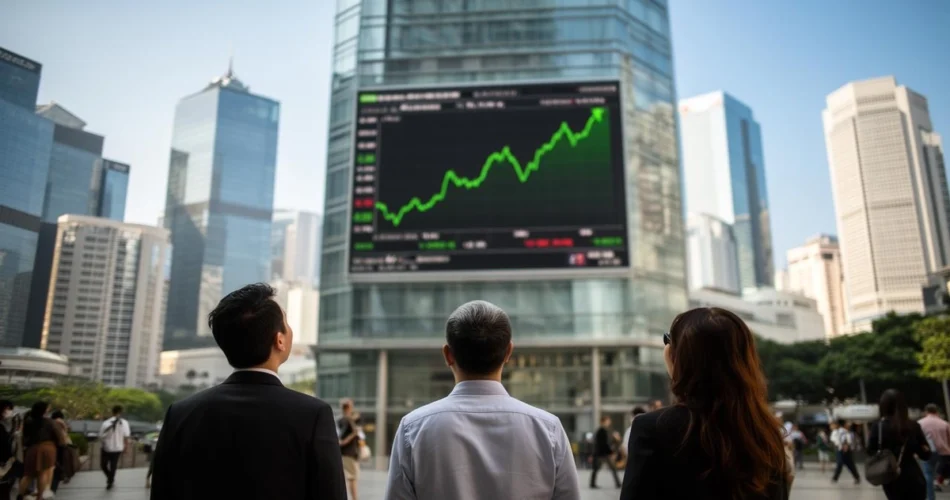
Hong Kong stocks rebounded on the morning of August 26, following a sharp pullback in the previous session. The Hang Seng Index closed the half-day session at 25,685, up 174 points, or 0.7%. The Hang Seng Tech Index performed even more strongly, rising 72 points, or 1.6%, to 4,660. The Hang Seng China Enterprises Index also advanced, gaining 104 points, or 1.2%, to 8,549.
Large-cap technology shares broadly recovered, serving as the primary driver of the market’s upward momentum. Xiaomi (01810.HK) surged 4.3% in the morning session to close at HK$28.96, making it the standout heavyweight performer. Meituan (03690.HK) rose 2.2% to HK$78.9; Alibaba (09988.HK) gained 1.5% to HK$115.9; and Tencent Holdings (00700.HK) climbed 1% to HK$446.4.
Chip stocks strengthened in tandem, with SMIC (00981.HK) rising 4.3% to HK$70.8; Hua Hong Semiconductor (01347.HK) gaining nearly 7%; and AXera (09992.HK) soaring more than 14%.
Among notable movers, Innovent Biologics (01801.HK) jumped 8.4% in the morning session to HK$108.5, ranking among the top gainers in both the Hang Seng Index and the China Enterprises Index. XPeng-W (09868.HK) rebounded 7.6% to HK$46.6, shaking off the previous day’s slump of more than 9%. CMOC Group (03993.HK) rose 7.1%, and Zijin Mining Group (02899.HK) gained 4.9%, lifting the broader non-ferrous metals sector.
Notably, H&H International (01112.HK) skyrocketed 20.6% in the morning session to HK$17.88, hitting an all-time high. Other small- and mid-cap stocks were also active, with Newborn Town (09911.HK) up 14.6%, Jiangxi Copper (00358.HK) up 12.2%, China Nonferrous Mining (01258.HK) up 11%, and ZhongAn Online P&C Insurance (06060.HK) up 10.6%.
Chinese brokerage stocks rallied collectively, buoyed by a dual tailwind of solid earnings and dividend payouts. Market sources indicated that multiple brokerages have recently released interim results showing stable profitability, coupled with clear dividend policies, attracting capital inflows.
The energy sector bucked the trend and declined, with oil and coal stocks underperforming and serving as the primary drag on the broader market’s gains.
Several listed companies released first-half earnings during the session. Sinopharm Group (01099.HK) reported first-half revenue of CNY 282.8 billion (approximately $42.1 billion), down 1.1% year-over-year, with net profit of CNY 3.4 billion (approximately $506.5 million), down 1.8% year-over-year. Ming Ming Hen Mang (01768.HK) delivered a standout performance, with first-half revenue of CNY 45 billion (approximately $6.7 billion), up 60% year-over-year, and net profit of CNY 2.24 billion (approximately $333.3 million), up 155.4% year-over-year. China Shipbuilding Leasing (03877.HK) reported first-half revenue of HK$1.91 billion (approximately $243.8 million), down 5.3% year-over-year, with net profit of HK$1.22 billion (approximately $155.9 million), up 10.6% year-over-year.
On the buyback front, Tencent Holdings spent HK$300 million (approximately $38.3 million) to repurchase 680,000 shares at prices ranging from HK$438.6 to HK$450.2 (approximately $57). Xiaomi spent approximately HK$50.78 million (approximately $6.5 million) to repurchase 1.8192 million shares. Kuaishou (01024.HK) spent HK$69.98 million (approximately $8.9 million) to repurchase 2.113 million shares.
On the institutional view front, China Securities noted that the current repair-driven rally has “a floor and a ceiling,” with clear policy support intentions but no unified force from new capital inflows. The market is characterized by存量博弈 (zero-sum trading among existing participants), and a breakout to the upside requires stronger catalysts.
Soochow Securities observed that the Hang Seng Index’s recent gains demonstrate market resilience, but the external interest rate environment remains a constraint, with the rally exhibiting more structural characteristics. The firm analyzed that Hong Kong’s recent advance is jointly driven by “valuation repair + marginal improvement in external liquidity + interim earnings and event catalysts + short covering,” rather than a full fundamental reversal. During the interim earnings window, capital allocation is shifting from liquidity-driven to performance-driven, with funds concentrating in high-certainty growth sectors such as gold, artificial intelligence, and shipping, while marginalizing weak-fundamental sectors like consumer and livestock, intensifying structural divergence.
Looking back at the previous trading session, the Hang Seng Index pulled back significantly after five consecutive days of gains, closing Monday at 25,511, down 6 points, with turnover reaching HK$254.08 billion (approximately $32.4 billion). News of Alibaba’s HK$80 billion (approximately $10.2 billion) share placement briefly weighed on market sentiment, sending the stock down more than 8% that day. However, Alibaba co-founder and Chairman Joe Tsai and CEO Eddie Wu seized the opportunity amid the sharp decline to jointly purchase more than HK$100 million worth of shares, injecting confidence into the market.
Source link
Author

- Ytv Market News
- Share-market news writer and analyst with deep experience covering equities, commodities, forex, and cryptocurrencies for readers in the USA, UK, Canada, and Australia. Ytv Market News delivers timely market updates, practical trading insights, and clear explanations of macro and company-level catalysts that move prices. Combines on-the-ground financial reporting with technical analysis, using concise charts and actionable ideas to help investors and traders make smarter decisions.
Latest entries
 Company Press ReleasesAugust 26, 2026Genova announces the expiration time for the tender offer
 Company NewsAugust 26, 2026Die Alexandria-Real-Estate-Aktie stabilisiert sich nach Q2-Rückschlag und vor Q3-Call
 Crypto NewsAugust 26, 2026Credit and Privacy Are Coming to XRP Ledger: What Does It Mean for XRP Holders
 Stock Market VideosAugust 26, 2026‘Call Her Daddy’ Podcast Alex Cooper’s Company Gets Huge Investment From Super Agent
