

Supermarket Income REIT Directors Buy Shares in £100 Million Equity Issue
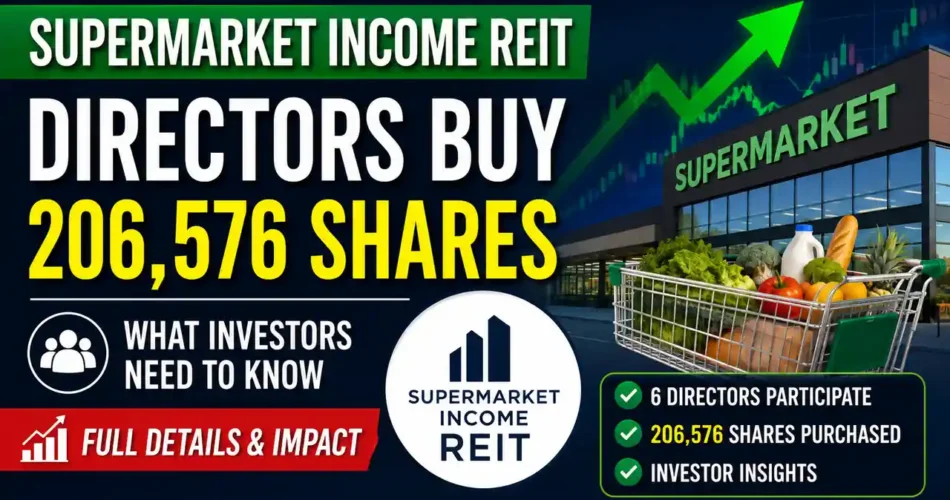
Supermarket Income REIT PLC has disclosed that six of its directors participated in the company’s recent equity issuance, purchasing additional ordinary shares at a price of £0.83 per share. The transactions were completed on 15 July 2026 and were subsequently reported through a regulatory announcement dated 17 July 2026.
The disclosure provides investors with a detailed look at share purchases made by members of the company’s board following the equity issue. The participating directors included Executive Directors, the Non-Executive Chair and Non-Executive Directors.
According to the regulatory filing, Robert Abraham purchased 60,240 shares, Michael Perkins acquired 12,048 shares, Nick Hewson bought 12,000 shares, Roger Blundell purchased 50,000 shares, Cathryn Vanderspar acquired 24,096 shares and Sapna Shah purchased 48,192 shares. Collectively, the six directors acquired 206,576 ordinary shares.
What Happened in the Supermarket Income REIT Shareholding Announcement?
The announcement relates to the participation of six directors in an equity issuance by Supermarket Income REIT. The company said the purchases were made as part of the issue described in its Results of the Issue announcement published on 15 July 2026.
All of the disclosed purchases were made at the same issue price of £0.83 per ordinary share. The transactions took place on the London Stock Exchange.
Using the reported transaction values, the six directors collectively committed approximately £171,456 to acquire the newly issued shares.
The disclosure was made under the UK Market Abuse Regulation requirements covering transactions by persons discharging managerial responsibilities, commonly referred to as PDMRs, and persons closely associated with them.
Breakdown of Director Share Purchases
Robert Abraham
Robert Abraham, an Executive Director of Supermarket Income REIT, acquired 60,240 ordinary shares at £0.83 each. The transaction had an aggregate value of £49,999.20.
Following the purchase, Abraham held or had an interest in 316,984 ordinary shares in the company.
Michael Perkins
Executive Director Michael Perkins purchased 12,048 ordinary shares. At the issue price of £0.83, the transaction represented an investment of £9,999.84.
Following the transaction, Perkins held or had an interest in 42,048 ordinary shares in Supermarket Income REIT.
Nick Hewson
Nick Hewson, the company’s Non-Executive Chair, acquired 12,000 ordinary shares at £0.83 per share. The purchase was valued at £9,960.
After the acquisition, Hewson held or had an interest in 1,643,609 ordinary shares in the company.
Roger Blundell
Non-Executive Director Roger Blundell purchased 50,000 ordinary shares at £0.83 per share. The transaction was worth £41,500.
His participation represents one of the larger individual purchases disclosed in the announcement.
Cathryn Vanderspar
Cathryn Vanderspar acquired 24,096 ordinary shares at £0.83 each. The transaction amounted to £20,000.
Her participation means that another member of the company’s board has increased exposure to Supermarket Income REIT through the equity issuance.
Sapna Shah
Sapna Shah purchased 48,192 ordinary shares at the same issue price. The transaction was valued at £39,996.96.
Her purchase was the second-largest disclosed acquisition by share volume among the six participating directors.
Why Director Share Purchases Matter to Investors
Director transactions can attract investor attention because they provide an additional perspective on how company insiders are positioned in relation to the business. When directors participate in an equity issuance, they are increasing their direct exposure to the company’s shares.
However, investors should avoid treating director participation as a standalone buy signal. Directors may participate for several reasons, including maintaining their proportional investment, supporting a capital raise, meeting investment expectations or aligning their interests with shareholders.
In the case of Supermarket Income REIT, the disclosed purchases were specifically linked to the company’s equity issuance. Therefore, the transactions should be considered within the broader context of the capital raising rather than viewed simply as open-market purchases.
What the Equity Issue Means for Supermarket Income REIT
Equity issuance can provide a real estate investment trust with additional capital to support its strategy. For a REIT, fresh equity can potentially be used to acquire assets, strengthen the balance sheet, manage debt or pursue other investment opportunities.
At the same time, issuing new shares can increase the number of shares in circulation. Existing investors therefore need to consider the effect of dilution alongside the potential benefits of additional capital.
The participation of directors demonstrates that members of the board were willing to invest alongside other participants in the issue. That alignment may be relevant to investors assessing management’s commitment to the company’s long-term strategy, although it does not guarantee future share-price performance.
Supermarket Income REIT and Its Investment Focus
Supermarket Income REIT is a UK-listed real estate investment trust focused on supermarket properties and other grocery-related real estate assets. Its investment proposition is closely connected to the defensive characteristics that investors often associate with food retail property.
Supermarket properties can benefit from the recurring nature of grocery demand, while long leases can provide visibility over rental income. Nevertheless, the performance of a REIT remains exposed to factors such as property valuations, interest rates, financing costs, tenant strength and broader economic conditions.
For shareholders, the latest director transactions are therefore only one part of the wider investment picture.
Key Numbers From the Director Transactions
The six directors collectively acquired 206,576 ordinary shares at £0.83 each. The combined consideration was approximately £171,456.
The largest purchase by volume came from Robert Abraham with 60,240 shares, followed by Sapna Shah with 48,192 shares and Roger Blundell with 50,000 shares. The smallest disclosed purchase was Nick Hewson’s 12,000-share acquisition, although his reported overall holding remained substantially larger than those of several other participating directors.
All six transactions were classified as purchases of ordinary shares and were executed on the London Stock Exchange on 15 July 2026.
What Investors Should Watch Next
Investors following Supermarket Income REIT may want to focus on several factors following the equity issuance. These include the company’s use of the additional capital, portfolio performance, property valuations, rental income, financing arrangements and future dividend announcements.
Another important consideration is the company’s ability to generate attractive returns from the capital raised. Additional equity can be beneficial when it is deployed into investments that generate sufficient returns relative to the cost of capital.
The director transactions also provide a useful ownership update. Investors can monitor future regulatory disclosures to determine whether directors continue to increase or reduce their holdings.
Investor Takeaway
The latest regulatory filing shows broad participation from the Supermarket Income REIT board in the company’s July 2026 equity issuance. Six directors collectively acquired 206,576 ordinary shares at £0.83 per share, representing approximately £171,456 of investment.
The transactions increase the directors’ exposure to the company and provide shareholders with greater visibility into insider participation in the capital raising. However, investors should interpret the purchases alongside the company’s financial performance, property portfolio, debt position, dividend outlook and wider market conditions.
Ultimately, the director purchases are a notable corporate disclosure, but they should not be interpreted as a guarantee of future returns or share-price appreciation. Investors should consider the complete investment case before making any decision.
Frequently Asked Questions
What did Supermarket Income REIT announce?
The company announced that six directors participated in its equity issuance and acquired additional ordinary shares at £0.83 per share.
How many shares did the directors buy?
The six participating directors collectively acquired 206,576 ordinary shares.
How much did the directors invest?
Based on the transaction values disclosed in the regulatory announcement, the combined consideration was approximately £171,456.
Who bought the largest number of shares?
Robert Abraham made the largest disclosed purchase, acquiring 60,240 ordinary shares for £49,999.20.
What was Nick Hewson’s purchase?
Nick Hewson, the Non-Executive Chair, purchased 12,000 ordinary shares at £0.83 each, for a total consideration of £9,960.
When did the transactions take place?
The disclosed purchases were completed on 15 July 2026 on the London Stock Exchange. The regulatory announcement was published on 17 July 2026.
Does director buying mean investors should buy the stock?
Not necessarily. Director participation can indicate alignment with shareholders, but it is only one factor. Investors should also examine valuation, earnings, property values, debt, dividends, interest rates and the company’s broader strategy.
What is the significance of a PDMR notification?
A PDMR notification provides public disclosure of transactions involving people who hold managerial responsibilities at a listed company. Such disclosures are intended to promote transparency around insider transactions.
Is this announcement positive for shareholders?
The participation of multiple directors may be viewed as evidence of board participation in the equity issue, but the ultimate impact depends on how effectively the company uses the capital and how its property portfolio and financial performance develop.
Source note: This article is an original editorial rewrite based on the publicly disclosed 17 July 2026 Supermarket Income REIT regulatory announcement. It does not reproduce the source announcement verbatim.
References
GOV.UK – Apply to be a UK Real Estate Investment Trust
HM Revenue & Customs – Real Estate Investment Trusts: Background and Introduction
Financial Conduct Authority – UK Market Abuse Regulation
Companies House – Find and Update Company Information
HM Revenue & Customs – UK Real Estate Investment Trusts: Taxation of Distributions

