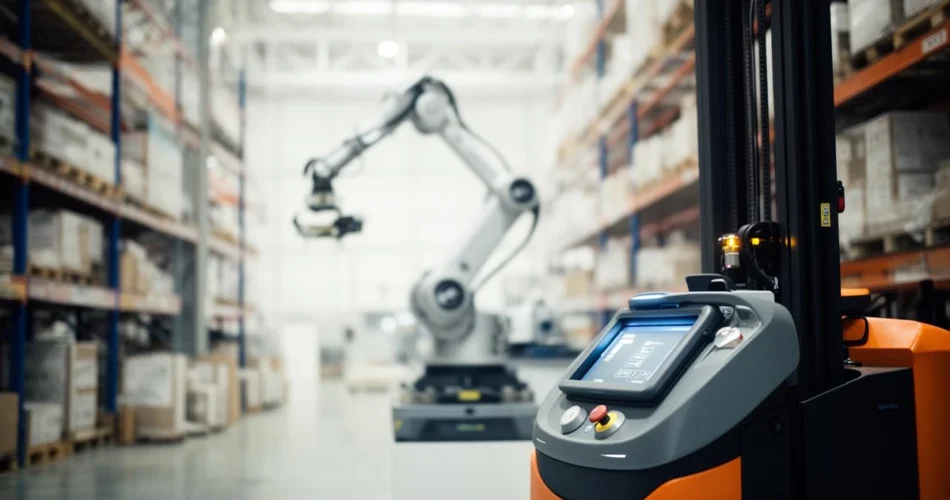
BlackBerry is betting that robotics will become its next major growth engine, with Chief Executive Officer John Giamatteo telling CNBC that the segment is already among the fastest-growing businesses inside the company’s QNX software portfolio.
The Canadian technology firm, once synonymous with keyboard-equipped smartphones, has spent years repositioning itself around QNX, a safety-critical operating system embedded in 275 million vehicles worldwide. That automotive footprint spans everything from braking systems to semi-autonomous driving features. Now the company sees an even larger opportunity in physical AI applications beyond the car.
“We think that could be even a faster-growing segment of the industry for things like robotics,” Giamatteo said in an interview with CNBC’s “The Tech Download” podcast.
Rather than chasing humanoid robots that have drawn attention in China, BlackBerry is targeting industrial use cases: warehouse automation, robotic forklifts, and medical equipment. The CEO framed these as natural extensions of QNX’s strength in environments where software failure carries real-world consequences.
“As excited as we are about the dynamics of the automotive industry and where that’s going, these other applications around robotics and medical instruments and industrial automation represent a tremendous growth opportunity,” he said. “And one that I think BlackBerry and our QNX portfolio is really well positioned to address.”
BlackBerry reported a QNX order backlog of $950 million, with robotics accounting for a portion of those commitments. The company did not disclose specific figures for robotics-related orders, though the CEO characterized the segment’s trajectory in emphatic terms.
“Robotics is going to shift in a hardcore way … and we couldn’t be more excited about the opportunity in front of us,” Giamatteo said.
The Nvidia Partnership
In April, BlackBerry announced an expanded partnership with Nvidia to deploy its software alongside Nvidia’s systems in robotics, medical technologies, and industrial applications. The collaboration positions QNX as a software layer for physical AI systems that pair specialized hardware with AI models.
Newer generations of robots increasingly combine purpose-built hardware with artificial intelligence software, and BlackBerry sees its decades of experience in automotive safety as a competitive advantage. The company’s argument is straightforward: the same reliability requirements that govern a car’s braking system apply to a robotic forklift operating alongside warehouse workers or a surgical robot in an operating room.
Financial Momentum
BlackBerry’s stock has roughly doubled in 2026, reflecting improving margins and profitability as the company completes its transformation from consumer hardware to enterprise software. The rally has been fueled by investor enthusiasm for physical AI themes, with autonomous vehicles and industrial robotics frequently cited as the next frontier after generative AI’s initial wave.
The QNX backlog figure offers a window into the company’s revenue visibility. While BlackBerry has not broken out robotics-specific order values, the segment’s inclusion in the $950 million backlog suggests meaningful early traction.
| Business Segment | Status | Key Metric |
|---|---|---|
| QNX automotive | Core business | 275 million vehicles embedded |
| QNX robotics | Fastest-growing segment | Part of $950M order backlog |
| QNX medical | Emerging opportunity | Not separately disclosed |
Note: Figures reflect company disclosures as of the CEO’s interview. Robotics and medical order values are not separately reported.
The Physical AI Bet
BlackBerry’s robotics push reflects a broader industry shift toward physical AI, a term increasingly used to describe systems where AI models interact with the real world through hardware. Autonomous vehicles, industrial robots, and smart medical devices all fall under this umbrella.
For BlackBerry, the transition represents both a risk and an opportunity. The company’s automotive business remains its foundation, but growth in that market is tied to vehicle production cycles and adoption rates for advanced driver-assistance systems. Robotics, by contrast, spans a wider range of industries with potentially faster deployment timelines.
Giamatteo’s comments suggest the company sees QNX’s safety-critical positioning as its moat. In markets where software bugs can cause physical harm, customers are less likely to trade reliability for cost savings, giving established players an advantage over newer entrants.
The challenge will be execution. Competing in robotics means adapting QNX to new hardware platforms, building developer ecosystems beyond automotive, and convincing customers in industries like warehousing and healthcare that a company best known for car software understands their specific needs.
Still, the early signals are positive. The Nvidia partnership gives BlackBerry access to one of the most important hardware ecosystems in AI, and the order backlog provides tangible evidence that customers are willing to commit to QNX beyond the automotive sector. If robotics maintains its current growth trajectory, it could reshape how investors value the company in the years ahead.
Source link
Author

- Ytv Market News
- Share-market news writer and analyst with deep experience covering equities, commodities, forex, and cryptocurrencies for readers in the USA, UK, Canada, and Australia. Ytv Market News delivers timely market updates, practical trading insights, and clear explanations of macro and company-level catalysts that move prices. Combines on-the-ground financial reporting with technical analysis, using concise charts and actionable ideas to help investors and traders make smarter decisions.
Latest entries
 Crypto NewsAugust 25, 2026Tom Lee: Ethereum Will Dominate Tokenization and AI Infrastructure Within a Decade
 Commodities NewsAugust 25, 2026China’s Top Refiner Seeks Transformation amid Falling Fuel Sales
 Investing InsightsAugust 25, 2026SpaceX Lands $8 Billion Military Satellite Contract, Compeq’s Space Boards See Volume and Price Gains with EPS Projected at NT$14 Next Year
 GermanyAugust 25, 2026Investors shrug off US sanctions plan for Iran, bitcoin powers on