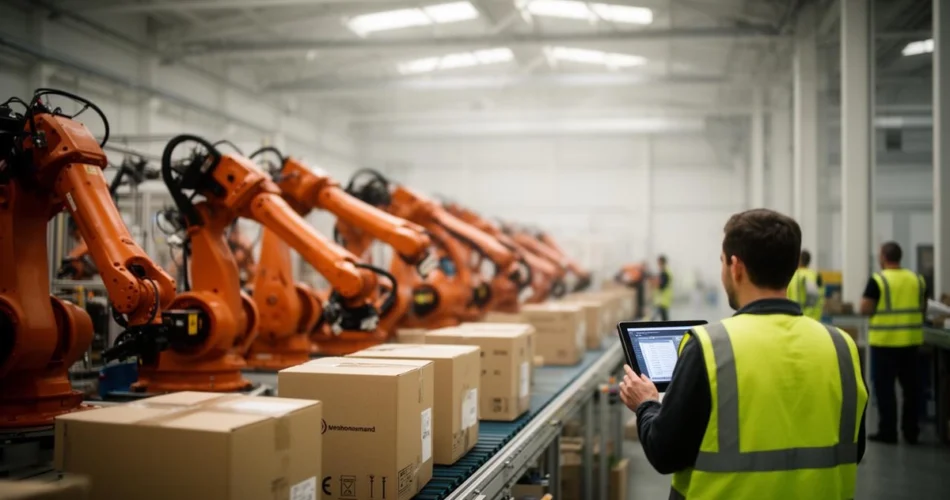
Amazon is developing a new generation of highly automated delivery stations that could process packages at roughly 2.5 times the speed of its current facilities, according to internal planning documents reviewed by Business Insider. The initiative, known internally as Project Tetromino, represents one of the company’s most ambitious attempts yet to automate the stubbornly manual final step of the e-commerce delivery chain: sorting packages and loading them into vans for the last mile.
The project would require a capital investment exceeding $530 million by 2029, with an initial pilot facility slated for 2028 at a cost of $103 million. Five additional sites would follow in 2029, each costing approximately $85 million, with 10 more locations planned for 2030. The name draws from the classic puzzle game Tetris, reflecting the challenge of efficiently stacking and packing irregularly shaped parcels into delivery vehicles.
Delivery stations are the final logistical stop in Amazon’s network, receiving packaged goods from fulfillment centers before drivers take them to customers. The task of organizing and loading those packages has long resisted automation because it demands sophisticated perception, decision-making, and manipulation capabilities from robots. Project Tetromino aims to solve that problem using artificial intelligence and robotics to handle what remains one of the most labor-intensive parts of the shipping process.
A potential key technology partner is Boxbot, an AI and robotics supply chain startup. The company’s system moves packages from conveyor belts onto storage trays, then uses AI to retrieve and sequence them for delivery. According to Boxbot’s website, the automated method can make the vehicle-loading process up to 10 times faster. Boxbot did not immediately respond to a request for comment.
An Amazon spokesperson disputed the financial figures and timeline in the leaked document, calling Project Tetromino an early-stage concept. The representative said the specific projections are inaccurate and do not reflect current plans, while emphasizing that the company regularly explores and tests new technologies to improve safety and the delivery experience for customers. Like any early-stage concept, the spokesperson added, plans evolve significantly as the company learns.
The push comes as Amazon accelerates its broader warehouse automation strategy. On its July earnings call, the company said it expects to more than double its fleet of robotic arms in 2026. Amazon has already deployed more than one million warehouse robots across its fulfillment centers, a milestone reached this year. The company has also introduced several advanced robotic systems, including Proteus, which can accept commands through natural language; Blue Jay, which integrates multiple robotic arms to pick, store, and consolidate items simultaneously; and Vulcan, its first robot with tactile sensing capabilities. Amazon is also testing Digit, a humanoid robot from Agility Robotics, for package handling and loading near Rivian delivery vans.
Amazon is hardly alone in pursuing last-mile automation. FedEx is expanding its use of AI-powered Dexterity robots that autonomously load packages into trailers, while UPS and DHL have adopted robots for unloading operations. The industry-wide push reflects mounting pressure to reduce costs and improve efficiency across logistics networks.
The automation drive, however, continues to raise questions about employment. Internal documents leaked in 2025 showed Amazon’s robotics team targeting 75 percent operational automation, with projections that the company could avoid hiring more than 160,000 people by 2027 and reduce job needs by more than 600,000 over a decade. CEO Andy Jassy acknowledged the tension in a June 2025 internal letter, writing that some roles will require fewer people while others will require more, and that AI-driven efficiency gains could lead to a smaller overall workforce over time.
Amazon robotics chief Tye Brady has framed the technology as a tool to make frontline work safer and more efficient rather than replace employees. The company spokesperson echoed that position, saying delivery-station initiatives are designed to complement and empower the workforce, with employees remaining central to how Amazon operates. Amazon has also pointed to delivery station pilots announced last year as part of a 700 million euro investment in European facilities, including machines that unload, sort, and scan packages.
On Wall Street, analysts maintain a strongly bullish stance on Amazon stock. The consensus rating is Strong Buy, based on 38 Buy recommendations and one Hold issued over the past three months. The average price target of $334 implies roughly 27 percent upside from current levels. Amazon shares gained 1.4 percent on Monday and extended gains in after-hours trading, bringing the stock’s year-to-date advance to 13 percent.
The financial roadmap outlined in the planning document shows a methodical scaling strategy. The 2028 pilot would serve as a proof of concept, followed by a measured expansion to five additional sites in 2029 and 10 more in 2030. If fully realized, the investment would push Amazon’s total commitment past the half-billion-dollar mark within three years of the initial pilot.
Note: Business Insider reviewed the internal planning document dated last month. Financial projections and timelines were disputed by Amazon.
Source link
Author

- Ytv Market News
- Share-market news writer and analyst with deep experience covering equities, commodities, forex, and cryptocurrencies for readers in the USA, UK, Canada, and Australia. Ytv Market News delivers timely market updates, practical trading insights, and clear explanations of macro and company-level catalysts that move prices. Combines on-the-ground financial reporting with technical analysis, using concise charts and actionable ideas to help investors and traders make smarter decisions.
Latest entries
 Crypto NewsAugust 25, 2026Shiba Inu Burn Rate Rockets 441% After Major Price Breakout
 Investing InsightsAugust 25, 2026Alexia Groff: Plants Can Make Meat Protein, But a 35% Heme Bottleneck Blocks the Plate — BigGo Finance
 CanadaAugust 25, 2026Canadian Investment Regulatory Organization Trading Halt
 AustraliaAugust 25, 2026Gold Hydrogen Confirms Helium Reservoir Continuity at Ramsay Project