

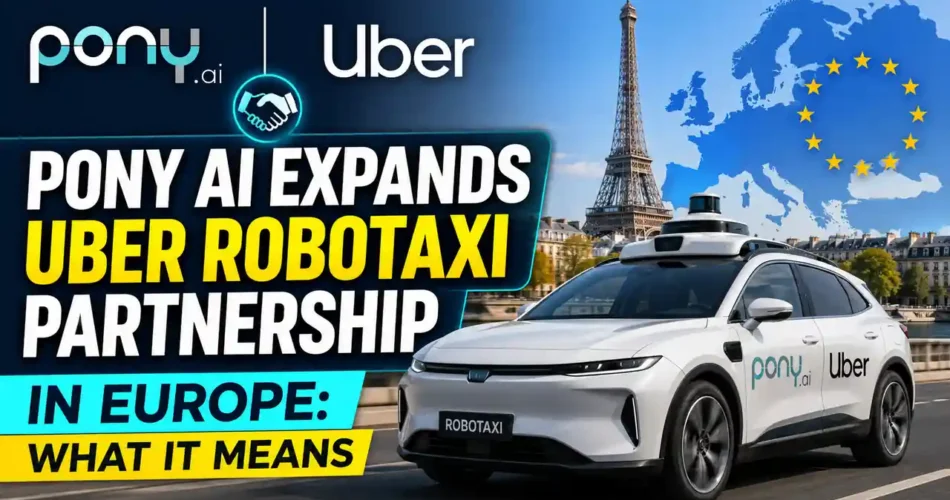
Pony AI Expands Robotaxi Partnership With Uber in Europe
Pony AI is expanding its relationship with Uber as the companies work to bring autonomous robotaxi services to more European markets. The development highlights the growing push by technology companies, automakers and ride-hailing platforms to commercialize self-driving transportation beyond the early testing phase.
The expanded partnership places Pony AI’s autonomous-driving technology alongside Uber’s global ride-hailing network. For investors and the wider mobility industry, the agreement is significant because successful robotaxi deployment requires more than advanced vehicle technology. Companies also need access to passengers, fleet operations, regulatory expertise, mapping infrastructure and the ability to scale services efficiently.
Europe represents an important opportunity for autonomous mobility because several countries are developing regulatory frameworks for automated vehicles while cities are looking for ways to improve transportation efficiency. Pony AI’s collaboration with Uber could therefore provide a pathway toward broader commercial adoption.
What the Expanded Pony AI and Uber Partnership Means
Pony AI has built its business around autonomous-driving technology, while Uber operates one of the world’s largest digital transportation platforms. Their partnership combines two different strengths: autonomous vehicle expertise and access to a large ride-hailing customer base.
Under the expanded relationship, the companies are expected to explore opportunities to deploy robotaxi services in European markets. The precise rollout of autonomous vehicles will depend on local regulations, operational requirements, safety validation and market readiness.
Instead of treating autonomous driving as a purely technological challenge, the partnership reflects a broader approach to robotaxi commercialization. A successful service must connect autonomous vehicles with passengers through a convenient platform while also managing fleet availability, charging or fueling, maintenance, customer support and safety operations.
Why Europe Matters for Robotaxis
Europe is an attractive region for autonomous mobility companies because of its dense urban populations and established public transportation systems. Major cities also face congestion, parking limitations and pressure to reduce transportation-related emissions.
Robotaxis could eventually become another component of urban mobility. Passengers could request autonomous rides through a familiar ride-hailing application, potentially reducing the need for privately owned vehicles for some journeys.
However, European markets are highly diverse. Each country can have different rules covering autonomous vehicles, insurance, liability, vehicle certification and road testing. This means that expanding a robotaxi business across Europe requires a market-by-market strategy.
Regulation Will Be a Critical Factor
The technology required to operate a driverless vehicle safely is only one part of the challenge. Governments and transportation authorities must determine how autonomous vehicles can be tested and commercially operated on public roads.
Issues such as cybersecurity, passenger safety, accident responsibility, data protection and emergency intervention can influence how quickly robotaxi companies expand.
For Pony AI and Uber, regulatory approval will therefore remain a major milestone. Even if autonomous vehicles demonstrate strong performance, commercial services cannot scale until the necessary legal and operational requirements are satisfied.
How Pony AI’s Technology Fits Into Uber’s Strategy
Uber has increasingly positioned itself as a platform connecting autonomous vehicle developers with consumers rather than attempting to develop every autonomous-driving system internally.
This strategy allows Uber to work with specialized technology companies while maintaining its role as the customer-facing mobility platform. Partnerships can potentially give Uber access to autonomous fleets without requiring the company to bear the entire cost of developing self-driving technology.
Pony AI, meanwhile, can benefit from Uber’s established passenger network and transportation infrastructure. The arrangement may help autonomous vehicles reach customers faster than building a separate ride-hailing ecosystem from the ground up.
The Platform Advantage
One of the biggest advantages of working with a platform such as Uber is customer access. Consumers already understand how to request rides, view estimated arrival times and make digital payments through ride-hailing applications.
Introducing autonomous rides through an existing platform could reduce some of the barriers associated with launching an entirely new transportation service.
At the same time, autonomous vehicles may require additional features, including clear passenger instructions, remote assistance capabilities and specialized customer support. Integrating these requirements into a mainstream ride-hailing platform will be an important part of the commercialization process.
Potential Benefits for Passengers
If robotaxi services become widely available, passengers could eventually gain another transportation option that operates without a traditional human driver.
Autonomous vehicles could potentially provide more consistent availability during certain periods, although actual service levels will depend on fleet size and operating conditions. Robotaxis may also help transportation companies manage labor costs over the long term, potentially changing the economics of ride-hailing.
For consumers, the most important factors will likely remain safety, price, convenience and reliability. A technologically advanced vehicle will not succeed commercially if customers consider the service expensive, difficult to access or unreliable.
Challenges Facing the European Robotaxi Market
Despite the potential opportunity, autonomous transportation remains a developing industry. Several challenges could slow expansion.
Safety and Public Trust
Public acceptance is one of the most important requirements for autonomous transportation. Customers need confidence that driverless vehicles can safely handle complicated traffic situations, unexpected road conditions and interactions with pedestrians and cyclists.
Companies will need to demonstrate safety through testing, transparent reporting and strong operational procedures. A small number of highly publicized incidents could affect public perception across an entire market.
Infrastructure and Operating Complexity
Robotaxis operate in environments that can vary dramatically from one city to another. Road markings, weather, traffic patterns, construction zones and driving behavior can all affect autonomous systems.
European cities also have historic road networks and dense urban environments that can present challenges for autonomous vehicles. Scaling successfully will require extensive testing and localization.
Competition Is Increasing
Pony AI is entering a market where several technology companies and automotive manufacturers are investing heavily in autonomous driving. The competitive environment could intensify as robotaxi services move from pilot projects toward commercial operations.
The companies that succeed are likely to be those that combine strong autonomous-driving performance with efficient fleet management, regulatory expertise and a compelling customer experience.
What the Partnership Could Mean for Pony AI
For Pony AI, expanding its relationship with Uber could strengthen its position as an autonomous-driving technology provider. Access to a major mobility platform could create opportunities to demonstrate its technology to a larger passenger base.
Commercial deployment could also provide valuable operational data. Autonomous-driving systems improve through extensive real-world experience, although the collection and use of such data must comply with applicable privacy and regulatory requirements.
The partnership may therefore represent more than a single deployment opportunity. If successful, it could become part of a broader strategy for bringing Pony AI’s autonomous technology into additional international markets.
What the Partnership Could Mean for Uber
For Uber, autonomous vehicles could become an important component of its long-term transportation strategy. The company has an incentive to participate in the autonomous mobility market because driverless fleets could eventually reshape the economics of ride-hailing.
Partnering with technology specialists allows Uber to diversify its autonomous vehicle relationships and potentially accelerate the availability of robotaxi services.
However, Uber must also balance innovation with customer safety and regulatory compliance. The success of autonomous services will ultimately depend on whether consumers are comfortable choosing a driverless vehicle for everyday trips.
Investor Outlook
The Pony AI-Uber expansion is noteworthy for investors watching autonomous vehicles, artificial intelligence and next-generation transportation. The agreement reinforces the idea that the robotaxi market is moving toward partnerships rather than isolated technology development.
Still, investors should distinguish between partnership announcements and actual commercial revenue. Robotaxi businesses can require substantial capital investment before achieving meaningful scale. Regulatory approvals, fleet deployment, utilization rates and operating costs will be important indicators of long-term financial performance.
The European expansion should therefore be viewed as a potentially important strategic development rather than an immediate guarantee of profitability.
What Comes Next?
The next stage will likely focus on regulatory approvals, technical validation, vehicle deployment and service integration. Pony AI and Uber will need to demonstrate that autonomous rides can operate safely and efficiently under European road conditions.
If initial deployments perform well, the companies could have an opportunity to expand into additional cities and markets. The pace of that expansion, however, will depend heavily on local authorities and consumer acceptance.
The broader significance is clear: autonomous mobility is increasingly moving from technology demonstrations toward partnerships designed to support real-world commercial transportation. Pony AI’s expanded relationship with Uber places the companies among the participants seeking to define how that transition develops in Europe.
Frequently Asked Questions
What is Pony AI?
Pony AI is an autonomous-driving technology company focused on developing self-driving systems and commercial applications for autonomous vehicles, including robotaxi services.
What is the Pony AI and Uber partnership?
The partnership brings Pony AI’s autonomous-driving capabilities together with Uber’s ride-hailing platform. The expanded relationship is focused on opportunities to deploy robotaxi services in Europe.
Why is Uber interested in robotaxis?
Autonomous vehicles could become an important part of the future ride-hailing market. Working with autonomous-driving specialists allows Uber to participate in this market while leveraging external technology expertise.
Why is Europe important for Pony AI?
Europe offers a large urban transportation market and multiple potential opportunities for autonomous mobility. Successful deployments could also provide a pathway toward broader international expansion.
Will Pony AI robotaxis be available across Europe immediately?
No. Robotaxi availability will depend on regulatory approvals, testing, safety requirements, vehicle deployment and local operating conditions. Expansion is expected to occur progressively rather than simultaneously across every European market.
Are robotaxis safe?
Autonomous-driving companies are required to develop and validate safety systems before commercial deployment. Safety performance can vary depending on the technology, operating environment and regulatory requirements, so passengers should consider approved services and local safety information.
What should investors watch after the partnership announcement?
Investors should monitor regulatory approvals, commercial launches, fleet growth, passenger adoption, operating costs, autonomous-driving performance and evidence of sustainable revenue generation.
Conclusion
Pony AI’s expanded robotaxi partnership with Uber represents another step in the development of autonomous transportation in Europe. By combining Pony AI’s self-driving technology with Uber’s established mobility platform, the companies could create a practical route toward commercial robotaxi deployment.
The opportunity is substantial, but so are the challenges. Regulation, safety, public trust, operating costs and competition will determine how quickly autonomous ride-hailing can scale.
For the broader mobility industry, the partnership illustrates an important shift: the future of robotaxis may depend not only on building capable autonomous vehicles, but also on connecting those vehicles to established transportation platforms and real-world passengers. If the European deployments prove successful, Pony AI and Uber could be well positioned to participate in the next stage of the global autonomous mobility market.
5 U.S. Government Sources for Reference
NHTSA – Automated Driving Systems Voluntary Safety Self-Assessment
– U.S. National Highway Traffic Safety Administration information on automated-driving safety disclosures, including Pony.ai. 0
NHTSA – Automated Vehicle Safety
– Official U.S. government information on automated driving systems and vehicle safety. 1
U.S. Department of Transportation – Automated Vehicles Activities
– Federal resources covering the development, testing and safe integration of automated vehicle technologies. 2
NTSB – Advanced Driver Assistance Systems and Automated Driving Systems
– National Transportation Safety Board information on automated-driving safety issues, investigations and robotaxi operations. 3
U.S. Department of Transportation – Artificial Intelligence Activities
– Official DOT information on AI applications in transportation, including automated driving systems. 4
“`5

