Intel (INTC -2.24%) set out to raise $15 billion on Aug. 10. Demand was strong enough that the offering priced at $20 billion the same day — 210.5 million new shares at $95 each.
The deal then grew once more. Underwriters exercised their option to purchase additional shares in full on Aug. 11, taking the total to about 242 million shares and about $23 billion in all.
Eleven days later, the stock trades below the price all of that money paid. Shares closed Thursday at $92.13, their second straight finish under $93.
What does it mean when a stock slips below a price that $23 billion of institutional demand just set?

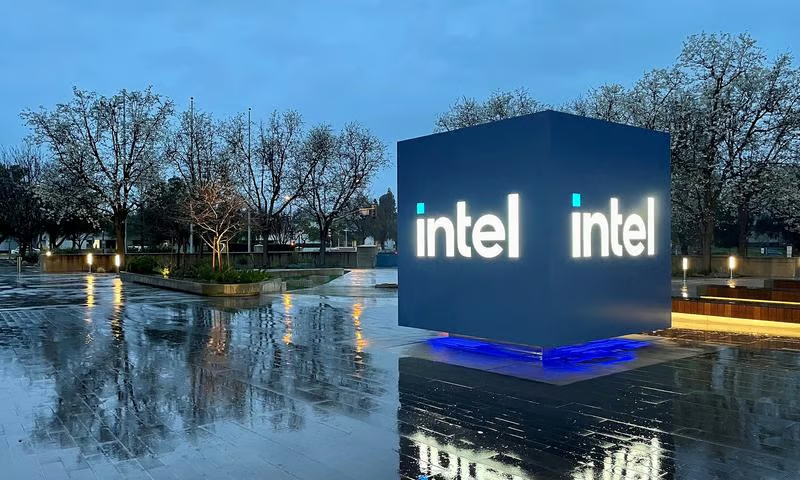
Image source: Intel.
The deal kept growing
The mechanics of the deal show how much appetite there was. Intel priced 210,526,315 shares at $95, upsizing the offering from the $15 billion it had announced hours earlier. It also granted underwriters a 30-day option on about 31.6 million additional shares, and they took every one of them. The offering was set to close on Aug. 12.
Notably, $95 wasn’t a fire-sale price. Intel’s stock last traded at $97.52 on the day the deal was announced, so buyers paid only about a 3% discount to the market.
In other words, this wasn’t a company shaking loose whatever cash it could get. Institutions lined up to pay nearly the market price, for far more shares than Intel originally set out to sell.
Intel says demand is the reason
Why raise the money at all? Intel’s announcement pointed at its customers. The company said they continue to signal “a strong and sustainable demand environment, driven by unprecedented investment in AI compute,” and that the offering would let it pursue growth opportunities “while maintaining a strong balance sheet and its commitment to an investment-grade rating.”
The stated use of proceeds is broad. Intel says the money is for general corporate purposes, a category that may include capital expenditures and working capital.
That flexibility is likely the point. Artificial intelligence (AI) demand is pulling Intel toward years of heavy spending, and the company chose to fund the next stretch of it with stock instead of debt.
The offering language also leans on opportunity, not distress. That framing is easier to defend when the stock sits above the offer price than when it sits below it.
Below the offer price
The change came fast. Shares closed above $103 as recently as Monday. Then came three straight down sessions: $96.69 on Tuesday, $92.80 on Wednesday, and $92.13 on Thursday. And shares still sit near that last level as of this writing.
The last two closes sit below $93, nearly 3% under the offer price. Anyone from the deal still holding those shares is underwater on them.
Of course, a break like this isn’t automatically a verdict on the company. New shares take time to digest, and the slide came during a rough stretch for chip stocks broadly. A 3% gap could close in a single good session.

Today’s Change
(-2.24%) $-2.06
Current Price
$90.07
Key Data Points
Market Cap
Day’s Range
$89.75 – $92.77
52wk Range
$23.65 – $142.35
Volume
91.7M
Avg Vol
119.3M
Gross Margin
39.05%
But I think the gap still tells you something. On Aug. 10, $95 was the price at which an enormous amount of professional money wanted in — enough to grow the deal by more than half over its original size. Today the market will sell anyone the same shares for less, and buyers aren’t stepping up to close the difference.
What would move the stock back through $95 is the same evidence that justified the raise. Intel has told investors that unprecedented AI demand is coming its way, and the latest results back the claim. Revenue grew 25% year over year to $16.1 billion last quarter, up from $12.9 billion a year earlier, and management’s third-quarter forecast of $15.8 billion to $16.8 billion holds revenue near that new level. More quarters in that direction, with the new $23 billion getting spent productively along the way, would arguably get the stock there on their own. But those quarters haven’t been reported yet, and the spending is only beginning.
The buyers of 242 million new shares were willing to pay $95. But the market wants more proof before it agrees — a reasonable ask.
Source link