
In an environment where most stocks are uncomfortably expensive, finding a cheap one raises questions. Should you act on your luck before the rest of the crowd finds it, or is that stock cheap for good reason?
Enter department store chain Macy’s (M -3.50%). Priced at less than 10 times its trailing earnings of $2.42 per share and just over 10 times next year’s expected bottom line of $2.33, this retailer’s stock is oddly inexpensive. What gives?
Despite glimmers of hope, investors are pricing in expectations of continued deterioration in its business.
The retail apocalypse is real
The so-called “retail apocalypse” isn’t complicated — the advent of e-commerce has been steadily chipping away at brick-and-mortar retailers’ revenue since the early 2000s. It’s been particularly tough on department stores, and Macy’s has been no exception. That’s why the stock’s down 66% from its 2015 peak, back to where it traded in the late 1990s.
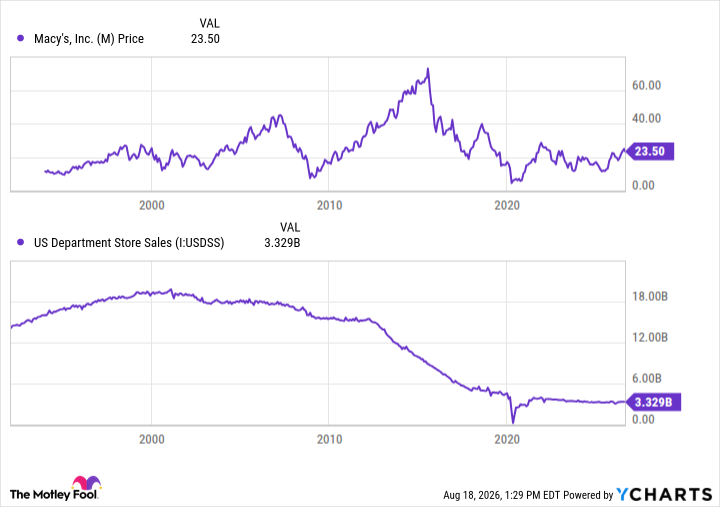
But the bears have overshot their target? That’s not an entirely unreasonable argument. Investors familiar with Macy’s probably know it’s one of the few retailers that outright owns much of the real estate where its remaining 665 stores operate. Although estimates of the value of its real estate portfolio vary widely from $5 billion to $15 billion, the low end of that range is near the company’s market cap of $6 billion.
In the meantime, its retail operation as it stands — which turned $22.6 billion in sales into pretax income of $849 million last year — is obviously worth at least a little something. Even subtracting the company’s current liabilities from its current assets (about $7 billion each), Macy’s market cap still doesn’t reflect its presumed value.
Except, maybe it shouldn’t. Maybe simply being in the brick-and-mortar retail business right now is a liability in and of itself that’s weighing on the company’s actual value.
More than a mathematical matter
On paper, Macy’s real estate portfolio may be worth several billion dollars. In reality, that theoretical value means nothing if selling it also means Macy’s must sacrifice the revenue that particular store site generates. Besides, simply shutting down any retail store can be surprisingly expensive.
Meanwhile, although not the case for all of its locations, the only prospective buyers for many of its sites would be other retailers still dealing with the aforementioned retail apocalypse. To this end, retail research outfit Coresight says store closings in the United States are on pace to reach 7,900 this year, versus only 5,500 openings.

Image source: Getty Images.
Connect the dots. Genuine interest in much of Macy’s real estate is apt to be limited. In the meantime, the company must continue nursing its own still-lethargic retail business, which has been shrinking since 2015.
Not counting on a turnaround yet
Never say never. It’s possible the brick-and-mortar retail business will eventually reach its absolute floor. Ditto for Macy’s. We’re even seeing modest evidence that it’s happening right now.
The market’s still not quite ready to count on such recovery, though, and understandably so. Investors are still mostly pricing in the notion that the department store retail business will continue to struggle, and Macy’s with it. It’s probably not a bad call either.
Source link