

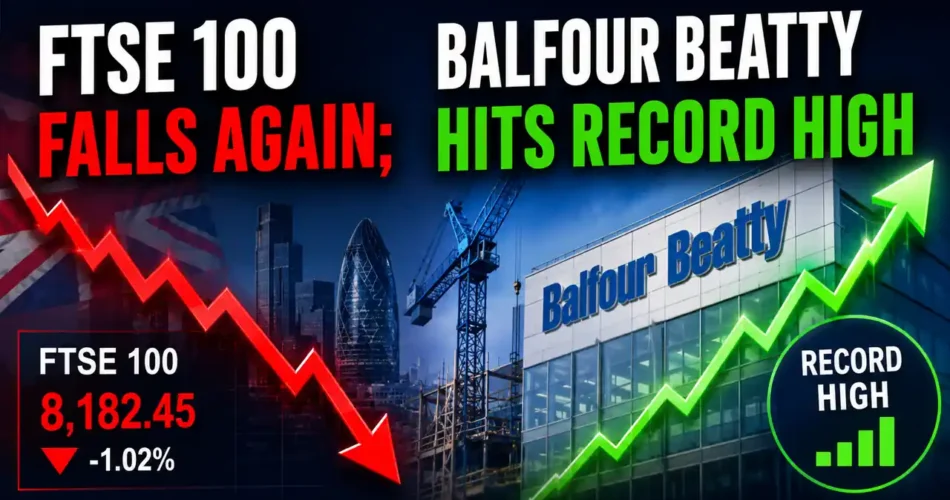
FTSE 100 Falls for Third Straight Session; Balfour Beatty Jumps to Record High
The FTSE 100 slipped for a third straight session, extending a cautious tone across UK equities. In contrast, Balfour Beatty surged to a record high after lifting its annual forecast and highlighting strong demand for infrastructure projects in the UK and the US.
Market Overview
London stocks were under pressure as investors weighed broader global uncertainty and paused ahead of key macro data. The FTSE 100 closed down 0.1% at 10,833.15 points, while the FTSE 250 rose 0.1% to 24,814.88 points, showing that mid-cap strength helped offset weakness in the blue-chip index.
For UK investors, this kind of session is a reminder that headline index performance can mask strong stock-specific moves. Even when the main benchmark falls, individual companies can still deliver sharp gains if they report improving demand, stronger guidance, or better operating momentum.
Why The FTSE 100 Fell
The index remained subdued as investors stayed cautious about the wider geopolitical backdrop and broader market direction. Traders were closely watching efforts to end the war in the Middle East, which added to the defensive tone in London trading.
The move was not dramatic, but it extended the recent drift lower in the FTSE 100. That pattern suggests investors were reluctant to add risk aggressively, especially with major global catalysts still in focus.
Balfour Beatty Hits New High
Balfour Beatty was the standout performer, jumping after raising its annual operating profit forecast. The company cited strong demand for infrastructure projects in both the UK and the US, which helped push the shares to a record high.
The stock rose sharply, reflecting strong investor confidence in the outlook. The move also helped underline how infrastructure-linked companies can outperform even when the wider market is weak.
What This Means For UK Investors
For a UK investor, the key takeaway is that the market remains selective. Blue-chip weakness does not necessarily mean the entire market is broken, and stocks with clear earnings momentum can still attract heavy buying.
This is especially relevant in the current environment, where investors appear willing to reward companies that can demonstrate resilience, contract visibility, and stronger profit guidance. Balfour Beatty’s move is a good example of how earnings upgrades can override wider market caution.
Sector And Sentiment
Infrastructure and construction names often benefit when investors expect sustained project spending and stable cash generation. Balfour Beatty’s update suggests the market is still willing to pay up for companies that can show operational strength and a clearer earnings path.
At the same time, the FTSE 100’s decline shows that sentiment toward the broader UK market remains fragile. That creates a mixed backdrop in which selective stock picking may matter more than simply owning the index.
Investor Outlook
Going forward, UK investors will likely watch whether the FTSE 100 stabilizes or continues to drift lower. They will also be looking for more companies that can lift guidance, because those updates are likely to keep driving outperformance in individual names.
If market caution continues, defensive positioning may remain popular. But the strong reaction to Balfour Beatty shows there is still appetite for quality stories with visible growth catalysts.
Why did the FTSE 100 fall?
The FTSE 100 fell for a third straight session as investors remained cautious amid broader global uncertainty and geopolitical concerns.
Why did Balfour Beatty jump?
Balfour Beatty rose sharply after raising its annual profit forecast and pointing to strong demand for infrastructure projects in the UK and the US.
What was the FTSE 100 close?
The FTSE 100 closed down 0.1% at 10,833.15 points.
What should UK investors watch next?
UK investors should watch whether index weakness broadens or remains limited, and whether more companies deliver earnings upgrades like Balfour Beatty.

