How the MoD’s ‘fully British’ defence drive ended up using foreign parts
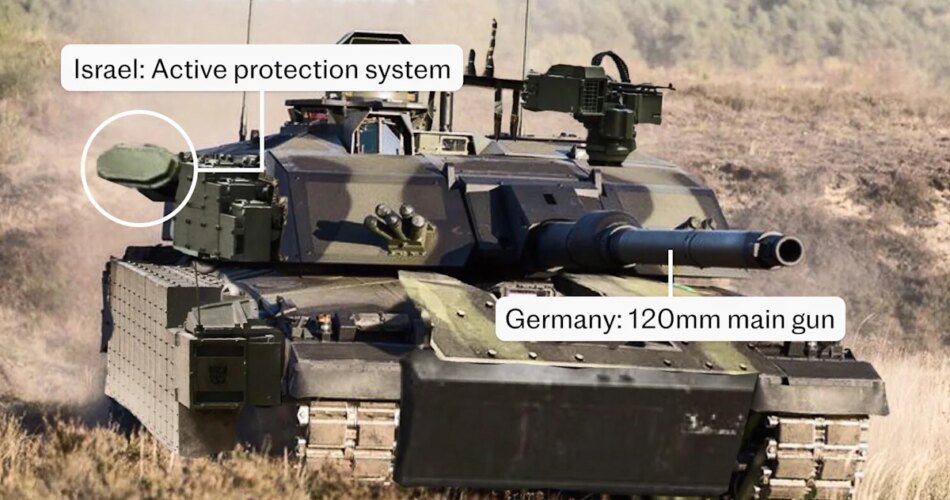
Illustration of foreign-made components in the Challenger 3 tank
As prototypes of the Challenger 3 battle tank arrived at a factory in Shropshire two years ago, they were hailed by the then-Conservative government as the first “fully British” tank built in more than 20 years.
It was an eye-catching claim and there’s certainly no doubt the £1.3bn upgrade programme for the Army’s armoured vehicles is bringing jobs and investment to the economy.
But is it true? The answer, strictly speaking, is no.
Though the Challenger 3 tanks are mostly British – using domestically-made armour, turrets and gun sights – they are being produced by a German-controlled company, make use of a German-made main gun and are equipped with Israeli-made active protection systems.
The reason for this is prosaic rather than nefarious, says Francis Tusa, an independent defence analyst.
“If you wanted to get anything within five years, the UK didn’t actually have the industrial capacity and capability to do these things,” he explains.
It highlights a major conundrum – and political risk – for the Government as Labour launches a fresh drive to “back British”.
With military spending on the rise once again, ministers have pledged to ensure that more of this money is funnelled towards the UK economy instead of overseas.
This includes a promise, outlined in June’s defence investment plan, to “weight procurement decisions towards British companies that can demonstrate a genuine, substantive presence and long-term commitment to British communities and British supply chains.”
As part of this, the Ministry of Defence (MoD) has said it will define what a “British company” is and use it to enforce a “buy British by default” rule.
The initiative also aims to give the UK more control over its own equipment, including what it can supply to Ukraine, amid concerns that export controls on kit made by the US and some European allies have left the military too constrained.
But though the moves have been broadly welcomed, industry sources say Labour’s patriotic push is also prompting a new phenomenon: “Britwashing”.
‘Slap a British flag on’
Similar to so-called greenwashing, where companies make tokenistic gestures to embellish their eco-credentials, this is where companies exaggerate their Britishness to improve their chances of securing lucrative government contracts.
And as lobbyists ramp up their campaigns to build a variety of unmanned aircraft, troop vehicles and naval vessels for the MoD, some are sailing fairly close to the wind.
“It’s pretty widespread,” says a source at a major defence company, who points to adverts designed to catch the eyes of MPs as they pass through Westminster’s Underground station.
“There are some firms that think all they need to do is just slap a British flag on their stuff or put ‘UK’ at the end of their name.”
In the past, says Tusa, this might best have been applied to equipment supplied by American defence contractors, where small numbers of jobs created in the UK for the supply of minor components were touted as domestic wins.
“It’s hiding the fact that it comes from an American factory, all the jobs are in America and all the intellectual property is American,” he adds.
“Traditionally, it was all a bit ‘nudge nudge, wink wink’.
“If you had challenged people at the MoD and even the Treasury and said, ‘That’s not British, is it?’, they’d have probably given a Hugh Grant-esque ruffling of their hair, a shrugging of the shoulders, a bit of a grin and said, ‘Well, that’s the game, isn’t it?'”
But with Donald Trump’s capricious style of foreign policy unnerving European capitals, many countries including Britain are seeking to hedge their bets by moving production back home or working more closely with allies on the Continent.
Tusa adds: “We’re on the cusp of something at the moment.
“If they are serious, we are going to have to see people really challenging the statements on jobs.
“You can’t have just a brass nameplate ‘British’ company with a solicitor’s office and £100 of assets.”
Yet it’s also valid to question what ministers really mean when they say “British” – particularly as the domestic defence industry has been reliant on American and European suppliers for decades.
Take production of the Royal Air Force’s Eurofighter Typhoon jets – a multinational collaboration in which Britain secured a 37pc share of the work needed to produce the jet.
John Healey, the Defence Secretary (right), visits a Tekever drone production site. Military spending is on the rise once again – Jaimi Joy/WPA/Getty Images
Or the Army’s new AW149 medium helicopters. These are described as a “sovereign” capability but Leonardo’s factory in Yeovil, Somerset, will do only 40pc of the work (rising to as much as 70pc when lifetime maintenance and upgrades are included).
That is significantly higher than the 5pc that the UK received from the latest order of Apache helicopters it secured from American giant Boeing, or the 3pc to 6pc work share for the manufacture of Chinooks for the RAF.
But there are often good reasons for not doing everything domestically – not least on price and capability grounds.
Take ships for example.
BAE and Babcock are building the Royal Navy’s Type 26 and Type 31 frigates, respectively, with largely foreign-supplied steel.
A spokesman for BAE says the company tries to use British steel “wherever possible”, but points out that domestic suppliers often don’t produce the specialist categories needed for military purposes.
Type 26 Frigate HMS Glasgow’s flight deck will be able to accommodate helicopters up to the size of the RAF’s Chinooks – Royal Navy
It is also difficult to persuade steel makers to start new production lines because the low volumes needed for defence projects are – in the context of the wider steel industry – trivial and not worth the investment.
Some of the world’s biggest motoring and defence giants are vying to provide a successor, but almost none of them are based on vehicles made in Britain.
Babcock, the domestic defence giant, has proposed a “best of British” vehicle based on the Toyota Land Cruiser, while British billionaire Sir Jim Ratcliffe’s Ineos Automotive has offered a militarised version of its Grenadier Quartermaster – the base of which will be made in France (Ineos says it will be 70pc British overall).
Other contenders include General Motors and General Dynamics, which are respectively proposing versions of Chevrolet and Ford pickup trucks made in the US.
German giant Rheinmetall has also put forward a vehicle adapted from the Mercedes-Benz G-Class.
Even Jaguar Land Rover, if it decided to compete, might have questions to answer. The modern version of the Land Rover Defender is currently made in Slovakia.
Only Fering, a UK start-up which is proposing the military-grade Pioneer X, is claiming to have an all-British design and is proposing to manufacture the cars in Battersea, south London.
The Army’s initial order will be for 3,000 vehicles and will be worth around £900m, with a victor yet to be decided.
It’s just one example of several high-profile procurement decisions that will test the MoD’s commitment to Britishness.
Another is the £360m competition to replace the RAF’s ageing fleet of Hawk training jets – including those used by the Red Arrows – by 2030.
Contenders include an American-Swedish model made by Boeing and Saab, an Italian jet by Leonardo, one from Korea Aerospace Industries and US giant Lockheed Martin and another by Turkish Aerospace Industries.
Both the Boeing-Saab jet and Leonardo’s offering could be assembled in the UK.
A British contender had been put forward by start-up Aeralis, but the company collapsed into administration earlier this year.
Defence industry executives often point out that different countries have come to specialise in certain areas over the years – and that if Nato allies work together, they can augment each other’s strengths rather than compete.
German giant Renk is the biggest supplier of tank gearboxes globally, for example, because it is exceptionally good at making them. Likewise, Leonardo is the global leader in laser targeting and guidance systems – which it makes at its electronics base in Edinburgh.
Not everyone wants to specialise, however. France is perhaps the pre-eminent example of a country that has taken the opposite approach, partly out of a belief that Europe should not rely on America.
Paris has long insisted on retaining its own sovereign capabilities across the military spectrum, from its nuclear deterrent to the Rafale fighter jet and Leclerc battle tank.
It’s this impulse that prompted French aerospace giant Dassault and the German arm of Airbus to part ways because of a next-generation fighter jet.
In this sense, many industry insiders argue Britain’s lack of certain industrial capabilities was not inevitable either.
In private, many blame gaps that have opened up since the end of the Cold War on a persistent push by the Treasury to save money.
Across successive decades, as politicians have sought to divert money to other priorities such as healthcare and benefits, the MoD has often been pressured to forgo more expensive, domestically produced kit in favour of ostensibly cheaper, “off-the-shelf” alternatives made abroad.
Ironically, says Tusa, this was the reason why German giant Rheinmetall had to be brought in to help restore production of gun barrels for the Challenger 3 tank.
“That was a capability BAE Systems previously had – they were doing it for M777 artillery pieces – but years ago, they said to the Government, ‘We’ve got this barrel-forging plant, do you still want this capability onshore?’ and the numpties at the MoD said they weren’t interested.”
Now that money is flowing back into the defence budget, however, there is pressure to restore some of what has been lost and ensure ministers can point to tangible benefits for British workers.
For example, Rheinmetall has invested more than £40m in its Telford, Shropshire, site, including in a gun hall that will restore Britain’s capability to produce 120mm and 155mm barrels and breeches.
The German company has hailed the programme as a “powerful example of how Britain can work with trusted allies without compromising its own industrial base”.
In doing so, it has pointed to work being done by domestic firms, including Newcastle-based turret maker Pearson Engineering, seating manufacturer NP Aerospace in the West Midlands and power-management provider Atec Engineering Solutions in Manchester.
It will not only deliver 148 upgraded tanks for the Army, a spokesman says, but also rebuild the “skills, facilities, supply chains, intellectual property and industrial capacity” Britain needs to make armoured vehicles “for decades to come”.
The Challenger 3 tanks are mostly British, using domestically-made armour, turrets and gun sights – Finnbarr Webster/Getty Images
Elsewhere, rearmament is spawning entirely new businesses who have made their Britishness a key selling point.
The company has secured contracts with the MoD and been praised by ministers as a “prime case of a veteran-founded UK defence start-up”.
Another one of the companies tapping into increased demand for defence and aerospace components is London-based Isembard.
The start-up – founded by Alex Fitzgerald, an Army reservist and former broadband entrepreneur – is building a distributed network of factories that can churn out machined metal parts quickly and cheaply.
“Our customers tell us that we’re actually cheaper and faster than our Chinese rivals when it comes to complex parts,” Fitzgerald says.
He started his business after becoming convinced that Britain and its allies needed to modernise their defence industries rapidly to help deter the likes of Russia and China.
“A country’s ability to defend itself is a function of its will and capability,” he says. “And capability is not just the equipment you have at the start but what you learn you need as any conflict takes place.
“Everyone’s obsessed about the product layer, but no one’s thinking enough about the industrial layer – whether it’s a drone, a missile, a submarine or a satellite, these things are all made of parts.”
‘A hell of a lot of effort’
Fitzgerald supports efforts to capture more value for the UK and believes ministers should consider a domestic version of the strict US international traffic in arms regulations to ensure manufacturing of home-grown designs stays onshore.
He also believes “made in the UK” should mean just that, including most of the manufactured components: “And if you’re not doing that, then it’s bull—t.”
With requirements for Britishness seemingly becoming stricter, drone producers such as Anglo-Portuguese Tekever and US-based Anduril are also stepping up their UK operations.
Credit: Tekever
Ultimately, however, the lengths companies will go to depend on how hard the Government pushes for British-made goods and whether it is worth it.
“Is it possible to build every single defence capability we want in the UK, from everything down to bolts?” asks Tusa.
“Yeah, absolutely. Will it take an awful lot of time? Also yes.
“It’s like pushing a broken-down car. To get the bloody thing moving, it takes a hell of a lot of effort – but once you’ve got it rolling, less so.”
An MoD spokesman said: “We are committed to backing British businesses and supporting our defence industrial and skills base, making defence an engine for growth in every postcode across the UK.”