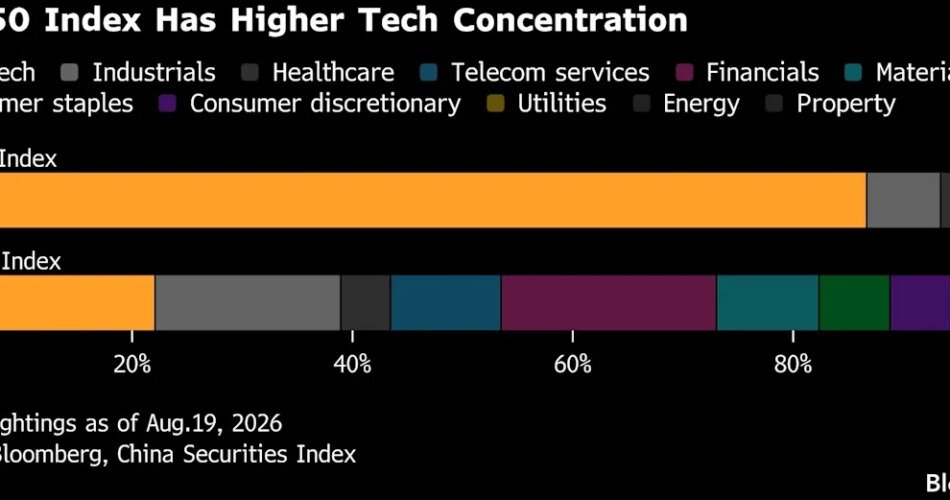
(Bloomberg) — Investors looking to track China’s hottest companies are shifting their focus away from the country’s traditional stock indexes.
Most Read from Bloomberg
As the artificial intelligence boom reshapes the corporate hierarchy, the technology-dominated Star 50 Index is emerging as the most relevant gauge for the equity market, less than a decade after its creation. It’s overshadowing longtime stalwarts like the CSI 300 Index, a blue chip index that’s heavy on financials, industrial producers and consumer companies even after a recent influx of high-tech names.
China is pouring trillions of dollars into technology self-sufficiency across semiconductors, advanced manufacturing and hardware production. As a result, the Star 50 now offers a concentrated bet on AI with 86% of its firms in information technology and has outstripped the traditional benchmark by about 30% this year.
“If you believe in China’s capacity to engineer, iterate, manufacture and mass-produce technology products and adapt quickly to shifts in global industry trends, then the STAR 50 is a compelling allocation,” said Shi Junbo, a fund manager at Hangzhou Xiyan Asset Management.
The Star Market was unveiled by Xi Jinping in 2018, in the early days of the trade war during Donald Trump’s first term as US president. Authorities have fast-tracked IPO approvals for firms deemed strategically critical, which quickly raised its status as a wave of marquee Chinese companies along the AI supply chain rushed to raise funds.
The widening gap in Chinese equity benchmarks mirrors a global trend, with investors rewarding the companies supplying the infrastructure behind the AI boom. In China, that trade has played out in corners of the market that many foreign investors remain underexposed to, Goldman Sachs wrote in a note, describing the STAR 50 as a “proxy for onshore AI hard tech.”
And that’s even before the index was able to capture the excitement over a recent wave of high-profile initial public offerings — and a healthy remaining pipeline of industry leaders preparing for listings. While the Star 50 includes homegrown champions like Moore Threads Technology Co. and MetaX Integrated Circuits Shanghai Co., memory chipmaker CXMT Corp., now the most valuable Chinese company, is widely expected to be included by the end of the year.
Source link