The Federal Open Market Committee (FOMC) meeting minutes from July 28-29 certainly had a hawkish slant.
“Many participants assessed that policy tightening would likely be necessary if inflation did not decline,” the minutes stated. “Some participants commented that financial conditions might not currently be sufficiently restrictive to facilitate a return of inflation to 2 percent.”
At the conclusion of its July meeting, the FOMC elected to hold interest rates steady within a range of 3.50% and 3.75%. However, the vote was not unanimous, and three voting members dissented, preferring a quarter-point rate hike.
While various members of the FOMC continue to hint at a rate hike being necessary, I believe such a move is very unlikely in 2026.

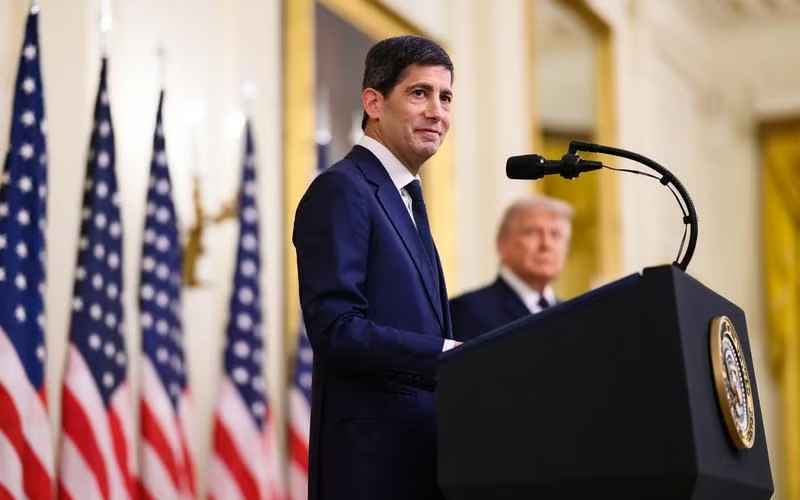
Image source: The White House.
Inflation has declined
The key phrase I am looking at in the FOMC’s above statement is “… if inflation did not decline.” The thing is, it has declined based on several recent economic data points.
The Consumer Price Index (CPI) declined by 0.4% in June and rose by 0.1% in July, marking the two lowest CPI readings dating back to at least July 2025. Core CPI, which excludes more volatile food and energy prices, came in flat in June and rose 0.2% in July.
The Iran war has driven up gas prices and also made gas very volatile, swinging month to month based on developments between the U.S. and Iran. Ultimately, gas came down in June but has been up and down since.
While energy is removed from the core CPI, it still affects the entire economy. For instance, food prices will be affected by how much it costs to ship that food to its destination, which in turn depends on oil and gas prices.
Other hints at softer inflation came from the July jobs report, which showed that nonfarm payrolls lost 23,000 jobs, well below economists’ estimates calling for an 85,000 gain.
Furthermore, average hourly earnings barely increased during the month. A hot labor market can drive inflation higher because it means people have money to spend.
The Producer Price Index (PPI), a measure of wholesale prices, rose 0.1% in July, below analyst estimates of 0.2%.
Given the soft data, the market has now walked back and delayed its rate-hike expectations. The Fed is now expected to hold rates steady at both its September and October meetings, although a rate hike is expected in December, according to CME Group’s FedWatch tool.
Keep in mind, these forecasts change often.
Why the Fed is likely to hold rates steady through 2026
Of course, anything can happen, particularly if the Iran war continues to flare up, or there is hot inflation data.
But I still think the Fed will hold for the rest of this year. The FOMC will likely try to avoid raising rates in September and October, if possible, given the looming midterm elections in November.
The Fed would prefer not to be viewed as political, if it can, so it would really take bad inflation data to sway the committee at those meetings.
The Federal Reserve Bank of Cleveland’s Nowcasting tool projects core CPI to be 0.2% in August.
Nowcasting also expects the Personal Consumption Expenditures (PCE) Price Index, the Fed’s preferred inflation gauge, to come in at 0.25% in July and 0.27% in August. This number is released toward the end of each month.
While it is only a projection, I doubt a PCE in this range would lead the Fed to raise rates. Investors should remember that the longer rates remain elevated, the more likely the economy is to tip into a recession, something the Fed is also quite cognizant of.
Source link