
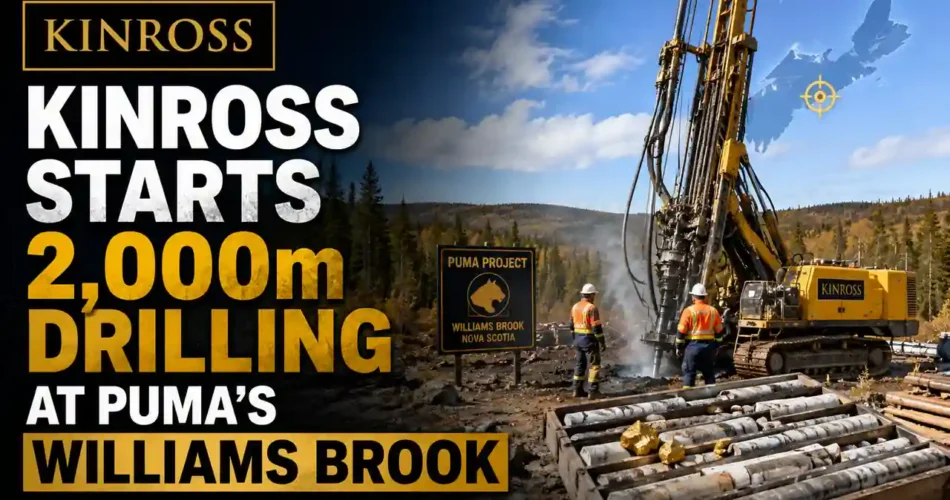
Puma Exploration Reports New Kinross Drilling at Williams Brook
Puma Exploration Inc. has announced that Kinross Gold Corp. has started another diamond-drilling campaign at the Williams Brook Gold Project in northern New Brunswick, Canada.
The initial phase includes approximately 2,000 metres of drilling at the Jaguar Gold Zone. The campaign is designed to test extensions of previously identified gold mineralization and investigate nearby geophysical targets.
The latest work forms part of Kinross’ exploration agreement with Puma and follows drilling, prospecting, trenching, soil sampling and geophysical surveys completed across the project during 2026.
Drilling Begins at Jaguar Gold Zone
Kinross launched the current drilling program at the Jaguar Gold Zone on July 26, 2026. The program includes seven planned drill holes, with individual holes ranging from approximately 200 to 500 metres in length.
The drilling campaign is focused on several important exploration objectives:
- Testing the central portion of the Jaguar Gold Zone.
- Investigating lateral and down-plunge extensions of known mineralization.
- Examining geophysical anomalies located approximately 500 metres from previously drilled areas.
- Improving the understanding of the geological and structural controls on gold mineralization.
- Testing potential mineralized zones to the north and southeast.
The current program follows Kinross’ Winter 2026 drilling campaign at Jaguar. That earlier program consisted of five drill holes totaling approximately 1,360 metres and was designed to evaluate the Jaguar system from multiple drilling directions.
Follow-Up to Earlier Results
The current drilling is intended to build on results generated during previous exploration work at the Jaguar Gold Zone.
During the Winter 2026 campaign, drill hole WB26-195 intersected a broad mineralized interval grading 0.45 grams per tonne gold over 56.50 metres. The interval included a higher-grade section grading 1.03 grams per tonne gold over 16 metres.
The mineralized zone was associated with a significant induced-polarization anomaly identified during surface exploration. This relationship could help Kinross trace gold-bearing structures beneath the surface and identify additional targets for future drilling.
The results do not yet establish the complete size or economic potential of the Jaguar Gold Zone. However, they provide valuable geological information that can guide additional exploration and help define the broader mineralized system.
Historical Exploration at Jaguar
The Jaguar Gold Zone is located approximately five kilometres northeast of the Lynx Gold Zone. Although historical exploration in the area has been limited, previous work has provided evidence of gold mineralization.
Induced-polarization surveys conducted in 2007 and 2008 identified several geophysical anomalies. A previous operator also completed four drill holes at Jaguar.
One historical hole, WB08-03, intersected 2.10 grams per tonne gold over nine metres within a wider interval grading 0.52 grams per tonne gold over 55 metres.
Puma later advanced the target through prospecting, trenching and surface sampling. The company identified an approximately 80-metre-by-50-metre gold-enriched area, while selected grab samples returned values as high as 34.70 grams per tonne gold.
Grab samples are collected from selected rock locations and may not represent the average grade or overall mineralization of a deposit. Therefore, drilling and systematic channel or trench sampling are required to establish the continuity, thickness and distribution of mineralized zones.
Testing Geophysical Anomalies
A key part of the current drilling campaign is the investigation of additional induced-polarization anomalies near the Jaguar Gold Zone.
Several anomalies identified through previous geophysical surveys occur within approximately 300 to 500 metres of the known mineralized area. These targets are considered prospective because some are associated with bedrock exposures examined during the 2026 summer field program.
Kinross plans to use drilling to determine whether the anomalies represent gold-bearing structures, alteration zones or other geological features.
The company is also working to define the geometry of a rhyolite unit associated with the Jaguar system. Understanding the shape and distribution of this unit could help explain the location of mineralization and the role of faults in controlling the movement of gold-bearing fluids.
Summer Exploration Program
Kinross began its broader Summer 2026 exploration program at Williams Brook in May. The field campaign included regional prospecting, geological mapping, soil geochemistry, test-pit trenching and a drone-based magnetic survey.
Three field crews worked across the property from May through July. Their activities were intended to identify new mineralized areas, refine existing targets and support future drilling plans.
The summer exploration work included:
- Regional prospecting and geological mapping across the property.
- Two soil geochemistry surveys at the Jonpol and 9218 areas.
- Thirty-two test-pit trenches in the Jaguar Gold Zone.
- A drone magnetic survey covering approximately 2,920.9 hectares.
- Follow-up investigations of historical induced-polarization anomalies and prospective bedrock exposures.
The Jonpol soil survey consisted of 669 total samples, including original samples, duplicates, blanks and certified reference materials. The 9218 survey included 742 total samples and also incorporated quality-control materials.
The use of duplicates, blanks and certified reference materials helps exploration companies monitor sample quality and laboratory performance.
Large Alteration System Identified
According to Puma, exploration completed during the 2026 field season has helped refine several high-priority drill targets. The work has also indicated the presence of a large, multi-kilometre hydrothermal alteration system at Williams Brook.
Hydrothermal alteration occurs when hot, mineral-bearing fluids change the composition of surrounding rocks. In many gold districts, alteration zones can provide important clues about the location of mineralized structures.
The importance of the alteration system will depend on assay results, geological interpretation and further drilling. Results from the summer exploration program were still pending when Puma issued its announcement.
The three field crews were expected to continue exploration at Williams Brook until September. Puma said additional drilling could be added depending on exploration results and the available budget.
Kinross Option Agreement
Kinross entered into an option agreement for the Williams Brook Project with Puma in October 2024. The project covers approximately 40,225 hectares and includes the Williams Brook, Jonpol and Portage properties.
Under the agreement, Kinross can earn a 65% interest in the project by funding at least $16.75 million in exploration expenditures over five years, from 2025 through 2030.
The agreement enables Puma to advance Williams Brook with financial support from a major gold producer while maintaining exposure to a potential discovery.
Kinross, meanwhile, has the opportunity to evaluate a large exploration land package in a region with established mining infrastructure and a long history of mineral exploration.
The partnership may also reduce Puma’s need to fund the entire exploration program through equity financing. However, Williams Brook remains at the exploration stage, and there is no guarantee that drilling will result in a commercially viable mineral discovery.
Location and Regional Potential
The Williams Brook Project is located in northern New Brunswick near roads and existing infrastructure. Puma’s New Brunswick exploration portfolio also includes the McKenzie Gold Project.
The company’s assets are positioned near the Rocky Brook Millstream Fault, a major regional geological structure associated with the Appalachian Orogeny. Puma considers this structure an important control on gold deposition in the region.
Regional faults can create pathways for mineral-bearing fluids. Nevertheless, the presence of a major geological structure alone does not confirm the existence of an economic gold deposit.
Detailed geological work, systematic sampling and additional drilling are required to determine the relationship between regional structures, alteration and gold mineralization.
What Investors Should Watch
Investors following Puma Exploration and the Williams Brook Project may focus on several upcoming developments:
- Assay results from the current Jaguar drilling campaign.
- Results from the 2026 summer soil, trenching and mapping programs.
- Evidence of continuity between the Jaguar mineralized zones.
- Results from drilling of nearby induced-polarization anomalies.
- Future exploration plans for the Lynx, Lion, Jonpol and Portage areas.
- Details of Kinross’ future exploration spending and drilling commitments.
Drilling results are generally released after core logging, sampling, laboratory analysis and quality-control procedures are completed.
Individual drill intercepts should be evaluated alongside their true widths, geological setting, grade distribution and continuity. A single high-grade interval does not necessarily indicate the presence of a large or economically viable deposit.
Important Cautions
The reported grades are exploration results and should not be interpreted as proof of a mineral reserve or mineral resource.
Additional drilling and technical studies are necessary to determine the scale, continuity and economic characteristics of the mineralization at Williams Brook.
Exploration companies also face risks related to geological interpretation, permitting, funding, market conditions, commodity prices and future project decisions. Actual results may differ from current expectations.
Frequently Asked Questions
What did Puma Exploration announce?
Puma announced that Kinross Gold had started another drilling campaign at the Williams Brook Gold Project in northern New Brunswick. The initial program covers approximately 2,000 metres at the Jaguar Gold Zone.
Where is the Jaguar Gold Zone?
The Jaguar Gold Zone is part of the Williams Brook Gold Project and is located approximately five kilometres northeast of Puma’s Lynx Gold Zone.
What is the purpose of the drilling?
The drilling is designed to test the core of the Jaguar Gold Zone, investigate extensions of known mineralization and examine nearby geophysical anomalies that may represent additional mineralized zones.
What were the earlier Jaguar drilling results?
Winter 2026 drilling included an interval grading 0.45 grams per tonne gold over 56.50 metres in hole WB26-195. The interval included a higher-grade section grading 1.03 grams per tonne gold over 16 metres.
What is an induced-polarization anomaly?
An induced-polarization anomaly is a geophysical response that may indicate differences in the electrical properties of subsurface rocks. Such anomalies can help identify areas for further investigation, but they do not independently prove the presence of gold.
How much can Kinross spend under the agreement?
Kinross can earn a 65% interest in Williams Brook by funding at least $16.75 million in exploration expenditures over five years, subject to the terms of the option agreement.
When will more results be available?
Puma said results from the 2026 summer exploration program were pending. The timing of assay results from the current drilling will depend on the completion of core logging, sampling and laboratory analysis.
Is Williams Brook already a producing mine?
No. Williams Brook remains an exploration project. The latest drilling is intended to evaluate the project’s mineral potential, and no production decision has been announced.

